


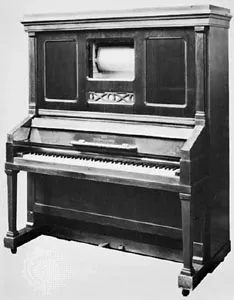
The player piano is not just an antique curiosity. It is a machine designed to play music without human hands. Early versions used perforated paper rolls. Modern versions use digital memory on computer discs. The goal remains the same. Let a machine handle the notes.
The Pneumatic Origins of the Pianola
It started with a cabinet. E.S. Votey, an American engineer, patented the first player piano in 1897. He called it the “Pianola.” This device sat in front of a standard piano. It had wooden fingers that reached over the keys.
Inside the cabinet, a paper roll moved over a tracker bar. This bar controlled pneumatic devices. Air released from these devices pushed the wooden fingers. The fingers struck the notes on the keyboard below.
Player pianos allowed people with minimal musical training to produce satisfactory music through careful foot pedaling.
Operators pumped a foot treadle to power the system. They used levers to control tempo and loudness. This required skill. You had to watch the roll and press the right pedals at the right time. It was an elementary form of musicianship.
Manufacturers soon changed this. They built the mechanism directly into the piano body. The foot treadle moved under the piano. The controls stayed in front. But they still needed the player’s intervention.
The Rise of the Reproducing Piano
The next step was automation. Manufacturers added devices to the paper rolls. These devices approximated artistic nuance. They handled tempo changes. They adjusted the relative loudness of bass and treble. They created crescendos and diminuendos.
These advanced machines were called reproducing pianos. They required no human input during playback. The roll itself contained the performance data.
Electricity eventually replaced foot power. This change had huge implications. Homes got player pianos. Amusement centers and dance halls got coin-operated versions. Reproducing pianos were often grand pianos. Standard player pianos were usually uprights.
Recording the Masters
By the early 20th century, the technology could capture great artists. Companies made rolls that reproduced performances with fair accuracy. You could hear Alfred Cortot. You could hear Claude Debussy. You could hear Sergey Rachmaninoff. Artur Rubinstein and George Gershwin were on the rolls too.
These reproducing piano performances were later transferred to phonograph records. The player piano became a bridge between live performance and recorded media.
Composers got interested. They wrote pieces without worrying about human hand limits. Igor Stravinsky wrote Étude for Pianola in 1917. Paul Hindemith composed Toccata for mechanical piano in 1926. The machine offered new creative possibilities.
The vogue for traditional player pianos faded in the 1930s. Radio and phonographs became more popular. People preferred listening to broadcasting or vinyl over mechanical cabinets.
The Digital Revival: Yamaha Disklavier
The technology did not disappear. It evolved. By the 1990s, Yamaha introduced the Disklavier. This is an acoustic player piano. It has a computer inside.
The Disklavier reads data from floppy discs or compact discs. It re-creates virtually every nuance of a performance. Tone. Touch. Timing. Dynamic range. It mimics a real performance closely.
The key-striking mechanism is different now. It is not pneumatic. It is electromagnetic. Sensors and solenoids activate the keys and pedals. This allows for precise control.
The Disklavier can do more than play discs. It can record. You play the keyboard. The machine captures the notes. It then plays them back. Piano students and performers can study their own work on an actual piano. No headphones. No conventional audio system. Just the instrument itself.
Disklaviers range from simple uprights to concert grands. They keep the player piano alive in a digital age. The hardware is old. The software is new. The result is a hybrid of past and present.


