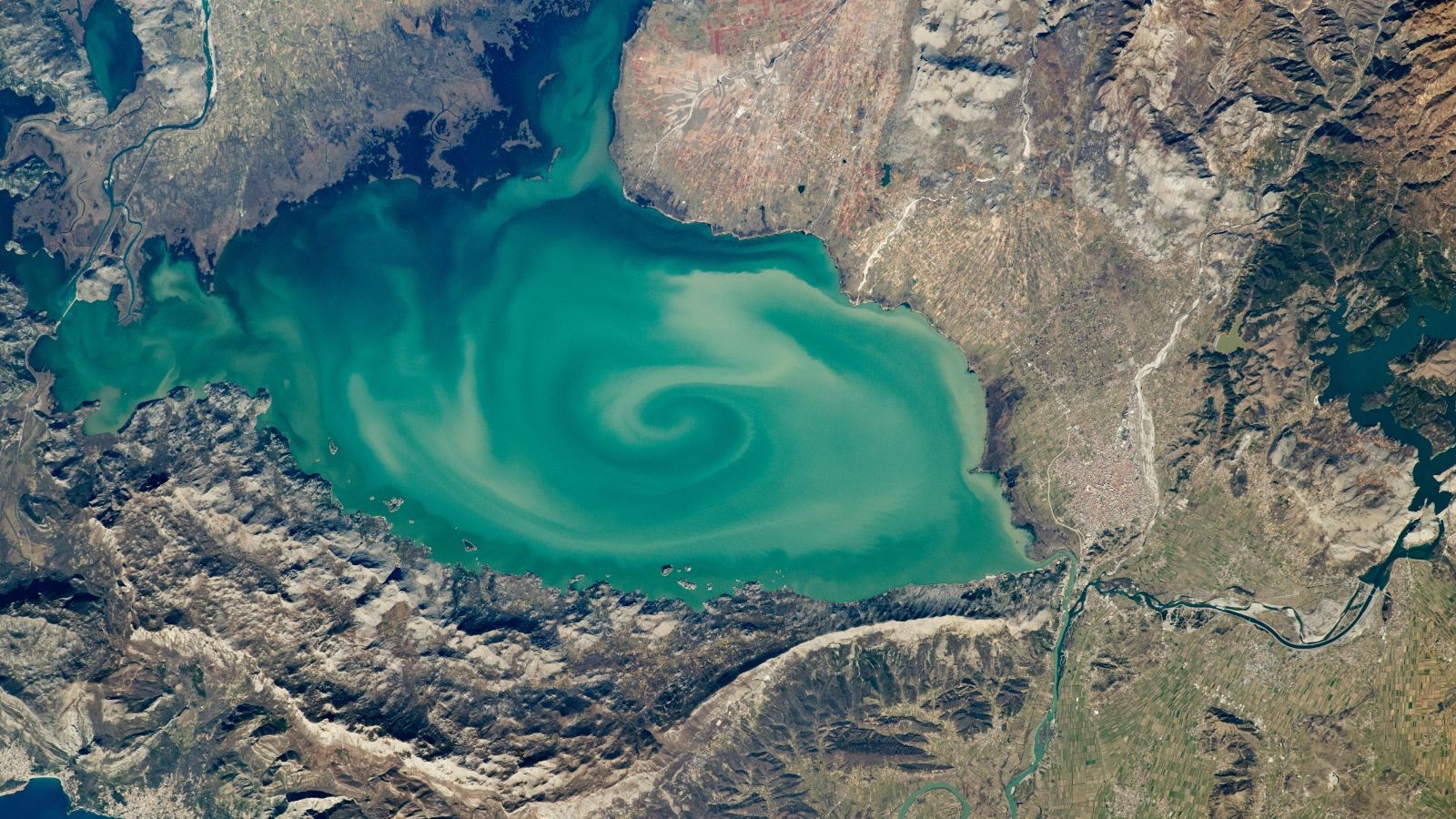
It wasn’t algae. That swirling, milky-green mass dominating the satellite view of Lake Skadar wasn’t a biological bloom. It was rock dust.
Look closer at the image from space. You see a massive vortex, a giant whirlpool of sediment churning across one of Southern Europe’s largest bodies of water. This isn’t just a pretty photo op. It is the visual result of geology, hydrology, and winter snowmelt colliding at the border of Montenegro and Albania.
How the Dinaric Alps Turn Lake Skadar Into a Vortex
Lake Skadar (or Scutari to some, Shkodër to locals) is a chameleon. Its size fluctuates wildly. Depending on the season, it spans between 140 and 520 square miles. The water level is not static; it breathes with the climate.
The lake sits on a tectonic divide. Montenegro claims roughly two-thirds of the shoreline and the western side. Albania holds the eastern shore. But the water itself doesn’t care about borders. It cares about gravity.
The main feed for this system is the Morača River, dropping down from the northwest. But the exit strategy is complex. The Bojana and Drin rivers carve out at the lake’s eastern tip. They funnel everything into the Adriatic Sea, which peeks into the frame in the bottom left corner of satellite imagery. To the south, the Dinaric Alps stand guard. Lofty, rugged, and rocky.
When late winter turns to early spring, the snowpack in those mountains melts. The meltwater rushes into the lake, carrying tons of limestone and dolomite. It’s a sediment bomb.
Then the wind hits.
Surface currents clash with the natural flow of inlets and outlets. The water twists. The suspended rock particles catch the light, turning the lake a milky green. A vortex forms. It looks chaotic. It’s actually fluid dynamics in action.
Why Lake Skadar Is a ‘Cryptodepression’ and a Karst Wonder
The lake is geologically weird. It’s a “cryptodepression.” What does that mean? Most of the lake floor sits below sea level, but you wouldn’t know it if you stood on the banks. The surrounding landscape hides the depth.
It’s also a karst landscape. This term comes from limestone formations. Millions of years ago, during the Cenozoic Era, this area wasn’t a lake. It was a cave system. Underground rivers ate away at the soft rock. The roof eventually collapsed. Water filled the voids. Now, the same erodible limestone that formed the caves is what swirls on the surface.
The lake is a “cryptodepression” because most of the lake’s floor is underwater, hidden by the rising terrain of the Dinaric Alps.
This origin story explains the clarity issues and the color changes. You aren’t seeing pollution. You are seeing the land itself, slowly washing away.
History, Shipwrecks, and Islands in the Mists
Skadar is dotted with islands. Some are mere bumps on the water’s surface; others, like Beška, host history. Beška has two churches that have stood for 600 years. They watch the vortex form and dissolve.
Grmožur island is darker. The ruins of a 19th-century fortress loom there. It’s a reminder that this place has always been contested ground.
Then there is the Skanderbeg.
This paddle steamboat didn’t sink naturally. It was a weapon. During WWII, Italian forces seized the vessel while occupying Yugoslavia. In 1942, local partisans sank it to keep it out of enemy hands. The wreck rests near the western shore.
When water levels drop, the hull breaks the surface. A ghost ship rising from the depths. When the levels rise, as they do in spring, it disappears again. Vanished by the same water that brings the green vortex.
Is Lake Skadar a Biodiversity Hotspot?
Despite the sediment churn, the lake is alive. Extremely alive.
BirdLife International lists over 280 bird species here. It is a critical stopover and nesting ground. The Dalmatian pelican (Pelecanus crispus ) finds refuge here. So do endemic species that exist nowhere else. The protected status on both the Montenegro and Albania sides isn’t just paperwork. It’s a lifeline for wildlife.
But the snails are the real story.
A 2013 study found roughly 50 species of freshwater snails in Skadar. That is more than any other lake on the planet. Why? The unique mix of water chemistry, depth zones, and isolation has allowed these small creatures to diverge and thrive. It’s an evolutionary experiment played out in the muddy, swirling waters.
The Unresolved Question of Clarity
So, is the green color a sign of trouble or just the lake doing what it does?
It’s both. The sediment load is natural. The algae blooms are natural. The human impact is a variable layer on top. But looking at it from space, you don’t see the problems. You see the pattern.
The vortex will fade. The sediment will settle. The water will clear. Or it won’t.
What happens when the snow stops falling? What happens when the wind dies down? The lake remains. A cryptodepression holding secrets in its limestone bones. Watching us watch it.
The photo captures a moment. The reality is ongoing. And it’s far stranger than a simple blur of green.