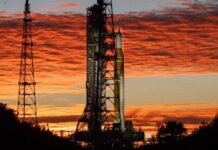
NASA is preparing to launch Artemis II, the first crewed mission to the Moon in over 50 years. The launch is scheduled for Wednesday at 6:24 PM EST (11:24 PM BST) from Kennedy Space Center in Florida, marking a significant step in the agency’s Moon to Mars initiative. This mission is not about landing, but about proving the technology and human endurance necessary for future long-duration spaceflights, including eventual crewed missions to Mars.
Crew Farewell and Final Preparations
The Artemis II crew—Reid Wiseman (Commander), Victor Glover (Pilot), Christina Koch (Mission Specialist), and Jeremy Hansen (Mission Specialist)—said their goodbyes to family members earlier today at the Neil A. Armstrong Operations and Checkout building. Due to quarantine protocols, physical contact was limited to waves and air kisses, though the emotional impact was clear.
The astronauts have now boarded the astrovan for transport to Launchpad 39B, accompanied by heightened security measures including military helicopter surveillance. Before entering the Orion capsule, they will conduct a final ground inspection of the 322-foot SLS rocket.
Mission Objectives and Trajectory
This 10-day mission will take the crew farther into space than any humans have traveled before—nearly 253,000 miles from Earth. The primary goal is to rigorously test the Orion spacecraft and life support systems under extreme conditions. Scientists will monitor the crew’s health closely, particularly the effects of prolonged exposure to radiation and microgravity.
A key moment will be the lunar flyby on flight day six, where Orion will pass within 4,000 to 6,000 miles of the Moon’s south pole, a region targeted for the next human landing as early as 2028. The mission will also validate the Orion capsule’s ability to withstand temperatures up to 3,000°F during re-entry.
Crew Profiles
The Artemis II crew brings a mix of experience and firsts to the mission:
- Reid Wiseman: A retired US Navy captain and former chief of NASA’s astronaut office, Wiseman has logged six months on the ISS and intends to document his thoughts during the flight.
- Victor Glover: Set to become the first person of color to venture beyond lower Earth orbit, Glover carries his Bible, wedding ring, and a book of quotes from Apollo 8 astronaut Rusty Schweickart.
- Christina Koch: A record holder for the longest single spaceflight by an American woman (328 days on the ISS), Koch will be the first woman to travel to the Moon. She’s bringing handwritten notes from loved ones.
- Jeremy Hansen: The only non-American crew member and a first-time space flyer, Hansen plans to carry moon-shaped pendants for his family and Canadian maple syrup.
How to Follow the Launch
Unlike the grainy broadcasts of the Apollo era, Artemis II will be a fully immersive multimedia experience. NASA will stream live coverage on its website (nasa.gov), social media platforms (X, YouTube, Instagram, Twitch), and a dedicated streaming channel (Nasa+). The mission commander, Reid Wiseman, will also post updates on social media when possible.
The launch window opens at 6:24 PM EST, with an 80% chance of favorable weather conditions. Mission managers will monitor data closely for any last-minute technical issues or weather violations that could cause a delay.
The Artemis II mission represents a pivotal moment in space exploration. By pushing the boundaries of human spaceflight, NASA is laying the groundwork for sustainable lunar presence and eventual crewed missions to Mars.