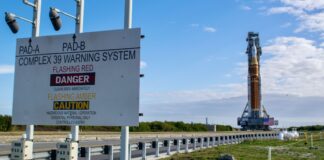
NASA is preparing for another attempt to roll its Artemis II moon rocket to the launchpad, with a planned liftoff in April. The mission’s four astronauts are currently in quarantine as the Space Launch System (SLS) and Orion capsule undergo final checks. This marks the second rollout for the massive rocket, which previously returned to the Vehicle Assembly Building due to leaks discovered during wet dress rehearsals.
The delays and repeated repairs highlight the complex challenges of deep-space missions. The Artemis I SLS also required multiple trips back to the Vehicle Assembly Building in 2022 before its successful uncrewed test flight. These issues have prompted NASA to announce a major overhaul of the Artemis program, aiming for annual launches and potentially reassessing the roles of contractors like SpaceX and Boeing, with two lunar landings targeted for 2028.
Once on the launchpad, NASA will conduct further testing and a flight readiness review before confirming the launch window. This cautious approach underscores the high stakes and technical rigor required for crewed lunar missions.
Northern Lights Spectacle
Simultaneously, a spectacular auroral display is expected to be visible across much of the northern United States. The National Oceanic and Atmospheric Administration (NOAA) has issued warnings about two coronal mass ejections (CMEs) – powerful bursts of plasma from the sun – that are forecast to impact Earth.
CMEs can trigger geomagnetic storms, disrupting satellites, communication systems, and creating vivid auroras. March 2024 is shaping up to be one of the best months for northern lights viewing in nearly a decade due to a highly active sun and Earth’s positioning during the spring equinox. These conditions combine to produce unusually frequent and intense thermospheric lightshows.
Quick Reads
Here are some additional science stories making headlines:
- DNA on Asteroids: Researchers have identified all five nucleotide bases of DNA on an asteroid passing through our solar system, raising questions about the origins of life.
- Uncounted COVID Deaths: A new study reveals that over 150,000 COVID-19 deaths went unrecorded during the early stages of the pandemic.
- Global Food Insecurity: Escalating geopolitical tensions, particularly in Iran, could push global food insecurity to record levels, leaving 363 million people hungry.
Oddity of the Day
Emperor cichlids in Lake Tanganyika exhibit aggressive behavior toward divers who make direct eye contact, even when observing their eggs or fry. This suggests that fish may be able to infer intent from gaze, a capability previously thought limited to primates and some birds.
Word of the Day
Doggerland – A submerged landmass that once connected Britain to mainland Europe during the last ice age, named after the medieval Dutch fishing boats called “doggers” that fished its waters.
Quote of the Day
“We feed them tuna; like royalty, they dine on the ocean’s top predators. In exchange, what do we get back?” – Rob Dunn, professor of applied ecology at North Carolina State University, on our complex relationship with cats.
The convergence of Artemis II’s preparations and the heightened auroral activity emphasizes humanity’s ongoing exploration of space while reminding us of the dynamic forces that shape our planet. These events demonstrate both the ambition of space travel and the raw power of the natural world.