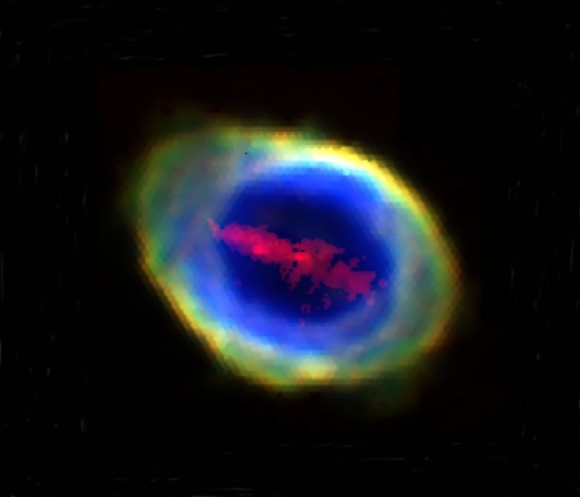
Astronomers have detected an unexpected, elongated structure composed of ionized iron at the center of the Ring Nebula, a well-known planetary nebula located approximately 2,000 light-years away in the constellation Lyra. The discovery, made using the newly-commissioned WEAVE instrument on the William Herschel Telescope, challenges existing understanding of how these nebulae form and evolve.
The Ring Nebula: A Cosmic Landmark
The Ring Nebula, also cataloged as Messier 57 (M57) or NGC 6720, has been a subject of astronomical study since its initial observation by Charles Messier in 1779. Messier, while searching for comets, mistakenly recorded the nebula as a fuzzy, ring-like object. Its iconic shape has made it a favorite target for both amateur and professional astronomers alike.
A Surprising Discovery
The iron structure, identified through high-resolution spectroscopic imaging with WEAVE, stretches across an astonishing length – roughly 500 times the distance between the Sun and Pluto. Its mass is estimated to be comparable to that of Mars, making it a substantial feature within the nebula.
“Even though the Ring Nebula has been studied extensively, WEAVE has allowed us to observe it with unprecedented detail,” explains Dr. Roger Wesson, an astronomer involved in the study. “We can now create images at any wavelength and map the chemical composition across the entire nebula.”
Two Competing Theories
The origin of this iron “bar” remains unclear, but scientists propose two primary explanations. The first suggests that it represents a previously unknown phase in the nebula’s ejection process – the way the dying star expelled its outer layers. The second, more intriguing possibility, is that the iron is the result of a rocky planet being vaporized by the star’s expansion, leaving behind an arc of plasma.
“Whether other chemical elements are present alongside the iron will likely determine the correct model,” states Professor Janet Drew. “Currently, that critical information is missing.”
Implications and Future Research
The discovery highlights the power of new instruments like WEAVE in uncovering hidden structures within well-studied celestial objects. The presence of such a massive iron structure raises questions about the dynamics of planetary nebula formation and the fate of planets orbiting aging stars.
Further research, focusing on identifying additional chemical components within the iron bar, will be crucial to understanding its true origin. This discovery underscores that even familiar cosmic landmarks can still hold unexpected secrets.