


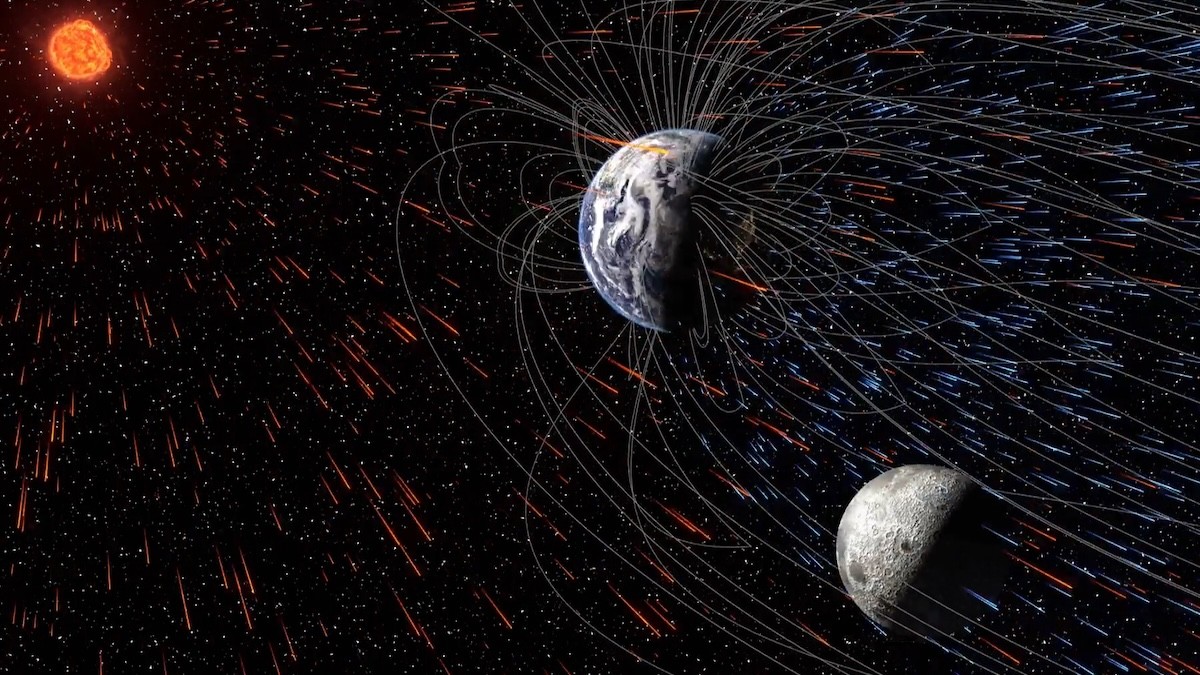
For billions of years, Earth has been subtly leaking its atmosphere to the Moon – not through a dramatic escape, but a consistent, magnetic funneling of particles. New research from the University of Rochester confirms that Earth’s magnetic field, rather than blocking atmospheric loss, actually facilitates it, depositing volatile elements onto the lunar surface.
Lunar Volatiles: A Long-Standing Mystery
The Moon appears barren, but lunar regolith (the loose surface dust) contains surprisingly high concentrations of volatile elements like nitrogen. While solar wind and micrometeorite impacts could explain some of this, they can’t account for the observed levels. The presence of nitrogen in particular suggested another source was at play – one that could bypass the planet’s magnetic shield.
The Role of Earth’s Magnetosphere
Scientists previously believed that once Earth developed a strong magnetic field, atmospheric loss would be minimized. However, recent simulations show otherwise. The magnetosphere, far from being a perfect sphere, is stretched into a comet-like tail by solar wind pressure. When the Moon passes through this tail, charged particles stripped from Earth’s atmosphere are deposited directly onto the lunar surface.
This isn’t a new phenomenon. The process has been ongoing for millennia, allowing volatile compounds to accumulate in the regolith over billions of years.
Implications for Lunar Research
The discovery has significant implications for lunar exploration. Not only could this mechanism explain the presence of oxygen (leading to water and rust formation on the Moon), but it also means that the lunar surface contains a record of Earth’s atmospheric history. The Moon’s regolith now serves as a time capsule, preserving atmospheric compositions from epochs past.
Understanding how Earth’s atmosphere interacts with the Moon’s surface is crucial for future lunar resource utilization and for reconstructing our planet’s environmental evolution.


