


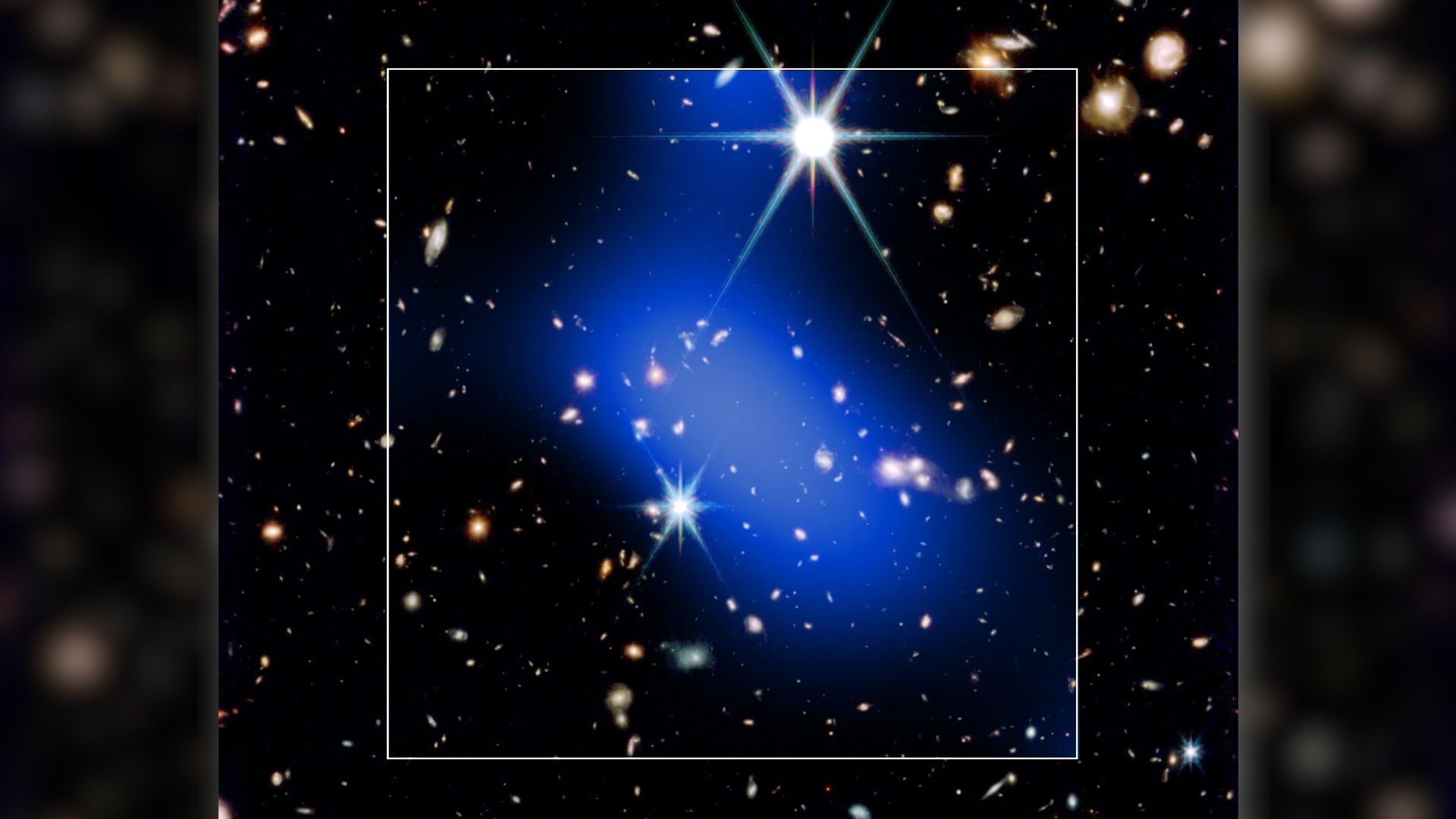
Astronomers have discovered a remarkably massive galaxy protocluster, dubbed JADES-ID1, located 12.7 billion light-years away. The finding challenges current cosmological models because this structure appears to have formed far earlier in the universe’s history than predicted.
What is a Protocluster?
A galaxy protocluster is essentially a galaxy cluster in its early stages. It represents a region where numerous young galaxies are gravitationally bound, embedded in a large cloud of hot gas. Unlike mature clusters, galaxies in a protocluster are less tightly packed, and the surrounding gas hasn’t yet reached temperatures high enough to emit easily detectable X-rays. This makes identifying them exceptionally difficult.
How Was JADES-ID1 Discovered?
Scientists utilized the combined power of the James Webb Space Telescope (JWST) and the Chandra X-ray Observatory to detect JADES-ID1. JWST’s infrared instruments identified at least 66 galaxies within the region, while Chandra detected X-ray emissions from the surrounding hot gas, confirming they belong to a single entity. The protocluster has a mass equivalent to 20 trillion suns and spans 1.1 million light-years across.
The Timeline Anomaly
The most intriguing aspect of JADES-ID1 is its age. Current models suggest such a massive structure shouldn’t form until 2–3 billion years after the Big Bang. However, JADES-ID1 existed when the universe was only about one billion years old.
“This may be the most distant confirmed protocluster ever seen,” said Akos Bogdan of the Harvard & Smithsonian Center for Astrophysics. “JADES-ID1 is giving us new evidence that the universe was in a huge hurry to grow up.”
Why This Matters
This discovery forces astronomers to reconsider the speed at which large-scale structures formed in the early universe. If JADES-ID1 formed so quickly, it suggests either our understanding of early galaxy evolution is incomplete or that the conditions in the early universe were more conducive to rapid structure formation than previously thought. The study, published in Nature on January 28, raises fundamental questions about the evolution of the cosmos and the validity of existing cosmological simulations.
In conclusion, JADES-ID1 presents a significant challenge to our understanding of how the universe evolved. Its existence demands further investigation into the processes that governed structure formation in the early cosmos, potentially reshaping our models of galactic and cluster development.


