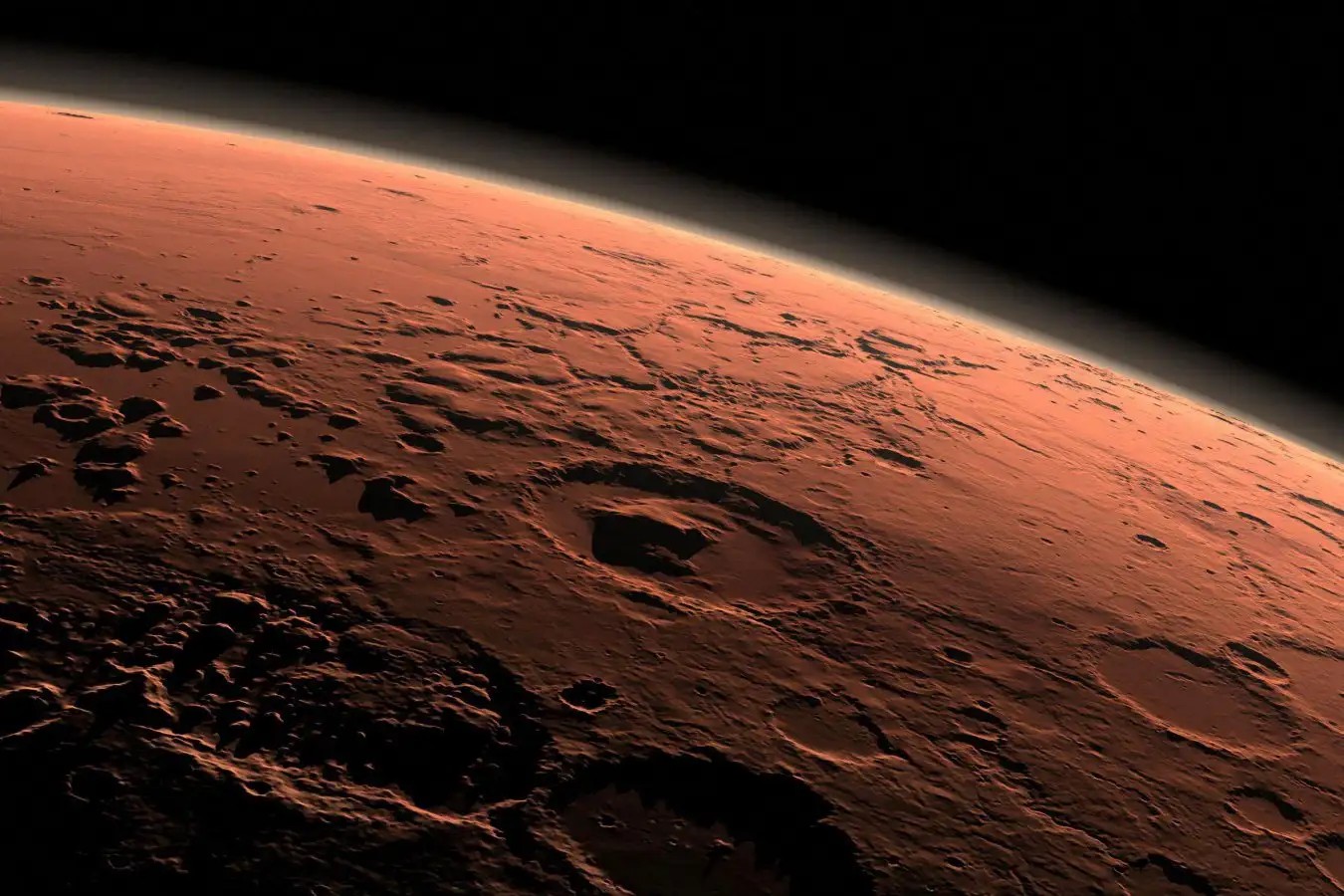
New research indicates that Mars may have once possessed a moon significantly larger than its current satellites, Phobos and Deimos. This hypothetical moon was massive enough to generate measurable tidal activity on the planet’s ancient seas, as evidenced by sedimentary rock formations within Gale Crater. The findings, presented by Suniti Karunatillake and colleagues at Louisiana State University, suggest the lost moon was 15 to 18 times the mass of Phobos.
Tidal Signatures in Martian Sediments
Researchers analyzed layered sedimentary rocks in Gale Crater, imaged by NASA’s Curiosity rover. These rocks exhibit a pattern of alternating thin layers of sand and mud, known as rhythmites. On Earth, similar formations are strong indicators of tidal activity. The layers suggest that incoming tides deposited sand, which was then covered by fine mud during slack water. The team’s analysis revealed tidal periods consistent with a moon far larger than either of Mars’ current moons.
Mathematical Confirmation of Past Tidal Forces
To validate their hypothesis, Ranjan Sarkar at the Max Planck Institute for Solar System Research used Fourier transforms to analyze the layering patterns. The results confirmed periodicities suggesting that both the sun and a larger moon once drove tidal forces on Mars. This builds upon earlier work by Rajat Mazumder, who proposed in 2023 that similar formations in Jezero Crater could also be tidal in origin, though those images lacked sufficient resolution for detailed analysis.
Remaining Debate and Alternative Explanations
Not all scientists are convinced. Some argue that the lakes within Gale and Jezero craters were too small to have generated noticeable tides, even with a larger moon. Nicolas Mangold of the Laboratory of Planetology and Geosciences suggests these craters are not ideal locations for recording tidal deposits. Others, like Christopher Fedo at the University of Tennessee, suggest that regularly varying river inflows could also produce similar sedimentary patterns.
However, Sarkar counters that subsurface connections could have linked Gale Crater to a larger, unseen ocean. Mars’ highly fractured surface and porous geology would allow for such hydrological connections, making tidal activity plausible.
The presence of a substantial past moon raises questions about the evolution of the Martian system. The current moons, Phobos and Deimos, may be remnants of this larger body, broken apart over billions of years. The discovery adds another piece to the puzzle of Mars’ early climate and potential habitability.