


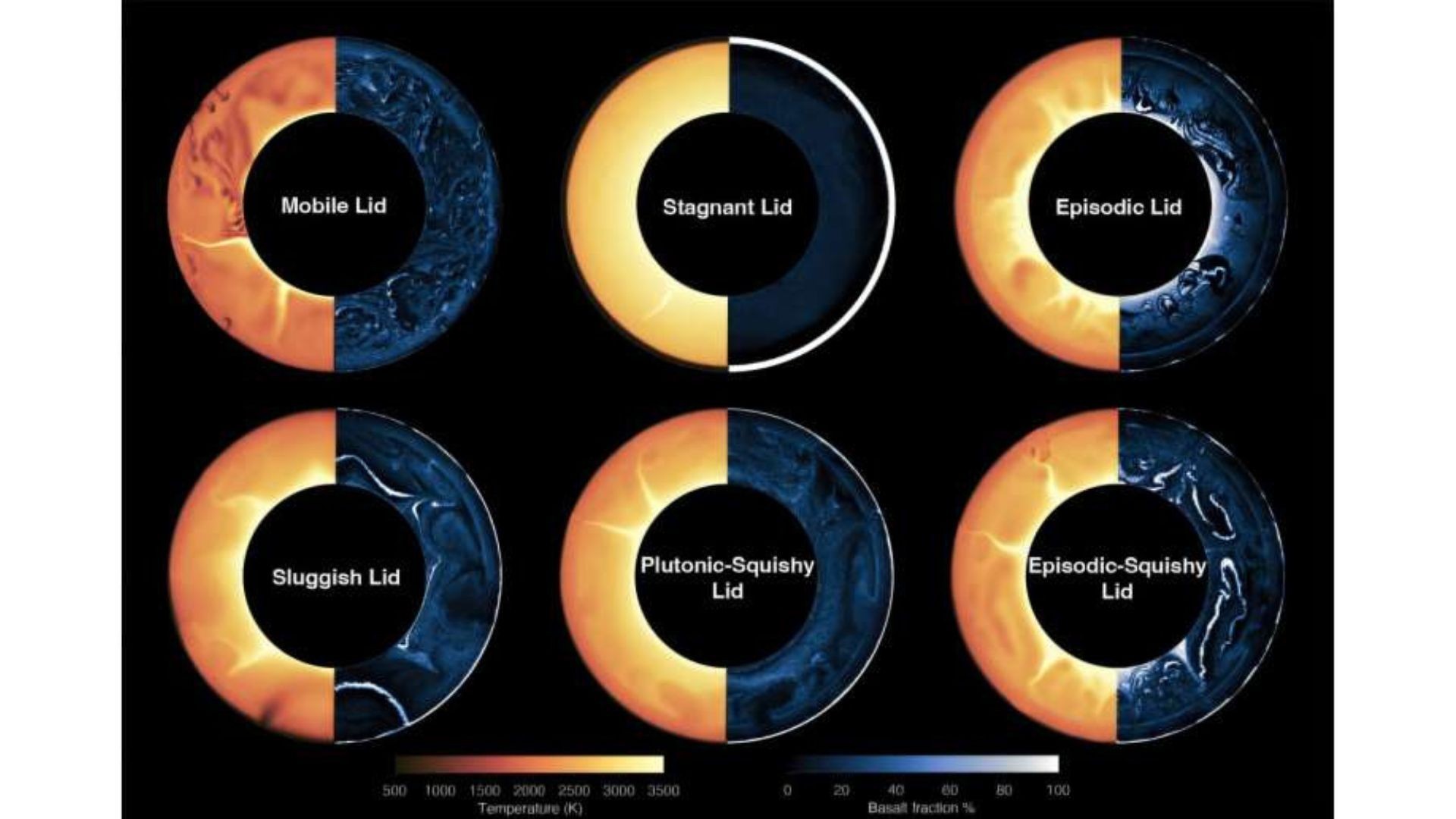
A new study reveals a previously unrecognized tectonic regime, dubbed the “episodic-squishy lid,” that may explain why Earth evolved into a geologically active world while Venus remained stagnant. This discovery fundamentally alters our understanding of planetary evolution and provides crucial insights into what makes a planet habitable.
The Problem with Planetary Evolution
For decades, scientists have struggled to reconcile the stark differences between Earth and Venus. Both planets formed under similar conditions, yet Earth developed robust plate tectonics, crucial for regulating climate and supporting life, while Venus remains a volcanic, scorching wasteland. The traditional models – either a planet has active plate tectonics or a “stagnant lid” – failed to bridge this gap.
Introducing the “Episodic-Squishy Lid”
Researchers using advanced geodynamic simulations have now identified a third, intermediary state: the episodic-squishy lid. This regime describes a planet where the outer shell alternates between periods of relative geological quiet and sudden bursts of tectonic activity. Unlike a stagnant lid, this “squishy” phase involves intermittent weakening of the crust due to magmatic intrusions and regional delamination, softening the surface before it stiffens again.
“Geological records suggest that tectonic activity on early Earth aligns with the characteristics of our newly identified regime,” explains Guochun Zhao, geologist at the Chinese Academy of Sciences.
This on-again, off-again behavior could be the missing piece in Earth’s early evolution. The models suggest Earth likely passed through this phase, gradually preparing its lithosphere for full-fledged plate tectonics as it cooled. This transition wasn’t sudden; instead, the planet’s tectonic behavior became more predictable as its lithosphere weakened over time – a phenomenon known as the “memory effect.”
Venus and the Unified Framework
The episodic-squishy lid also provides a compelling explanation for Venus’s geological state. Simulations accurately reproduce Venus-like patterns by placing the planet in a similar regime, where magmatism weakens the surface periodically without forming true plates. This unified framework allows scientists to view the histories of Earth and Venus under a single theoretical lens.
Implications for Exoplanet Research
Understanding how planetary lithospheres weaken and transition between tectonic states is critical for assessing habitability beyond our solar system. Tectonics directly influence how water and carbon dioxide cycle through a planet’s interior and atmosphere, impacting climate stability.
By mapping all six tectonic regimes under various conditions, researchers have created a comprehensive diagram revealing likely transition pathways as planets cool. This will help prioritize observational targets for future missions searching for Earth-like worlds and super-Earths.
Ultimately, this discovery suggests that habitability isn’t simply about a planet’s size or distance from its star – it’s about its geological history and the specific tectonic regimes it has passed through. The “squishy lid” phase may be a common stepping stone for rocky planets, guiding their evolution towards either a thriving Earth-like state or a stagnant Venusian fate.