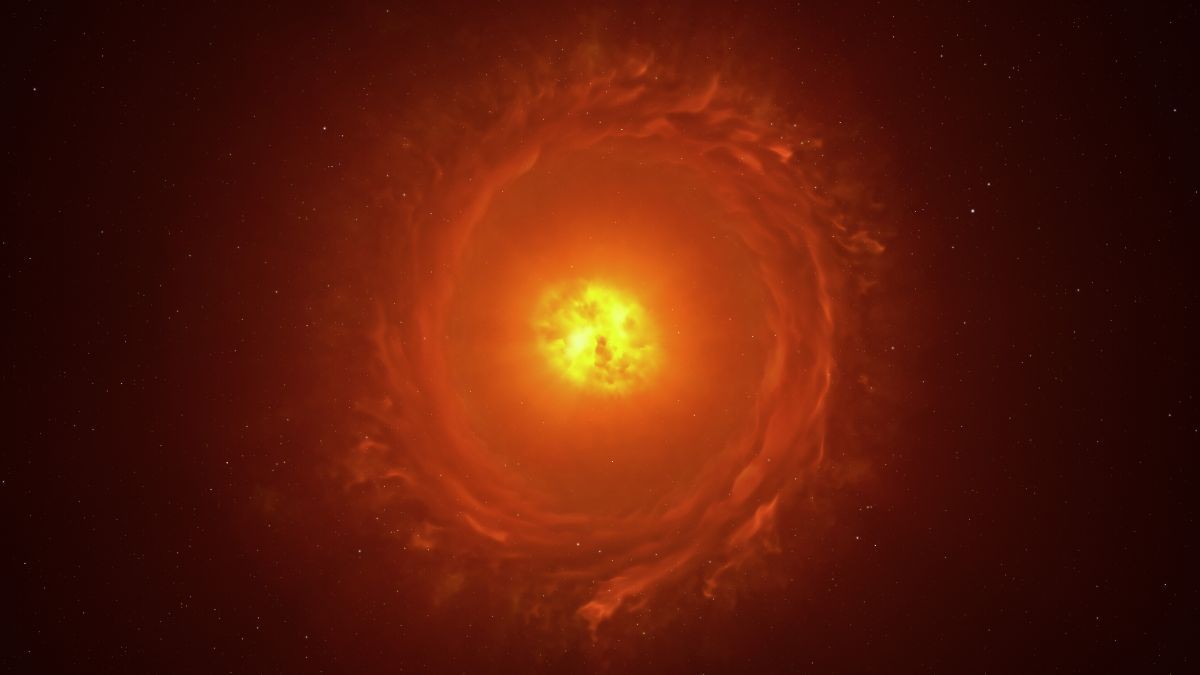
One of the largest known stars, WOH G64, has undergone perplexing changes, sparking debate among scientists about whether it’s evolving toward destruction or merely exhibiting its volatile nature. The star, located in the Large Magellanic Cloud 160,000 light-years away, is roughly 1,500 times the radius of the Sun, making it a prime subject for studying the final stages of massive stellar life.
Initial Observations: A Dramatic Shift?
In 2013-2014, astronomers observed a significant transformation in WOH G64. The star appeared to transition from a typical red supergiant to a hotter, yellower state. A team led by Gonzalo Muñoz-Sanchez initially interpreted this as the star entering a rare yellow hypergiant phase – a potential precursor to a core-collapse supernova. Their analysis suggested a rapid shift in temperature, size (reducing to around 800 solar radii), and atmospheric chemistry. The presence of a close binary companion was also identified, potentially influencing the star’s behavior.
Why this matters: Red supergiants are inherently unstable stars. They burn through their fuel reserves rapidly, undergoing dramatic changes as they expand into enormous volumes before eventually collapsing. Understanding these transitions is crucial for predicting the timing of supernova events.
Conflicting Evidence: Is It Still Red?
However, subsequent observations cast doubt on the initial interpretation. In late 2025, astronomers Jacco van Loon and Keiichi Ohnaka analyzed new spectra from the Southern African Large Telescope. They found titanium oxide in WOH G64’s atmosphere – a molecule that cannot exist in the extreme heat of a yellow hypergiant.
This finding suggests the star may never have stopped being a red supergiant. The earlier shift in color could be a temporary fluctuation rather than a fundamental evolutionary leap.
The Role of Binary Companions
The presence of the binary companion complicates the picture. Interactions between the two stars could generate changes in brightness and spectral features that resemble a more significant transformation without actually occurring.
The broader context: Stellar binaries are common, and their interactions can drive unpredictable behavior in both stars. This makes disentangling true evolutionary changes from external influences a major challenge in astronomy.
What’s Next for WOH G64?
Continued monitoring is essential to determine the star’s true fate. Whether WOH G64 is on the brink of a supernova or simply displaying its natural instability remains uncertain. The star’s unpredictable behavior highlights the complexity of studying massive stars in their final evolutionary stages.
“WOH G64 is full of surprises,” concludes van Loon, “and will remain a fascinating little corner of the Universe.”
The star’s fluctuating behavior serves as a reminder that even with advanced telescopes, understanding stellar evolution requires patience, persistence, and a willingness to revise initial conclusions in light of new evidence.