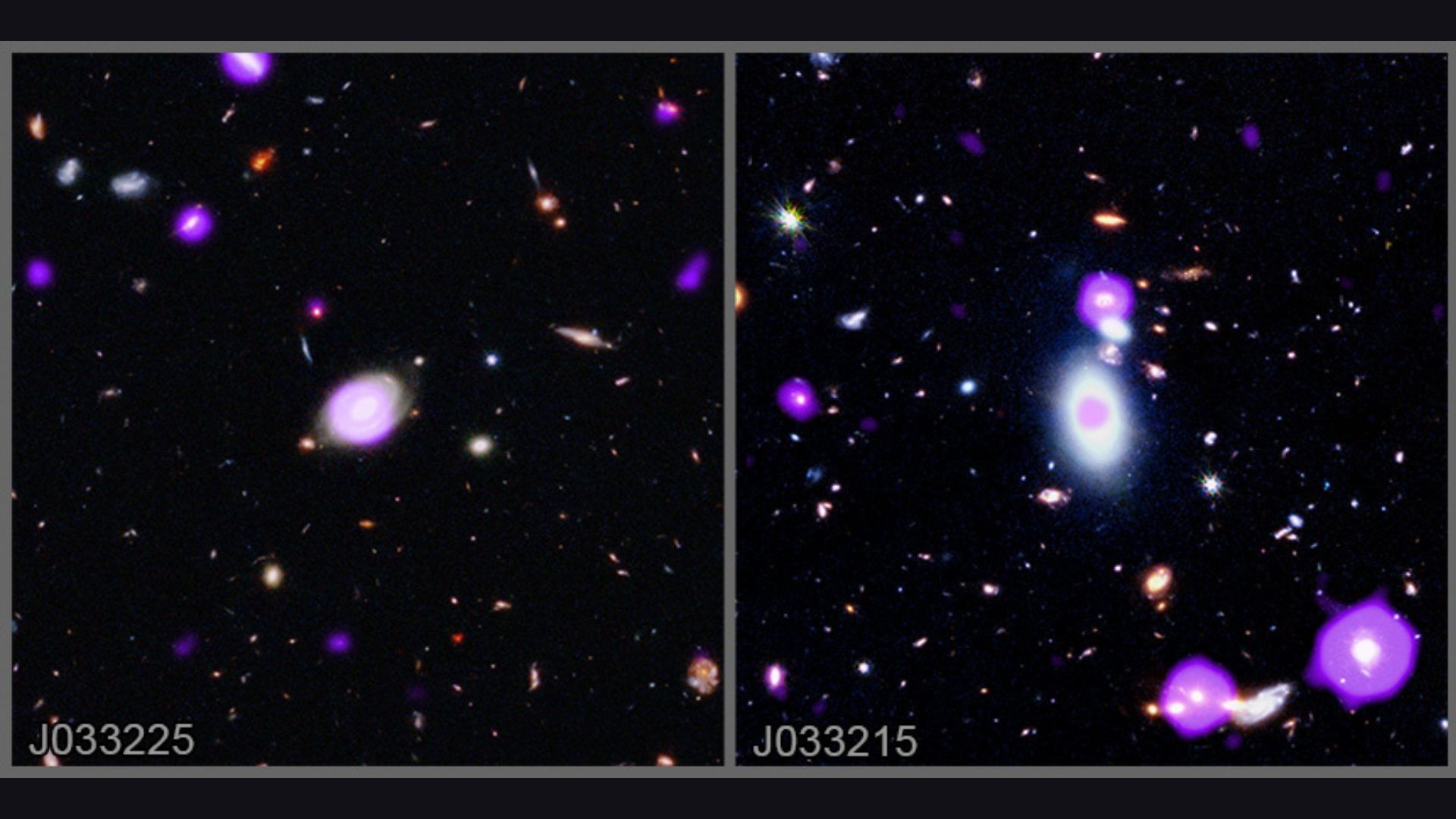
For billions of years, supermassive black holes (SMBHs) have acted as the heavyweights of the cosmos, growing to masses millions or even billions of times greater than our Sun. However, astronomers have long observed a puzzling trend: the rapid growth seen in the early universe has slowed to a crawl.
A new study published in The Astrophysical Journal suggests that these “cosmic monsters” aren’t shrinking or disappearing—they are simply running out of food.
The Mystery of the Slowing Growth
In the early stages of the universe, specifically during a period known as “cosmic noon” (roughly 10 billion years ago), black holes were growing at an incredible pace. Since then, their rate of expansion has plummeted.
For years, scientists debated the cause of this slowdown, considering three primary theories:
1. Fewer Candidates: Are there simply fewer active black holes in the modern universe?
2. Smaller Sizes: Are modern black holes smaller and thus less capable of pulling in matter?
3. Reduced Consumption: Are individual black holes simply eating less than they used to?
By analyzing data from 8,000 actively feeding black holes and 1.3 million galaxies, researchers have identified a clear winner. The issue isn’t the number of black holes, but the availability of fuel.
The “Wedding Cake” Approach to Discovery
To solve this enigma, the research team used a “wedding cake” design—a tiered method of observation that combines wide, shallow surveys of nearby space with extremely deep, narrow “pencil-beam” looks at distant regions.
The team relied heavily on X-ray observations from premier space telescopes, including NASA’s Chandra, the ESA’s XMM-Newton, and eROSITA. X-rays are the ideal tool for this research because:
* They are produced by the intense heat of matter falling into a black hole.
* They stand out clearly against background starlight.
* They can penetrate the thick clouds of gas and dust that often obscure black holes from visible light telescopes.
A Drastic Decline in Consumption
The findings are striking. The researchers concluded that the primary reason for the slowdown is a dramatic decrease in cold gas —the essential “fuel” black holes need to grow. Since the peak of cosmic noon, the amount of available material has dwindled, forcing even the largest black holes into a state of starvation.
“Our best estimate is that the decrease is a factor of 22,” noted study co-author Neil Brandt.
This means that the feeding rate of these giants has dropped by more than twentyfold compared to their heyday. While this study doesn’t explain how black holes grew so fast in the very early universe, it provides a definitive answer for the last 75% of cosmic history.
Why This Matters for the Cosmos
The growth of a supermassive black hole is not an isolated event; it is deeply connected to the life cycle of its host galaxy. There is a known correlation between the mass of a black hole and the mass of the stars in its galaxy’s central bulge. As black holes grow, they influence star formation and the overall structural evolution of galaxies.
The study confirms that the era of “rampant” black hole growth is over. With the population of supermassive black holes having largely stabilized about 7 billion years ago, the universe is entering a much quieter, more stable phase of galactic evolution.
Conclusion: The universe’s largest black holes are experiencing a massive decline in growth because the cosmic supply of cold gas has been depleted. This shift marks the end of an era of rapid celestial expansion, moving toward a more settled and stable cosmic landscape.