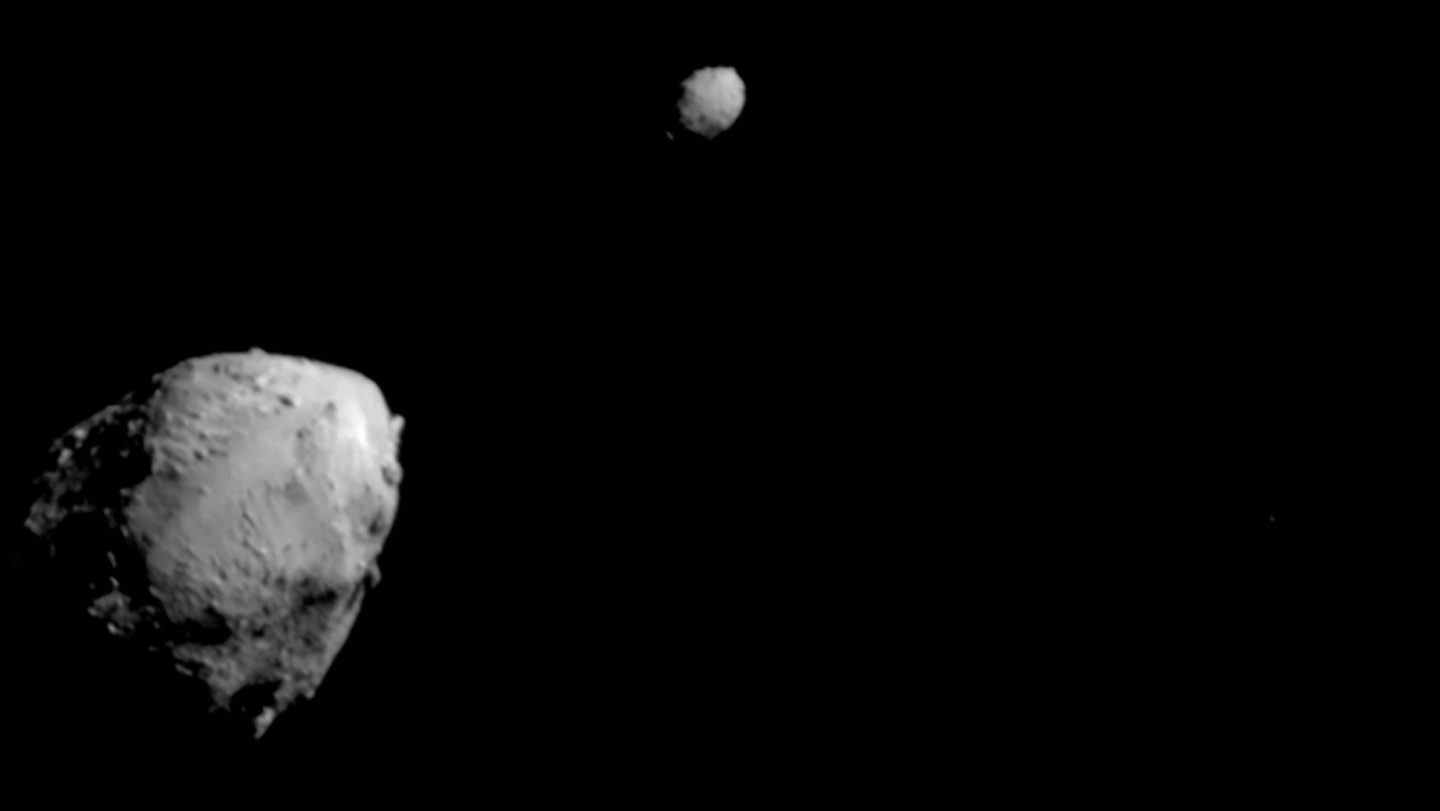
NASA’s DART mission has achieved a historic first: altering the orbital path of an asteroid around the sun. This groundbreaking experiment, detailed in the journal Science Advances on March 6, demonstrates humanity’s capability to influence celestial bodies – a critical step toward protecting Earth from potential asteroid impacts.
The DART Mission and its Impact
In September 2022, the Double Asteroid Redirection Test (DART) spacecraft intentionally collided with Dimorphos, a small asteroid orbiting the larger Didymos. The impact successfully shortened Dimorphos’ orbital period by 32 minutes, a substantial change confirmed by initial observations. However, the full extent of the alteration wasn’t known until recently.
Researchers discovered that the impact didn’t just shift Dimorphos’ orbit around Didymos; it also measurably altered the entire system’s orbit around the sun. This effect was primarily due to debris ejected from the collision, which pushed against the asteroid pair, slowing their combined movement by more than 10 micrometers per second.
Measuring the Change with Stellar Occultations
The subtle shift in orbital speed was detected through meticulous measurements of stellar occultations. This technique involves observing asteroids as they pass in front of distant stars, momentarily dimming their light. By comparing predicted occultation timings with actual observations over two years (October 2022 – March 2025), astronomers calculated a 150-millisecond decrease in orbital speed.
The data collection relied heavily on dedicated amateur astronomers, with one observer traveling to the Australian outback to secure critical measurements. This highlights the vital role citizen science plays in space exploration.
Implications for Planetary Defense
Didymos and Dimorphos pose no current threat to Earth, but this experiment proves the feasibility of kinetic impact as a planetary defense strategy. The European Space Agency’s Hera mission, set to arrive at the asteroid pair later this year, will provide further data.
“Knowing how a deliberate impact changes an asteroid’s orbit can help make defense plans against another, in case we need to do a kinetic impact for real.”
The DART mission wasn’t about averting an immediate danger; it was about demonstrating a capability. As asteroid detection improves, this technology could be crucial in deflecting hazardous objects before they reach Earth. The success of DART marks a turning point in planetary defense, proving that humanity can actively intervene to safeguard its future.