NASA and the U.S. Navy are finalizing recovery operations as the Artemis II crew prepares to return to Earth following a record-breaking mission around the Moon. After completing a historic loop that took them further from our planet than any humans have ever traveled, the crew is now set to splash down off the coast of Southern California this Friday.
The Final Countdown to Re-entry
The mission’s primary focus has now shifted from lunar exploration to the high-stakes phase of atmospheric re-entry. This stage is one of the most dangerous parts of any spaceflight, as the spacecraft must withstand extreme heat and intense pressure while transitioning from the vacuum of space back into Earth’s atmosphere.
To ensure the safety of the crew, NASA has conducted rigorous remote inspections of the Orion spacecraft—affectionately named Integrity by the astronauts. Using external cameras, engineers scanned the vehicle for any structural abnormalities or damage that could compromise its integrity during the descent.
“No concerns,” stated Debbie Korth, deputy manager of the Orion program, confirming that the spacecraft is in optimal condition for the re-entry phase.
Recovery Operations and Logistics
A coordinated effort between NASA and the Navy is underway to retrieve both the astronauts and the capsule. The recovery plan includes:
– Primary Recovery Vessel: The U.S.S. John P. Murtha, an amphibious dock ship, has been deployed to the designated landing zone.
– Splashdown Location: The crew is expected to land in the waters off the Southern California coast on Friday.
– Mission Oversight: The recovery is being managed by NASA’s Artemis landing and recovery team to ensure a seamless transition from space to sea.
A Milestone for Human Spaceflight
The Artemis II mission is more than just a technical success; it represents a pivotal moment in the history of exploration. It marks the first major step toward resuming crewed lunar landings, ending a hiatus of over 50 years since the Apollo era.
The mission has also broken several social and international barriers:
– Victor Glover has become the first Black man to venture into deep space.
– Christina Koch has become the first woman to travel into deep space.
– Jeremy Hansen of the Canadian Space Agency has become the first non-American to participate in a lunar mission.
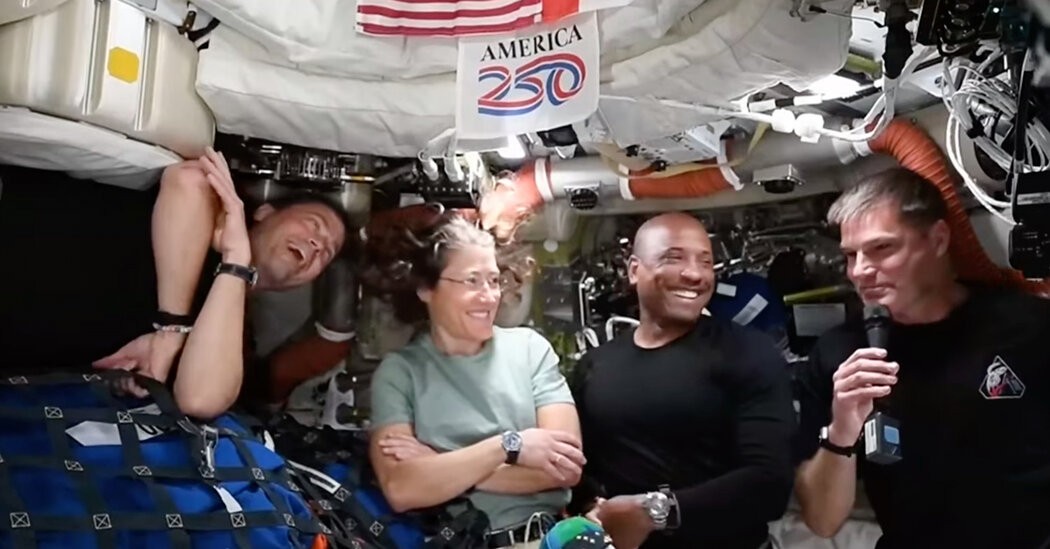
Beyond the technical achievements, the crew has highlighted the profound human element of the mission. Despite the cramped quarters of the Orion capsule—which offers living space roughly equivalent to two minivans—the crew reported an unprecedented sense of connection. Christina Koch noted that the bond formed between the crew members is a “privilege” unique to the intensity of deep-space travel.
Conclusion
As Artemis II nears its conclusion, the mission stands as a successful bridge between the legacy of the Apollo program and a new era of lunar exploration. The upcoming splashdown will mark the successful completion of a journey that has redefined the boundaries of human presence in deep space.