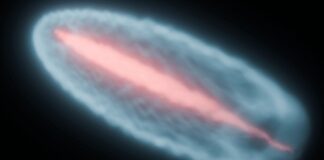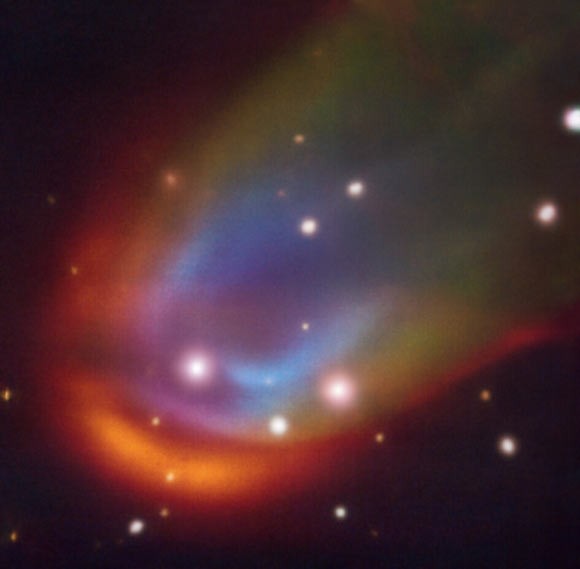
Astronomers have detected a peculiar and powerful shock wave emanating from the white dwarf star RXJ0528+2838, located approximately 730 light-years away in the constellation Auriga. The phenomenon defies current stellar evolution models and could fundamentally change our understanding of how these stellar remnants behave.
The Anomaly Explained
White dwarfs, the dense remnants of sun-like stars, typically interact with interstellar gas to create bow shocks – curved arcs of material similar to the wave forming in front of a moving ship. These shocks are usually driven by outflows from the star itself, but RXJ0528+2838 presents a unique puzzle: it exhibits no clear outflow mechanism yet produces a remarkably strong shock wave.
The star exists in a binary system with a companion star, meaning material can be transferred between them. In typical systems, this material forms a disk around the white dwarf, fueling outflows. However, RXJ0528+2838 shows no evidence of such a disk. This lack of expected behavior is why the discovery is so significant.
The Mystery Deepens
Initial observations from the Isaac Newton Telescope revealed a strange nebulosity around RXJ0528+2838. Detailed follow-up using the MUSE instrument on the Very Large Telescope confirmed the presence of a powerful shock wave, implying the white dwarf has been expelling material for at least 1,000 years. The puzzle remains: how can a diskless white dwarf sustain such a long-lasting outflow?
Researchers believe the answer lies in the star’s unexpectedly strong magnetic field. This field may be channeling material stolen from the companion directly onto the white dwarf, bypassing the disk formation process. This mechanism, however, does not fully explain the observed energy levels. The magnetic field strength, as currently measured, appears insufficient to sustain the outflow for the observed duration.
Implications for Stellar Physics
The discovery challenges the conventional understanding of binary systems involving white dwarfs. It suggests that previously unknown energy sources or more efficient outflow mechanisms may be at play. The “mystery engine” driving this phenomenon—likely related to the magnetic field—requires further investigation.
“We found something never seen before and, more importantly, entirely unexpected,” said Dr. Simone Scaringi of Durham University.
The findings underscore the complexity of stellar interactions and highlight that even well-studied objects like white dwarfs can still hold surprising secrets. This discovery opens new avenues for research into magnetic fields, binary star dynamics, and the evolution of compact stellar objects.
The research was published in Nature Astronomy on January 12, 2026.