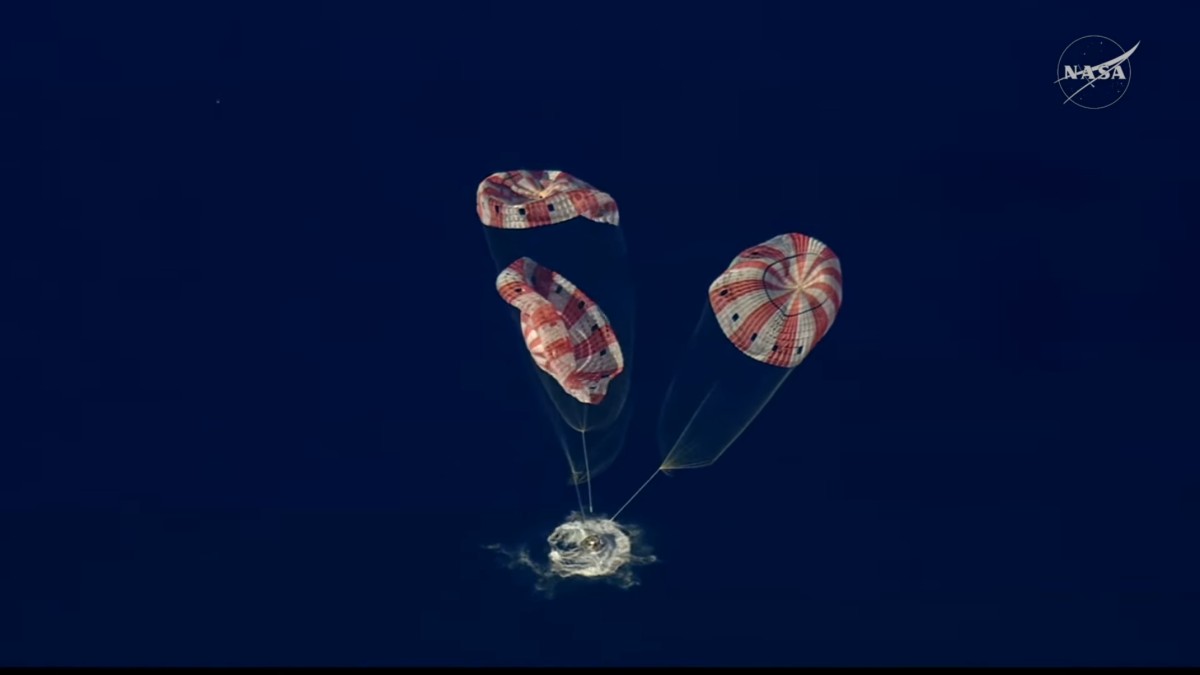
The Artemis II mission has officially returned to Earth, marking a significant milestone in human space exploration. On Friday evening, the crew capsule successfully splashed down in the Pacific Ocean off the coast of California, bringing the astronauts home safely after their journey.
A Return to Iconic Spaceflight Imagery
The descent provided a moment of high drama and nostalgia for space enthusiasts. Approximately thirty minutes before the splashdown, video footage captured the critical moment the crew module separated from the service module—a vital step in the reentry process.
The visual of the capsule hitting the water echoed the iconic Apollo-era splashdowns of the 1960s and 70s, signaling a triumphant return to deep-space crewed operations. This successful recovery has sparked celebrations across the United States, from San Diego to Downey, California, where space centers gathered to watch the live broadcast.
Technical Challenges During Recovery
While the splashdown itself was a success, the recovery process faced unexpected delays. Once the capsule hit the water, the crew had to wait over an hour for the deployment of specialized recovery equipment.
The recovery sequence involved several technical stages:
– The “Front Porch” Deployment: A hexagonal raft designed to attach to a stabilizing collar around the capsule.
– Crew Extraction: After the delay, the astronauts were moved onto this floating platform to await transport.
– Helicopter Airlift: Each crew member was picked up individually by helicopter.
Artemis II Commander Reid Wiseman was the final astronaut to be airlifted from the floating platform. The mission concluded when the helicopters transported the crew to the deck of the USS John P. Murtha, where astronauts Christina Koch and Vic Glover were seen waving to a global audience via livestream.
Why This Mission Matters
The successful return of the Artemis II crew is more than just a technical victory; it is a validation of the systems required to bring humans back from deep space. Unlike previous low-Earth orbit missions, Artemis missions test the limits of life support and reentry technologies necessary for long-term lunar exploration.
The delays experienced during the “front porch” inflation highlight the inherent complexities and risks involved in maritime recovery operations, reminding us that even the most advanced space missions rely heavily on precise, real-world logistics on the ocean surface.
The successful splashdown of Artemis II marks a pivotal step in humanity’s ability to safely navigate the journey between Earth and the Moon.