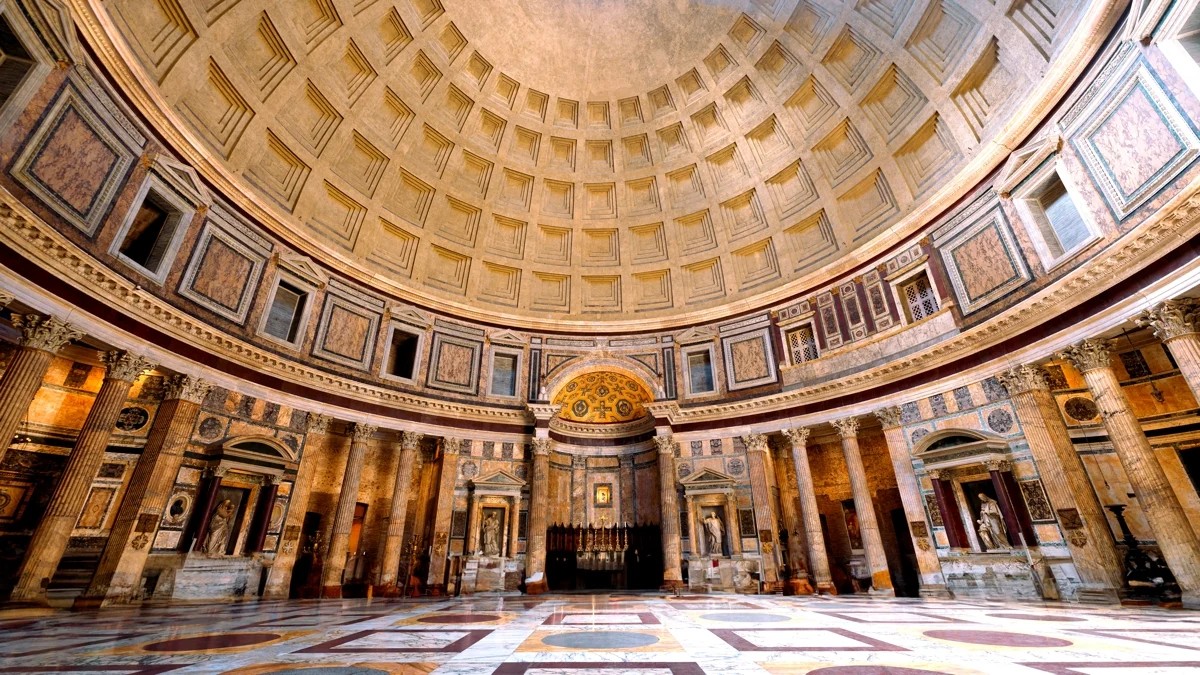
We tend to hand-wave history like the Roman Empire conjured civilization from thin air. It is an imperialist instinct to think they invented everything. They didn’t.
Even those marble-clad architects stood on the shoulders of giants. Or, in this case, on the dirt floors of Neolithic settlements that vanished eight thousand years ago.
A new study upends the credit for a sophisticated building material long thought to be a Roman miracle. The technique? Dolomitic plaster. The inventors? Ancient farmers in the Judean Hills. The Romans? Likely latecomers. Or perhaps, just independent rediscoverers.
The “Impossible” Chemistry
Roman engineering gets the glory for good reason. The Pantheon. Aqueducts. Concrete that survives saltwater and time. But beneath that durability was a trick with lime that confused experts for centuries.
Most ancient builders used calcitic plaster. It’s easy to make. It cracks. It fears water.
Romans, however, sometimes mixed in dolomite. This mineral, composed of calcium magnesium carbonate, creates a plaster that dries faster. It resists water better. It’s tougher. But working with dolomite is a nightmare.
“Using dolomitic lime is challenging,” the researchers noted. It requires precision at every single step. “It explains why it is so rarely found.”
Vitruvius, the famous first-century BCE engineer, wrote about the process. He didn’t name the mineral directly, but his descriptions match dolomite production. Until now, historians assumed this was a unique Roman insight.
Archaeological silence before Vitruvius supported the theory. Prehistoric sites usually yielded gypsum or calcite tools. Dolomitic lime? Invisible.
Until the dirt in Jerusalem spoke.
The Motza Anomaly
The site is Motza. It sits about 5 kilometers west of modern Jerusalem. For decades, it was just soil. Then developers planned a highway. Between 2015 and and 2021, archaeologists rushed in, sifting through layers of occupation that spanned millennia.
They dug down roughly 9,000-years-ago.
There, they found it.
Over 100 plaster floors. Many were coated in red pigment. Preserved like a snapshot of Neolithic domestic life.
But the real shocker was in the kilns.
The builders at Motza weren’t just smashing rocks. They built specialized furnaces. One for limestone. One for dolomite. They knew these stones needed different heat profiles. This isn’t trial and error. This is technical know-how.
It implies a sophistication we never gave them credit for. Neolithic people usually get painted with the broad brush of “hunter-gatherer simplicity.” Motza suggests a localized industrial complexity.
A Lost Technology?
The method found at Motza breaks modern assumptions.
The plaster showed signs of full recrystallization. Both the calcite and dolomite components reformed into a new structure. Scientists previously thought this was physically impossible under the conditions these early humans could generate.
Yet there it was.
This technique produced a superior building material. Stronger. Water-resistant. Durable.
So, what happened?
Did the knowledge pass down? Unlikely. There is no archaeological chain connecting Motza to Rome. The gap is 8,0000 years long. That is an eternity in cultural memory.
More probable? The Romans stumbled onto it again.
Independent invention. The same brilliant chemistry rediscovered, separated by millennia of darkness. The knowledge didn’t survive. It went dormant. Buried under layers of dirt and forgetfulness.
The Roman Empire rose, built its monuments, and attributed its success to itself.
History is rarely that honest.
It is just dust, waiting for the right shovel to find it again.