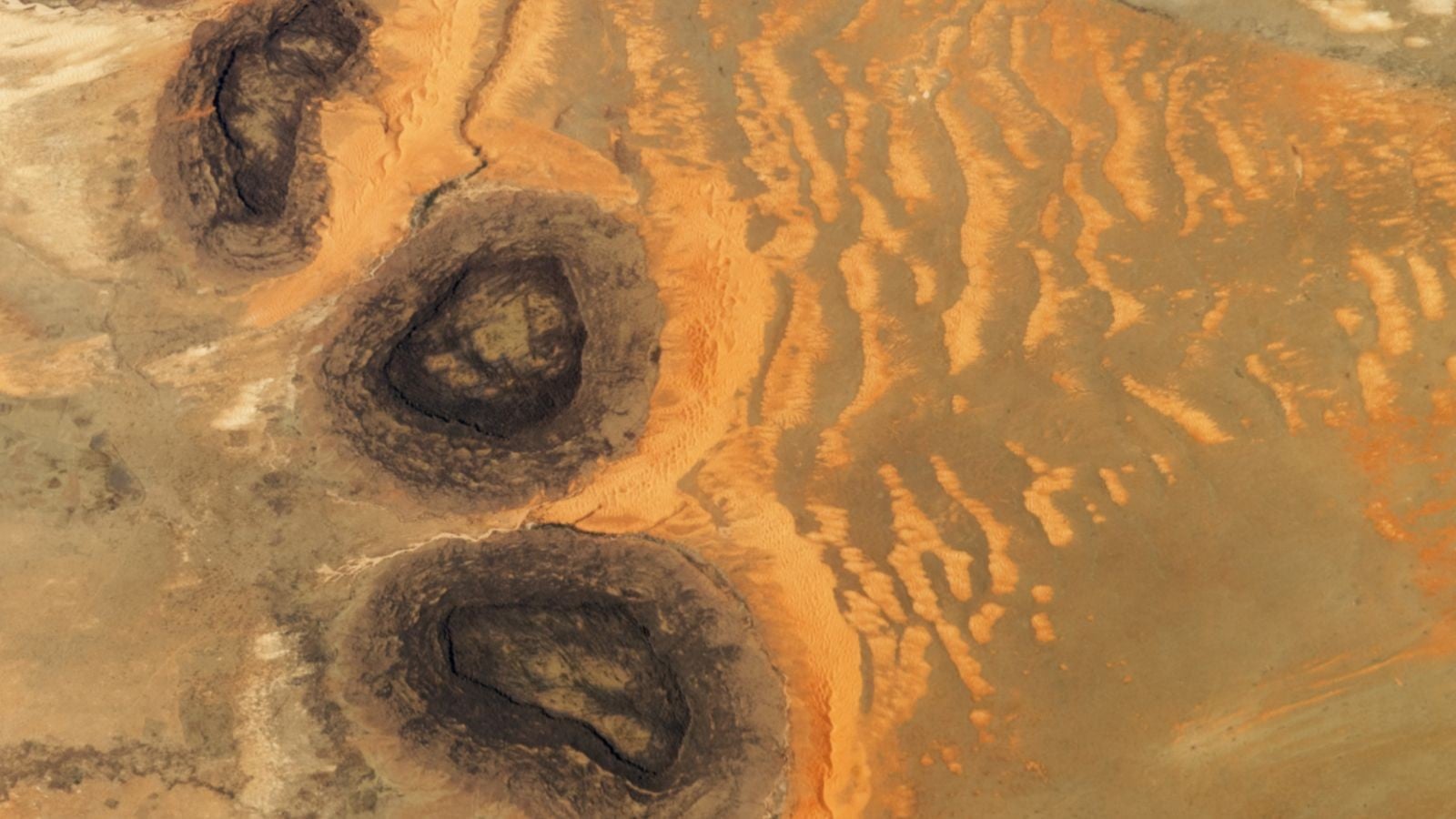
Three striking “black mesas” – remnants of a Paleozoic-era landscape – are reshaping sand patterns in the Sahara, creating both unique dune formations and strangely barren zones. A recent astronaut photograph captured this geological oddity near Guérou, Mauritania, revealing how ancient rock structures influence modern wind-driven landscapes.
Geological Origins and Composition
These mesas, flat-topped hills rising 300–400 meters above the surrounding plains, are composed of sandstone and stretch up to 9.5 kilometers across. Their dark coloration stems from “rock varnish,” a black coating rich in manganese and iron oxides, formed over millennia by arid conditions and microbial activity. This varnish isn’t just aesthetic; it indicates long-term exposure to harsh desert environments.
The formation of these mesas traces back to the Paleozoic era (541–251.9 million years ago), when they were likely part of a continuous rock formation eroded over time by wind and water. Similar massive structures, like the “Eye of the Sahara” (Richat Structure) located 460 kilometers north, suggest a broader geological history of uplift and erosion in this region.
How Mesas Shape Dune Patterns
The mesas create two distinct effects on surrounding sand distribution:
- Eastern Dune Accumulation: Prevailing winds carrying sand pile it against the eastern slopes of the mesas, forming climbing dunes (ridge-like accumulations) and barchan dunes (stripy, crescent-shaped formations). The reddish-yellow hue of the sand is consistent with typical Saharan dune compositions.
- Western Dune Scour: The western sides of the mesas remain largely dune-free due to “wind scour.” Fast-moving air currents squeezed between the mesas actually blow sand away, preventing buildup.
This dual effect – accumulation on one side, removal on the other – makes these mesas unique landscape sculptors. The phenomena is visible in satellite imagery, showing dunes flowing away from the black rocks like tails.
Global Context and Martian Analogues
While mesas are found globally (including the U.S. Southwest), the Sahara has a high concentration of them. The same erosive forces that shape these features on Earth also operate on Mars, where mesas carved by billions of years of wind erosion are a prominent geological feature. This suggests that the processes shaping landscapes are not unique to our planet.
Ultimately, these Saharan mesas demonstrate how ancient geological formations can actively reshape modern landscapes, revealing the enduring power of erosion and wind patterns across vast stretches of time and even other planets.