For over six decades, Cygnus X-1 has stood as a cornerstone of modern astrophysics. As the first black hole ever confirmed by scientists, it has served as a primary laboratory for testing our understanding of gravity and space-time. Now, a groundbreaking new study has finally succeeded in measuring the energy of its most elusive feature: its “dancing” relativistic jets.
A Cosmic Tug-of-War
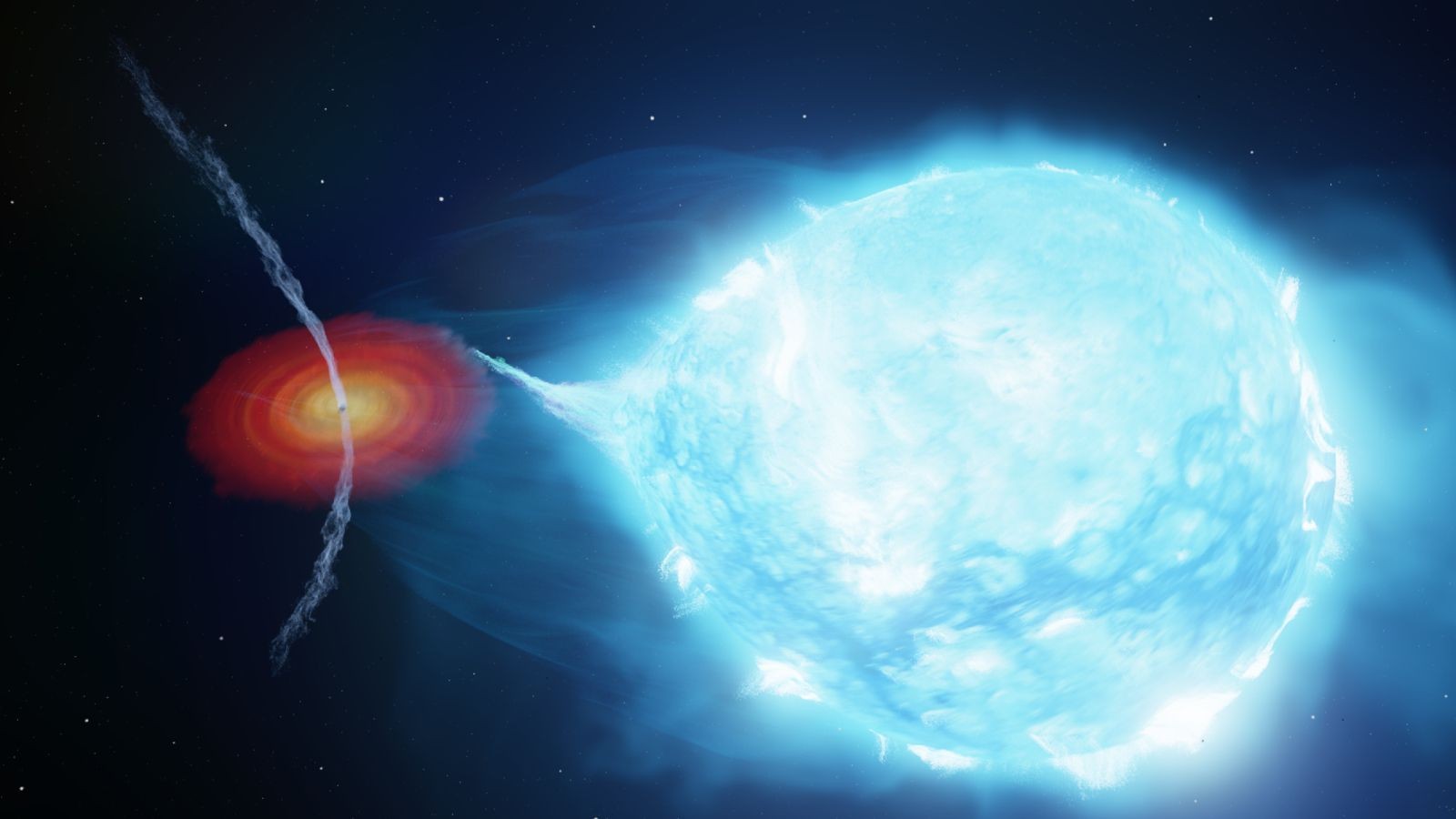
Located approximately 7,000 light-years away in the constellation Cygnus, Cygnus X-1 is not a solitary entity. It exists in a high-stakes binary system with a blue supergiant star known as HDE 226868.
The relationship is predatory: the black hole, which is roughly 21 times more massive than our Sun, relentlessly strips the outer layers of its companion star. This captured matter forms a superheated, swirling accretion disk that glows intensely in X-ray light. As the black hole spins, its immense magnetic fields launch two powerful beams of plasma—jets—outward from its poles.
The Phenomenon of “Dancing Jets”
While astronomers have long known these jets exist, they have historically been incredibly difficult to measure accurately. This difficulty stems from a unique celestial interaction:
- The Cause: The companion star, HDE 226868, emits powerful stellar winds—invisible gusts of charged particles.
- The Effect: These winds constantly buffet the black hole’s jets, pushing them away from the star.
- The Motion: Because the two objects orbit a common center of mass, the jets appear to sway or wobble from our perspective on Earth.
Lead researcher Steve Prabu from the University of Oxford describes this motion as “dancing jets.” By combining radio telescope data from across the globe, researchers were finally able to account for this constant movement and calculate the jets’ true properties.
Key Findings: Speed and Power
The study, published in Nature Astronomy, reveals the staggering scale of these outflows:
– Velocity: The jets travel at approximately 335 million mph (540 million km/h), which is roughly half the speed of light.
– Energy Output: The jets radiate an energy equivalent to roughly 10,000 suns.
– Efficiency: Most importantly, the research found that about 10% of the energy released as matter falls into the black hole is carried away by these jets.
Why This Matters for Modern Physics
This discovery is more than just a feat of measurement; it provides a crucial “anchor” for theoretical physics.
For years, scientists have used large-scale simulations to model how the universe evolves, assuming a 10% energy transfer via jets. Until now, this was a theoretical assumption. By confirming it through direct observation of Cygnus X-1, scientists can now validate their models.
Furthermore, because the laws of physics are believed to be universal, these findings apply to all black holes—from small, stellar-mass objects like Cygnus X-1 to the supermassive black holes found at the centers of galaxies. Understanding these jets is vital to understanding galactic evolution, as these massive outflows act as a “feedback loop,” shaping the gas, dust, and star formation of the entire galaxy surrounding them.
“Because our theories suggest that the physics around black holes is very similar, we can now use this measurement to anchor our understanding of [other] jets,” says co-author James Miller-Jones.
Conclusion: By successfully measuring the erratic, “dancing” jets of Cygnus X-1, astronomers have moved from theoretical assumptions to observational proof, providing a vital benchmark for how black holes influence the evolution of the cosmos.