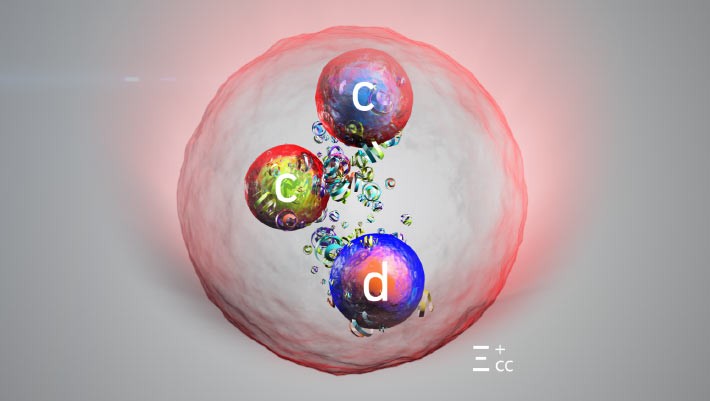
Physicists at CERN’s Large Hadron Collider (LHC) have confirmed the existence of a new, heavier relative of the proton, called Ξcc⁺ (Xi-double-charm-plus). This discovery offers scientists a fresh perspective on the strong force—the fundamental interaction that holds matter together at its most basic level.
What are Quarks and Why Do They Matter?
At the heart of this discovery lie quarks, the elementary particles that form protons, neutrons, and all other composite particles in the universe. There are six known types of quarks: up, down, charm, strange, top, and bottom. Quarks rarely exist in isolation; they combine to create hadrons, which include familiar particles like protons and neutrons.
Most hadrons are unstable and decay almost immediately after forming. The LHC is designed to create these fleeting particles by colliding beams of high-energy protons. The decay products, which are stable enough to measure, reveal the properties of the original, short-lived hadron.
A Second Double-Charm Baryon
The newly-discovered Ξcc⁺ contains two charm quarks and one down quark. This makes it a “baryon” (a three-quark particle) with an unusual composition. It’s only the second baryon observed to contain two heavy quarks (charm quarks, in this case). The first such particle was detected by the LHCb experiment nearly a decade ago.
The LHCb collaboration observed the new particle with a statistical significance of 7 sigma—far exceeding the 5 sigma threshold for a confirmed discovery. This means the chances of the signal being a random fluctuation are vanishingly small.
Why This Discovery Is Important
The existence of Ξcc⁺ helps refine our understanding of quantum chromodynamics (QCD), the theory governing the strong force. QCD predicts the existence of not just ordinary hadrons but also more exotic combinations, such as tetraquarks (four quarks) and pentaquarks (five quarks).
This new particle will allow theorists to test QCD models more rigorously. It is similar to a particle discovered in 2017, which contains two charm quarks and an up quark instead of a down quark. Despite this similarity, the new particle is predicted to decay up to six times faster due to subtle quantum effects—making it even harder to detect.
Upgrades Lead to Breakthroughs
The discovery was made using data from the LHC’s third run, after significant upgrades to the LHCb detector in 2023. CERN director-general Mark Thomson emphasized the critical role of these upgrades in enabling new discoveries.
This major result is a fantastic example of how LHCb’s unique capabilities play a vital role in the success of the LHC.
The finding sets the stage for further research with the High-Luminosity LHC, which will increase the rate of particle collisions and allow physicists to probe the fundamental forces of nature with unprecedented precision.
In essence, the discovery of Ξcc⁺ doesn’t just add another entry to the particle catalog; it sharpens our understanding of the universe’s most fundamental interactions.