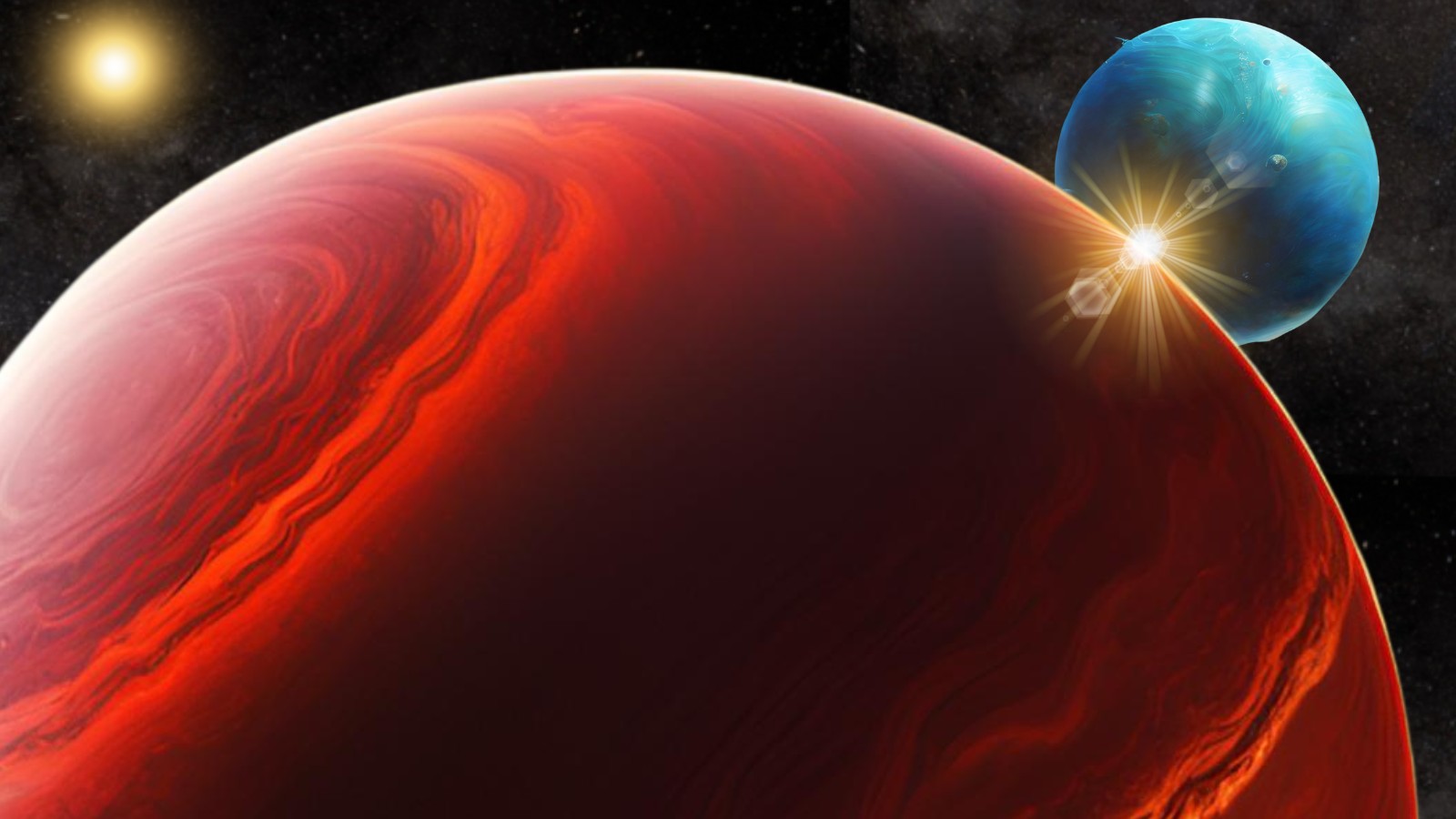
Astronomers have detected unusual orbital behavior in an exoplanet 133 light-years from Earth, hinting at the presence of an extraordinarily massive moon. If confirmed, this exomoon would challenge conventional definitions of what constitutes a “moon,” potentially being half the mass of Jupiter. The discovery relies on precise measurements of the planet’s wobble, a gravitational signature indicating the pull of an unseen companion.
The Discovery of HD 206893 B’s Anomaly
The gas giant, HD 206893 B, orbits a young star and exhibits a peculiar wobble in its orbit. This wobble, detected using the GRAVITY instrument at the Very Large Telescope in Chile, suggests a large, unseen object is gravitationally influencing the planet.
“What we found is that HD 206893 B doesn’t just follow a smooth orbit around its star. On top of that motion, it shows a small but measurable back-and-forth wobble,” explained University of Cambridge astronomer Quentin Kral. The wobble occurs with a nine-month period, consistent with a large moon in orbit.
Astrometry and the Hunt for Hidden Companions
The team employed astrometry, a method of precisely tracking celestial body positions over time. This technique allows for the detection of subtle gravitational “tugs” from unseen objects. Unlike previous studies focused on long-term planetary orbits, this research monitored HD 206893 B over just months, revealing the telltale wobble. The potential exomoon orbits at roughly one-fifth the distance between Earth and the sun, tilted at a 60-degree angle, possibly due to past gravitational disturbances.
Redefining What a Moon Is
The estimated mass of this potential exomoon is staggering: around 40% of Jupiter’s mass, nine times the mass of Neptune. Such size raises fundamental questions about categorization.
“This naturally raises the question of whether such an object should even be called a moon,” Kral said. “At these masses, the distinction between a massive moon and a very low-mass companion becomes blurred.” Currently, there is no official definition of an exomoon; any orbiting body is generally considered a moon.
Why This Matters
Exomoon detections are notoriously difficult. Unlike exoplanets, which are often found using the transit method (measuring dips in starlight as they pass in front of their stars), moons produce extremely faint signals. The current study’s astrometric approach is promising because it is sensitive to longer-period moons at greater distances, where stable orbits are more likely.
“As observational techniques improve, our definitions and understanding of what constitutes a moon will almost certainly evolve.”
This discovery not only pushes the boundaries of our understanding of planetary systems but also establishes a roadmap for future exomoon research. The first confirmed exomoons are likely to be the most massive examples, but as technology advances, smaller and more numerous moons will become detectable.
The confirmation of this exomoon would mark a paradigm shift in planetary science, forcing us to reconsider the very definition of a moon and expand our understanding of the diversity of celestial bodies beyond our solar system.