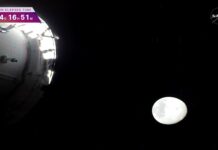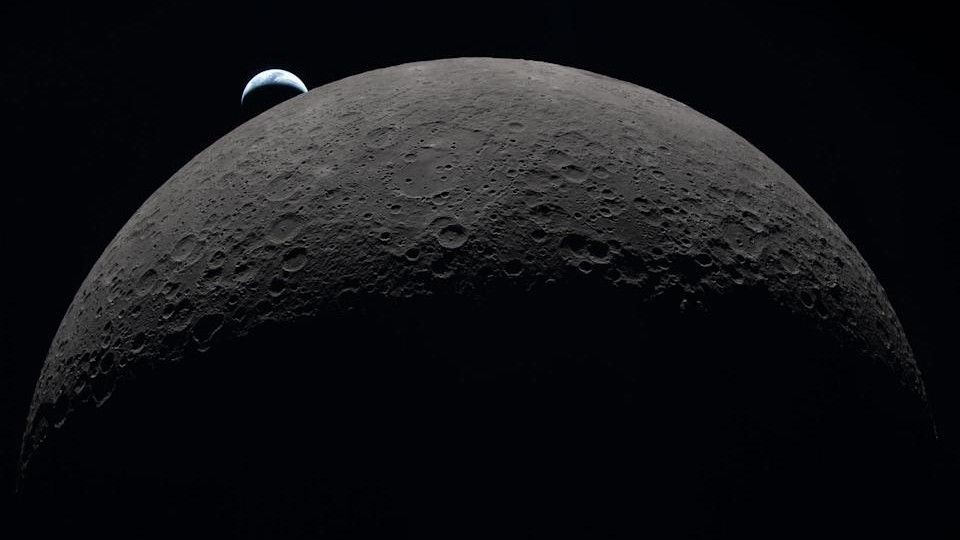
NASA has released a groundbreaking collection of images captured by the Artemis II crew during their historic flyby of the lunar far side. These visuals offer humanity its first direct look at the moon’s hidden face through the eyes of living astronauts, marking a significant leap in our lunar exploration capabilities.
A New Perspective: “Earthset” and Solar Eclipses
The mission has provided two particularly striking visual phenomena that redefine our relationship with the cosmos:
- The “Earthset”: In a poetic mirror to the famous 1968 “Earthrise” photo, the crew captured an “Earthset”—the moment our home planet disappears behind the rugged, cratered horizon of the moon. The image shows the advancing shadow of night sweeping across Earth, a reminder of the billions of people living below as the crew ventured into deep space.
- A Lunar Solar Eclipse: For the first time in history, humans have witnessed a solar eclipse from behind the moon. As the spacecraft dipped into the lunar shadow, the crew experienced roughly 40 minutes of total radio silence, allowing them to observe the sun’s corona—described by the crew as “baby hairs”—forming a glowing halo around the lunar disk.
“When we were on the far side of the moon, looking back at Earth, you really felt like you weren’t in a capsule… It really just bent your mind,” said mission specialist Jeremy Hansen.
Discoveries on the Lunar Surface
The flyby was not merely a visual journey but a scientific one. Unlike the Apollo missions, which followed different flight paths, the Artemis II trajectory allowed the crew to view the entire far side of the moon. This vantage point led to several key observations:
- New Lunar Craters: The crew identified two previously unknown craters. In a gesture of tribute, they requested they be named Integrity (after the crew capsule’s call sign) and Carroll (in honor of commander Reid Wiseman’s late wife).
- Active Lunar Dynamics: The astronauts documented multiple impact flashes, capturing the “real-time” creation of new craters as meteors struck the lunar surface.
- Visual Complexity: The crew noted unexpected green and brown hues across the landscape and marveled at the “terminator”—the line dividing light and shadow—which created deep, black valleys and islands of light.
Breaking Records and Changing Perspectives
The mission pushed the boundaries of human reach. Reaching a maximum distance of 252,760 miles (406,777 km) from Earth, the crew broke the previous record for the farthest humans have ever traveled by approximately 4,100 miles.
Beyond the technical achievements, the mission highlighted the profound psychological impact of deep-space travel. The crew reported a renewed sense of connection to our home planet, noting that the vastness of space serves to emphasize Earth’s fragility and self-sufficiency.
Why This Matters
This mission represents more than just a record-breaking distance; it is a vital step in transitioning from “visiting” the moon to “understanding” it. By capturing high-resolution data and real-time observations of lunar activity, NASA is gathering the essential clues needed to understand the geological evolution of both the Moon and Earth.
Conclusion: The Artemis II flyby has successfully combined record-breaking distance with unprecedented scientific discovery, providing humanity with a new visual and emotional connection to our place in the solar system.