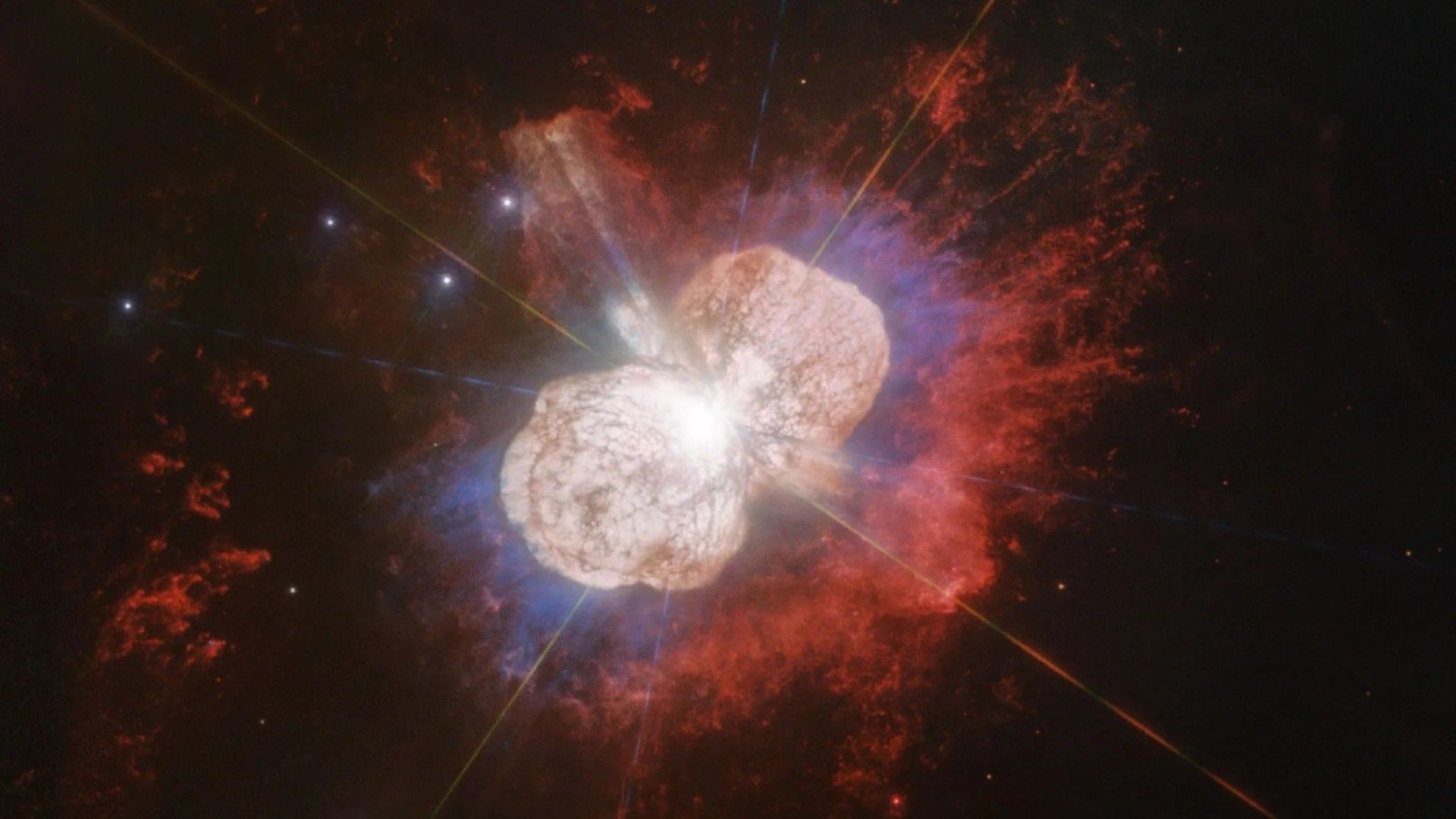
When a star flares up to thousands of times its normal brightness, it looks like a cosmic catastrophe in the making. Observers might expect a supernova—a violent explosion that destroys the star. But sometimes, the star survives. These deceptive, non-fatal eruptions are known as “supernova impostors.”
For decades, astronomers have struggled to understand why these massive stars behave so erratically. They eject huge amounts of material in a process called eruptive mass loss, yet the underlying mechanisms have remained elusive. A new study, however, has cracked a key part of the puzzle by linking these outbursts to a star’s chemical composition.
The Modeling Problem
Understanding supernova impostors is difficult because these events are sporadic. Current observational methods, such as infrared or radio monitoring, typically capture only the immediate aftermath of an eruption. They provide a snapshot of “now” rather than a comprehensive history of the star’s behavior. This makes it hard to measure exactly how much mass is lost over time.
This observational gap creates a significant bottleneck for theoretical astrophysics. Computer models used to simulate stellar evolution—essentially predicting how stars live and die—often fail when applied to the most massive stars. The simulations frequently “sputter out” before the star reaches the end of its life.
The primary culprit is eruptive mass loss. Models attempt to account for this by simulating conditions where radiation pressure pushes material off the star, exceeding its stable luminosity limit (known as super-Eddington conditions). However, these models rely on a critical “efficiency parameter” —a variable that determines the strength of the outburst. Until now, this value was essentially a guess, an unconstrained variable that prevented accurate predictions.
A New Approach: Galactic Census
To resolve this uncertainty, a team of astronomers led by Shelley J. Cheng from the Center for Astrophysics | Harvard & Smithsonian, along with colleagues Charlie Conroy and Jared A. Goldberg, took a different approach. Instead of focusing on individual stars, they analyzed stellar populations across the Local Group—our galaxy’s nearest neighbors, including the Small Magellanic Cloud, the Large Magellanic Cloud, and the Andromeda Galaxy (M31).
The team utilized data from wide-field surveys like PanSTARRS1, which have revolutionized our ability to detect luminous transients and map red supergiants in distant galaxies. Red supergiants are massive, swollen stars in their late evolutionary stages, making them ideal candidates for studying eruptive mass loss.
Using sophisticated MESA stellar evolution models, the researchers created “mock” stellar populations. They adjusted the mysterious efficiency parameter in their simulations to see how it affected the predicted brightness and distribution of these stars. They then compared these simulated galaxies against actual observational data.
The Metallicity Connection
The comparison revealed a clear and significant trend: the efficiency of eruptive mass loss is directly linked to metallicity.
Metallicity refers to the abundance of heavy elements (anything heavier than hydrogen and helium) in a star. The study found that stars with higher metallicity experience more violent eruptions. In simpler terms, the more “heavy” elements a star contains, the more material it tends to eject during outbursts.
Key Finding: There is a positive correlation between metallicity and the intensity of eruptive mass loss. High-metallicity stars are far more prone to dramatic, supernova-like outbursts than their low-metallicity counterparts.
Implications for Stellar Evolution
This discovery has profound implications for how we understand the life cycles of massive stars. The calibrated models show that stars with initial masses greater than 20 times that of the Sun may never become red supergiants at all.
Due to the intense mass loss driven by high metallicity, these colossal stars shed so much material early in their evolution that they skip the red supergiant phase entirely. Instead, they follow a different evolutionary path, potentially altering the types of remnants they leave behind after their eventual death.
What Comes Next?
While this study provides a robust explanation for eruptive mass loss in our local galactic neighborhood, the work is not complete. Astronomers must now test this metallicity-mass loss relationship in more distant and diverse galaxies to confirm it is a universal trend.
Future research will also need to determine why this relationship exists. Does metallicity affect the trigger of the eruption, or does it primarily influence the amount of material ejected?
For now, the saga of supernova impostors highlights just how dynamic and complex stellar life cycles are. By refining our models with real-world data, we are moving closer to understanding not just how stars shine, but how they violently reshape the universe around them.