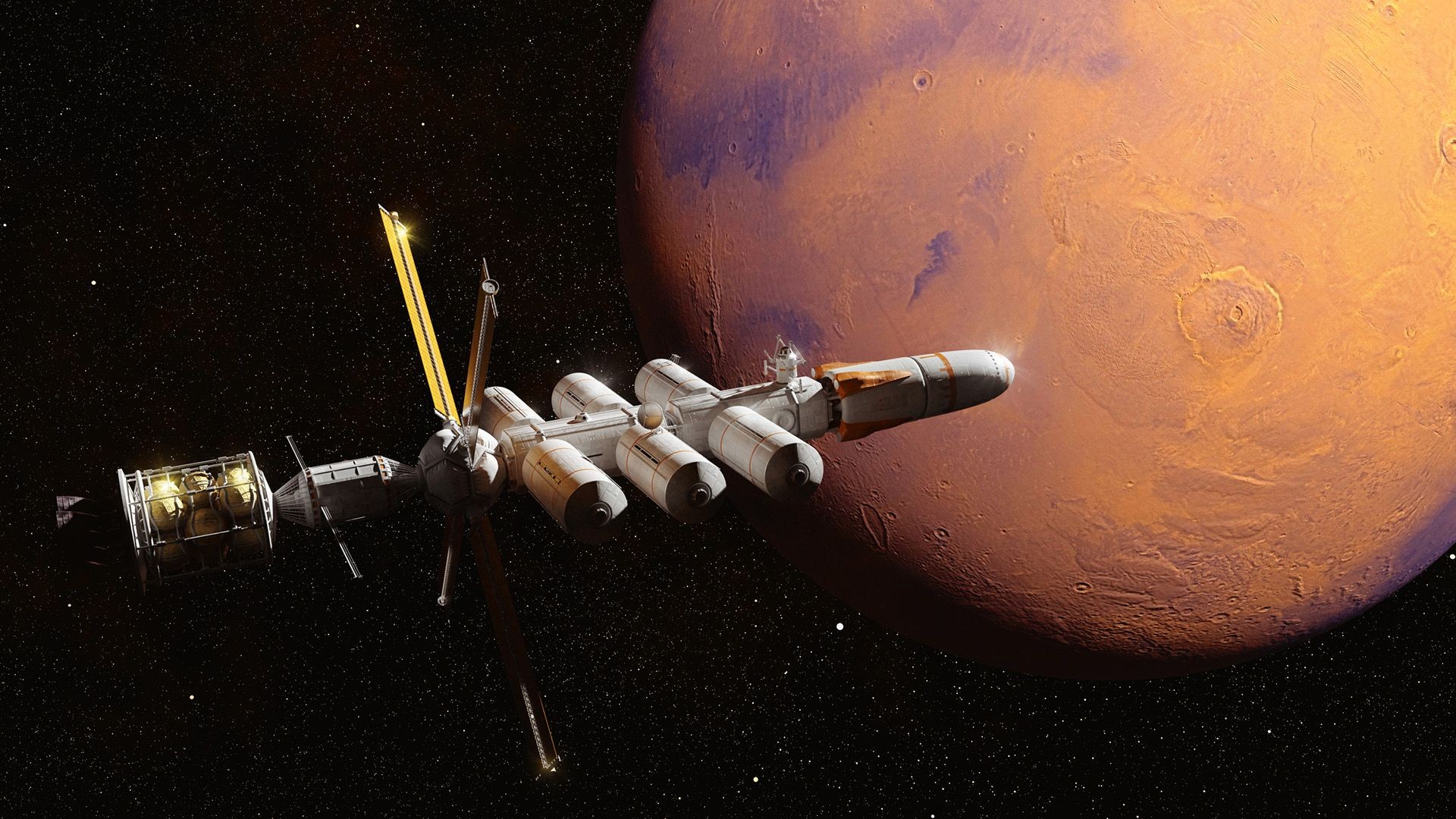
A groundbreaking study suggests that astronauts could one day complete a round-trip mission to Mars in less than six months—a timeline that cuts current mission durations nearly in half. This potential leap in interplanetary travel stems not from advanced propulsion theories, but from an accidental discovery made by analyzing early, imprecise orbital data of near-Earth asteroids.
The findings, published in the journal Acta Astronautica, challenge the long-held assumption that Mars missions require lengthy waits and slow transfers. By leveraging geometric clues from asteroid trajectories, scientists have identified specific windows where rapid transit is mathematically possible, offering a new blueprint for future exploration.
The Problem with Current Mars Missions
Under existing mission architectures, traveling to Mars is a slow and logistically complex endeavor. Because Mars orbits farther from the Sun than Earth, spacecraft must wait for the two planets to align in a fuel-efficient configuration, known as a “transfer window.” These windows open only once every 26 months.
Consequently, a typical mission profile looks like this:
– Outbound Journey: 7 to 10 months.
– Surface Stay: Variable, often months to await the next return window.
– Return Journey: 7 to 10 months.
Total Mission Time: Approximately two to three years.
This extended duration exposes astronauts to significant risks, including prolonged radiation exposure, muscle atrophy, and psychological strain. Reducing this timeline is critical for making human Mars missions safer and more sustainable.
An Accidental Breakthrough
The concept for faster travel emerged from the research of Marcelo de Oliveira Souza, a cosmologist at the State University of Northern Rio de Janeiro in Brazil. In 2015, Souza was studying the orbits of near-Earth asteroids to assess impact risks. He focused on an object named 2001 CA21, which early estimates suggested followed a rare path crossing both Earth’s and Mars’ orbital zones.
“I was not looking for this,” Souza told Live Science. “Maybe I was in the right place at the right time.”
While later observations refined the asteroid’s true trajectory, discarding the initial data as inaccurate, Souza realized that the early, imprecise geometric estimates contained valuable insights. These initial calculations hinted at “ultra-short” routes between the planets that standard orbital mechanics often overlook.
From Theory to Feasibility
Souza’s initial calculations for the October 2020 Mars opposition suggested a theoretical trip time of just 34 days. However, this extreme speed required departure velocities of 32.5 kilometers per second (km/s) and arrival speeds of roughly 108,000 km/h (64,800 mph). Such velocities are currently beyond the reach of existing rocket technology and would make safe landing impossible with current systems.
Recognizing these limitations, Souza refined his model to find trajectories viable for near-term technology. He applied Lambert analysis —a standard method for calculating paths between two points in space—to future Mars oppositions in 2027, 2029, and 2031. He constrained the paths to stay within 5 degrees of the asteroid’s orbital tilt, ensuring the geometry remained similar to the promising early estimates.
The analysis revealed that the 2031 alignment offers the most viable opportunity for rapid travel using upcoming propulsion capabilities.
The 2031 Mission Profile
According to the study, a round-trip mission launched in April 2031 could be completed in just 153 days (roughly five months). Here is how that timeline would unfold:
- Departure: Earth launch on April 20, 2031, at approximately 27 km/s.
- Transit: Arrival at Mars on May 23, after a 33-day journey.
- Surface Operations: A 30-day stay on Mars.
- Return: Departure from Mars on June 22, arriving back on Earth by September 20.
Additionally, Souza identified a lower-energy alternative within the same window. This option would require a slower launch speed of 16.5 km/s but would extend the mission to 226 days (about 7.5 months). Even this slower option represents a significant reduction compared to traditional multi-year missions.
Technological Implications
While the 2031 trajectory is theoretically sound, its practical implementation depends heavily on advancements in spacecraft design and propulsion. The required velocities are comparable to those achieved by NASA’s New Horizons probe, which launched in 2006 at 16.26 km/s—the fastest launch from Earth at that time.
However, New Horizons was a lightweight, single-purpose probe. Carrying humans, life-support systems, and return fuel requires significantly more mass and energy.
The study suggests that next-generation heavy-lift rockets, such as SpaceX’s Starship or Blue Origin’s New Glenn, may possess the necessary power to achieve these speeds. If these vehicles can deliver payloads to escape velocity with the required precision, they could unlock these rapid transit corridors.
Why This Matters
This research shifts the conversation from “if” we can go faster to “how” we can engineer the systems to do so. By identifying specific geometric opportunities, scientists can narrow the search for viable trajectories, allowing engineers to design propulsion systems and spacecraft structures tailored to these high-speed demands.
In summary, while human missions to Mars in 2031 remain theoretical, this accidental discovery provides a concrete mathematical pathway to drastically reduce travel time, turning a multi-year ordeal into a matter of months.