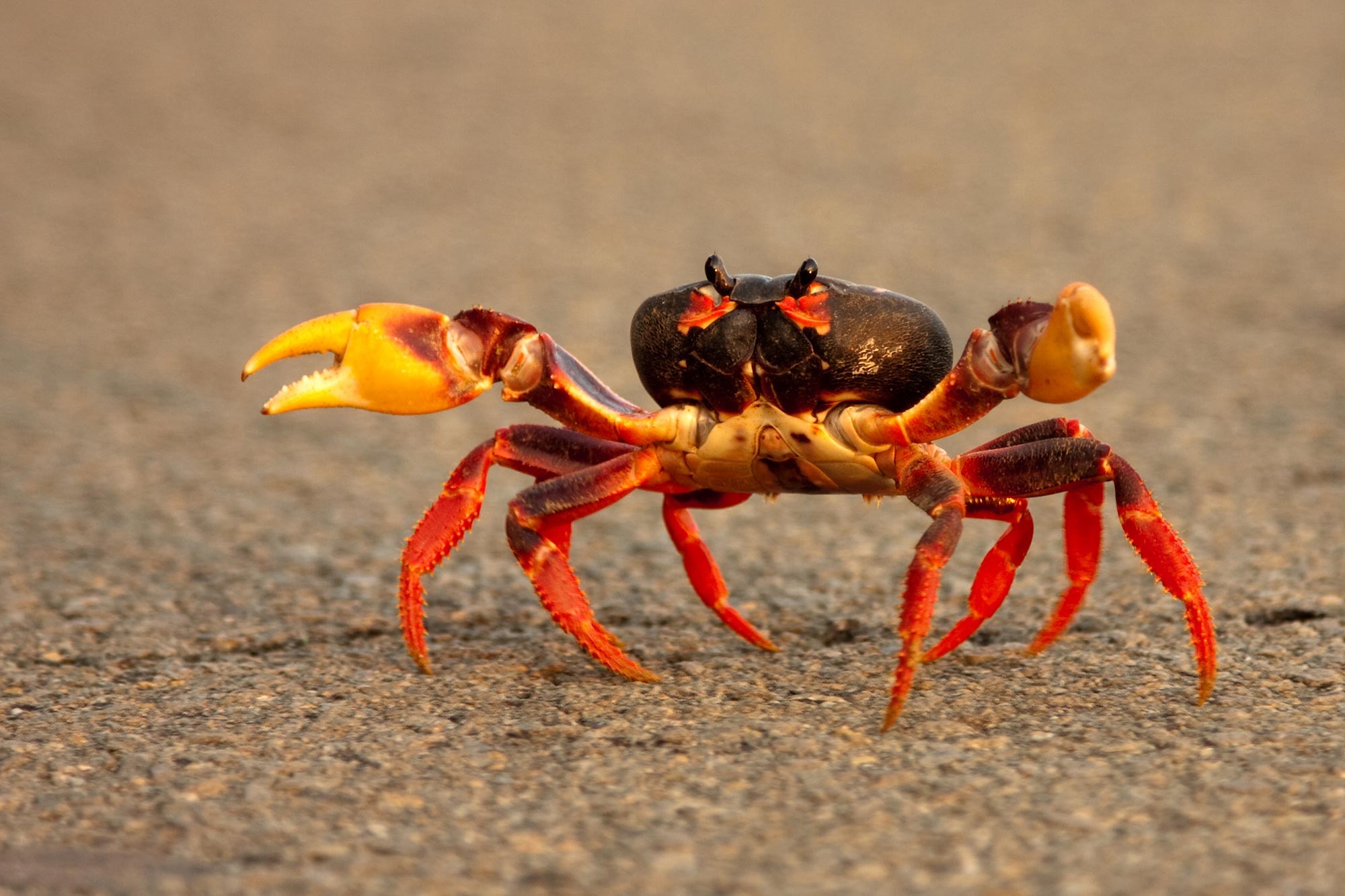
For centuries, the sideways walk has been the crab’s most recognizable trait—a quirky, almost comical movement that sets them apart from nearly every other animal on Earth. But this peculiar gait is far from a random evolutionary accident. New research suggests it was a singular, pivotal innovation that occurred roughly 200 million years ago, fundamentally altering the trajectory of crustacean evolution.
Published in eLife, a comprehensive study reveals that sideways locomotion likely evolved only once in the lineage of “true crabs” (Brachyura). This finding challenges previous assumptions that such behaviors might have emerged repeatedly across different species. Instead, it points to a specific moment in the Jurassic period where a single ancestral shift provided a survival advantage so significant that it became the defining characteristic of an entire group.
Decoding the Crab’s Gait
True crabs represent the largest and most diverse group of crab-like decapods, with nearly 8,000 species inhabiting environments ranging from deep-sea trenches to terrestrial beaches. Their success is often attributed to “carcinization”—the repeated evolutionary process where non-crab animals evolve crab-like body shapes. However, while body shapes converge frequently, behavior does not.
Until now, scientists lacked a clear picture of when and how sideways walking originated. The new study, led by Yuuki Kawabata of Nagasaki University, sought to answer three critical questions:
* When did sideways locomotion first appear?
* How many times did it evolve independently?
* Did any lineages revert to forward walking?
To find answers, the researchers combined direct behavioral observations with genetic data. They filmed 50 species of true crabs in controlled, habitat-mimicking arenas, recording their movement patterns for 10 minutes each. These observations were then mapped onto a robust evolutionary tree derived from DNA sequences of 344 crab species.
A Singular Evolutionary Event
The results were striking. Among the 50 species observed, 35 moved primarily sideways, while 15 walked forward. When these behaviors were plotted against the evolutionary history of true crabs, a clear pattern emerged: sideways walking evolved only once.
This single event occurred in a forward-walking ancestor near the base of the Eubrachyura lineage—the group comprising most modern, “advanced” crabs. From that point onward, the sideways gait was preserved across millions of years of evolution.
“This single event contrasts starkly with carcinization, which has occurred repeatedly across decapod species,” explains Kawabata. “This highlights that while body shapes may converge multiple times, behavioral changes such as sideways walking can be rare.”
This distinction is crucial for understanding evolutionary biology. It suggests that while nature often finds similar physical solutions to similar problems (hence the many crab-like shapes), complex behavioral shifts are far more constrained and difficult to evolve.
Why Sideways? The Survival Advantage
So, why did this specific movement stick? The researchers propose that sideways locomotion offered a distinct survival advantage, particularly in evading predators. By moving laterally, crabs can escape in less predictable directions, making it harder for hunters to anticipate their path. This agility likely contributed significantly to the ecological dominance of true crabs, allowing them to colonize diverse habitats worldwide.
However, the study also notes that sideways walking is not without costs. It can interfere with other essential behaviors, such as burrowing, feeding, and mating. This trade-off may explain why the trait did not evolve more frequently or why some lineages retained forward walking. The behavior appears unique to true crabs, with only minor parallels in unrelated animals like crab spiders and leafhopper nymphs.
Timing and Opportunity
The emergence of sideways walking coincides with a major geological and ecological shift: the end of the Triassic period and the beginning of the Jurassic, approximately 200 million years ago. This era was marked by the breakup of the supercontinent Pangaea, the expansion of shallow marine habitats, and the “Mesozoic Marine Revolution,” a period of intense evolutionary arms races among ocean life.
These environmental changes created new ecological niches and opportunities. The combination of a novel movement style and a changing world likely allowed true crabs to diversify rapidly. While sideways walking provided the mechanical advantage, the environmental context provided the stage for their success.
Conclusion
The sideways walk of the crab is more than a curiosity; it is a testament to the power of singular evolutionary innovations. By evolving this unique gait just once, 200 million years ago, true crabs unlocked a survival strategy that has endured through mass extinctions and geological upheavals. This study not only clarifies the history of crab locomotion but also underscores how rare behavioral shifts, when aligned with environmental opportunity, can shape the destiny of entire animal groups.