Richard Feynman thought he knew physics.
He famously puzzled over why a standard lawn sprinkler spins one way but its reverse—sucking water in instead of shooting it out—behaves so differently. For decades, the “Feynman sprinkler problem” sat open. No one could quite agree on the mechanics.
Now, researchers have settled it. They did not use high-tech particle accelerators or wind tunnels.
They used “silly sprinklers.” The kind with looping, spiraling plastic tubes that kids throw on lawns every summer. By testing these quirky backyard devices in reverse, a team from NYU and the Colorado School of Mines finally cracked how flowing water spins objects.
The results appeared in Proceedings of the National Academy of Sciences.
What Is Feynman’s Sprinkler Actually Asking?
It sounds simple.
Take a standard rotary sprinkler. Water pressure pushes liquid out of angled nozzles. The reaction force spins the arm. Newton’s third law. Action and reaction. It works like a rotating rocket.
Now reverse it.
Suck the water in through those same nozzles. Which way should it spin? Intuition suggests it should spin the opposite direction of the standard sprinkler.
Feynman tried this in the 1980s. He couldn’t get a clear answer. The device barely moved.
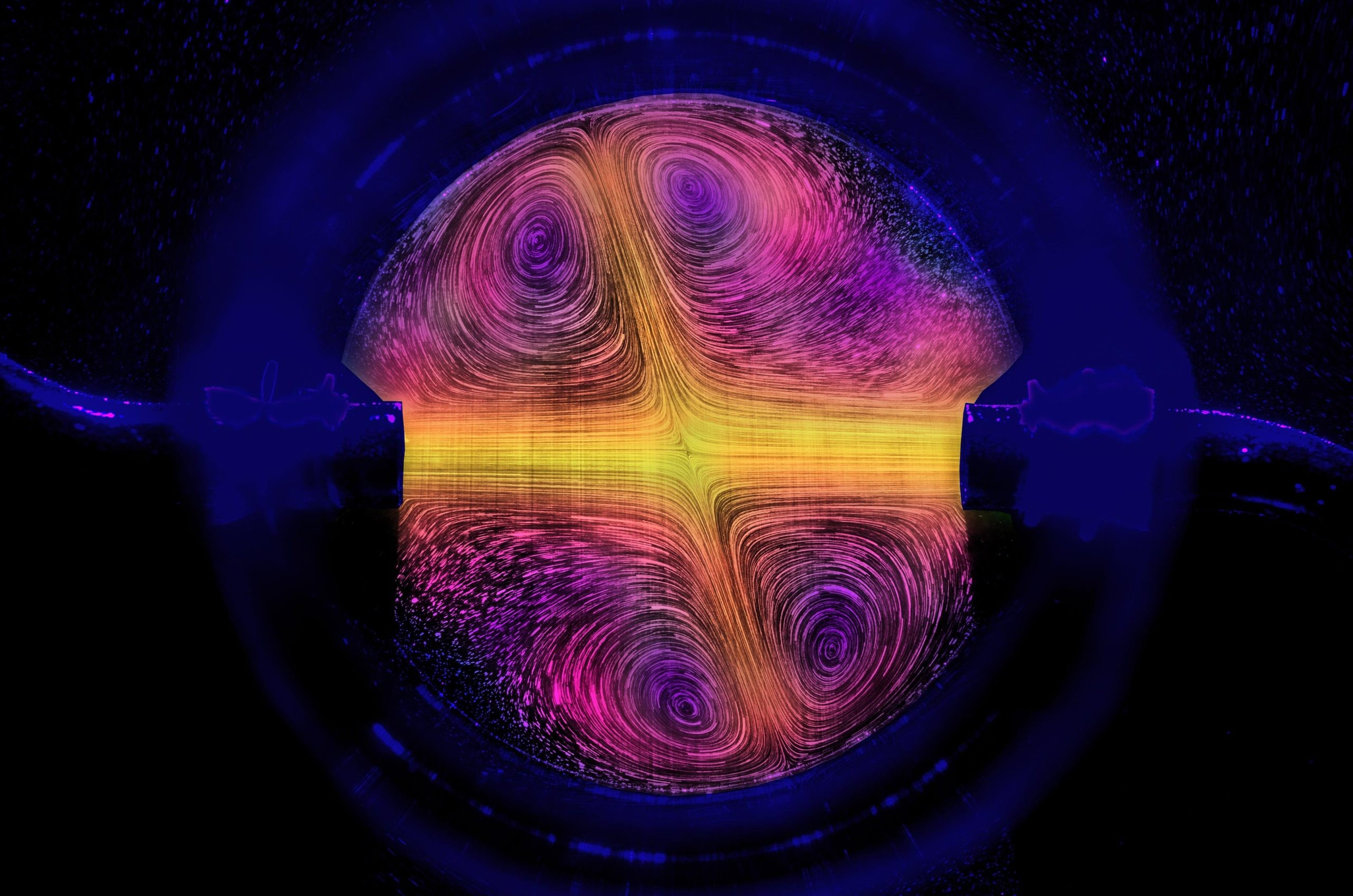
The new study explains why. It is not about the water entering the nozzle. It is about what happens when two jets of inward-flowing water collide inside the central chamber.
How Loop Shapes Control Water Torque
Previous experiments used simple S-shaped arms. That left gaps in the theory. Did the shape of the tube matter? What if the water took a longer path?
The researchers built their own collection of sprinklers. They varied the geometry wildly. Loops. Curves. Winding paths.
They tested each design in two modes:
- Forward: Spraying water out.
- Reverse: Drawing water in.
This allowed them to measure torque precisely. Torque is the twisting force that causes rotation. They also tracked how the water moved inside the tubes versus outside.
The data was clear.
Why Momentum Flux Beats Other Theories
Two older theories failed under scrutiny.
One, proposed by Ernst Mach in the 1880s, argued that the fluid swirls one way while the sprinkler turns the other. The new experiments showed this did not account for the measured rotation or torque.
Another theory focused on water flowing around the outside of the sprinkler arms. Feynman had considered this. It turned out to be irrelevant. The exterior flow did not affect the motion.
Instead, the momentum flux theory won.
Here is how it works:
When water is sucked in, two jets enter the central chamber from opposite sides. They do not hit each other perfectly head-on. There is a slight offset. A collision zone forms. This imbalance creates a net force. That force pushes the sprinkler to rotate.
It functions like an “inside-out rocket.”
“This work provides the experimental answer for Feynman’s Sprinkler Problem by showing, across sprinkler types, how the angular momentum flows drives sprinklers’ rotation,” said Leif Ristroph of NYU.
Does This Matter Outside the Backyard?
It is not just about lawn games.
Understanding how fluids apply force to rotating bodies is fundamental engineering. Turbines, pumps, and marine propellers all rely on converting fluid flow into mechanical energy.
Brennan Sprinkle from the Colorado School of Mines noted the findings offer a “firmer understanding” for designing such devices. If you know exactly how shape controls momentum flux, you can build better turbines. You can predict how they will behave in turbulent conditions.
The team also found that tweaking the arm shape allows for control. You can alter the water jets to manage the torque. That is useful knowledge for engineers trying to optimize energy conversion.
So, next time you see a silly sprinkler spinning on the grass, do not just laugh.
Watch the loops. Think about the collision inside. It might just be solving a century-old physics debate.