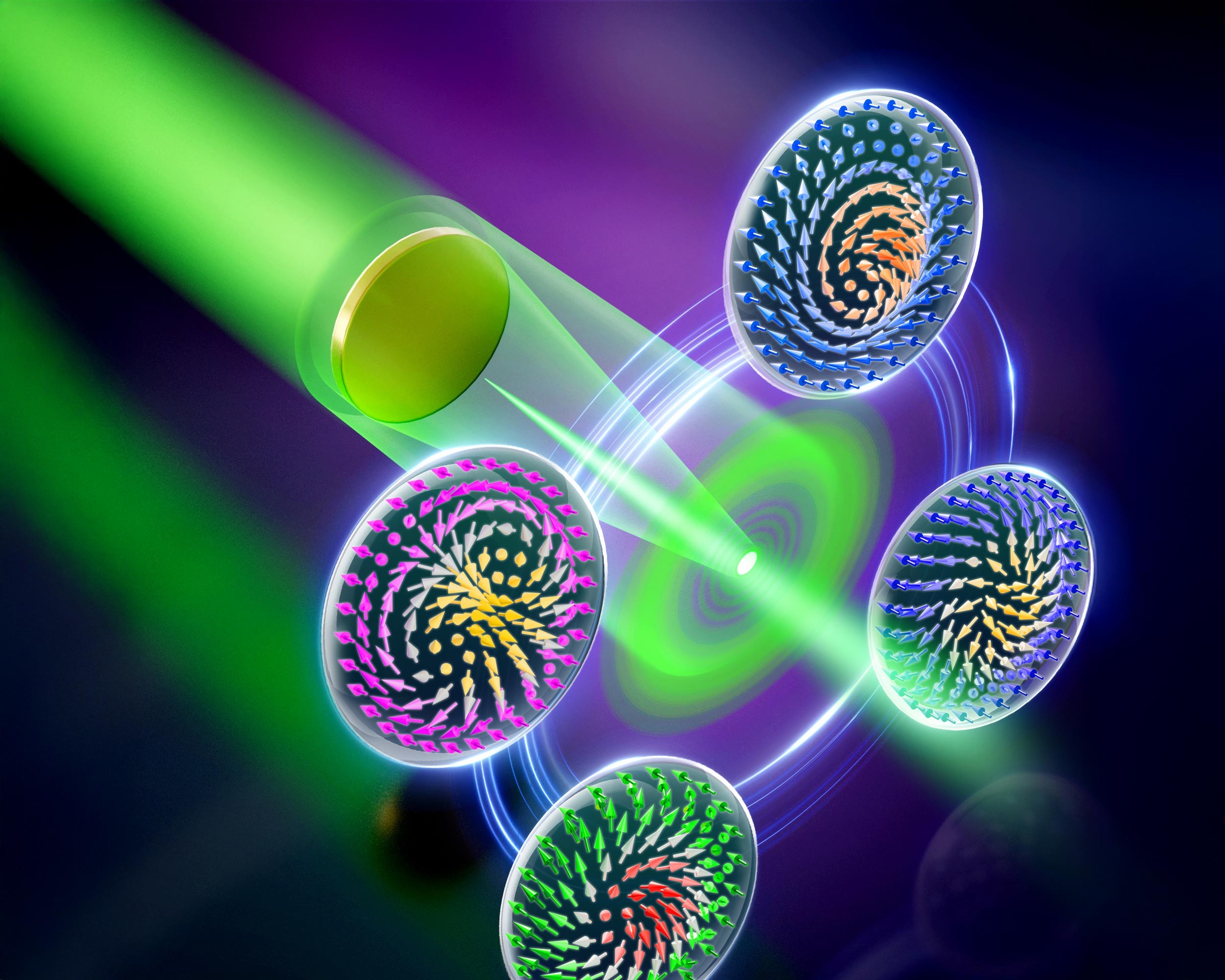
A simple laser setup is doing heavy lifting in modern physics. Scientists at Nanyang Technological University in Singapore have found an unexpectedly cheap way to generate exotic light structures called optical skyrmions. They ditched the high-cost, custom-made metamaterials usually required for this job. Instead, they leaned on a light-bending phenomenon dating back two centuries.
The method turns the Poisson spot into a tool. That’s it. A laser hits a small disc. Diffraction takes over. The result is a stable, swirling pattern in the light. These structures resemble hedgehog spines, or so the researchers say. They matter because skyrmions hold information. Stable, compact, and robust. Perfect for future data storage. Perfect for optical computing.
The Poisson spot: From 19th-century bet to photonics engine
To understand why this is cool, you have to look at the history. Or rather, the bet. Back in the early 1800s, physicists argued over light’s true nature. Particle or wave? Siméon Poisson, a supporter of the particle view, did some math on wave theory. He predicted that a bright spot should appear in the dead center of a circular shadow.
Naturally. Because nothing good happens in a shadow’s center.
If the shadow’s heart was truly dark, wave theory was dead. It wasn’t. A bright point appeared. The wave theory won the argument. That point is now the Poisson spot. It proves diffraction exists. Light bends. It spreads. It wraps around corners.
Asst. Prof. Shen Yijie and his team at NTU used this basic diffraction to create skyrmions. No fancy materials. Just light hitting an object and behaving as nature intends.
“Optical skyrmions can now be generated… without relying on expensive, complex man-made materials or highly specialized techniques.”
It’s a massive simplification. Previously, creating these structures meant building expensive micro-structures designed specifically to twist light. This? A disc. A laser. Diffraction. Lower technical barrier means more labs can play in this sandbox.
Generating four skyrmions in one beam
The setup doesn’t just make one skyrmion. It makes four. Simultaneously. Inside a single light field.
The team identified:
1. Spin skyrmions: Relating to the rotational character of the light.
2. Stokes skyrmions: Described by polarization vectors (how light vibrates).
3. Electric-field skyrmions.
4. Magnetic-field skyrmions.
Think of it like having four different maps of the same territory, all drawn on one page. Computer simulations show these as swirling arrows. The arrows show how electric, magnetic, and spin properties shift direction as you move away from the center of the Poisson spot.
Why does this clustering matter? Isolation studies can hide relationships. By holding these components in one place, researchers can see how they connect. Electric and magnetic properties might link in ways we haven’t seen before. If the structure stretches or distorts, it holds. Stability is key for carrying data.
Why optical skyrmions beat traditional memory approaches
Skyrmions originated in particle physics. Then moved to magnetic materials. Now they’re here, in photonics. Why the pivot? Because magnetic storage is hitting physical limits. It’s getting harder to shrink bits down further. Light doesn’t heat up. Light travels at light speed. And optical skyrmions are tiny. Stable.
Traditional creation methods required metamaterials—artificially engineered micro-structures. Effective, sure. But expensive. Hard to scale. Hard to access.
The Poisson spot method bypasses this. It relies on natural laws. This accessibility is the real breakthrough. It’s not just about making the light. It’s about inviting a broader scientific community to tinker with topological optics. If any university with a decent laser and a coin-sized disc can make these structures, the field moves faster.
The future of topological photonics
This research doesn’t just add to a pile of papers. It changes how we view the Poisson spot. Not just as a historical curiosity, but as a versatile workshop. Adjusting the conditions—the wavelength, the disc size—lets researchers tune the size and shape of these skyrmions. Precise control leads to reliable devices.
The study was led by NTU’s Shen Yijie, alongside Jun Yao, Xi Xie, and others. The work landed in Optica. The implications stretch toward information processing. And perhaps, eventually, toward computers that process information with light instead of electrons. No resistive heating. No signal decay over long distances in the same way.
Will it replace silicon? Unlikely tomorrow. But it offers a new pathway. One built on light bending around a corner.
The research is available as “Optical skyrmions in Pisson spots.” A solid reminder that sometimes, the answers we’ve been missing are hiding in the shadows, waiting for the right angle.