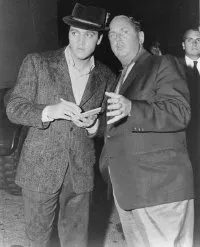
Elvis Presley was the sound. Colonel Tom Parker was the architect.
Parker was more than just a manager. He was a mystery wrapped in a suit, a man who guided the only artist in his career to heights that still seem almost mythical today. But this wasn’t magic. It was strategy. Cold, calculated, and slightly terrifying.
Consider the spring of 1955. Elvis was adding “Baby Let’s Play House” and “I’m Left, You’re Right, She’s Gone” to his setlist. He wasn’t just singing. He was provoking.
By February 1956, just months later, Elvis appeared on The Dorsey Brothers’ Stage Show. He performed “Baby Let’s Play House.” The performance was sensual. The lyrics were dangerous. The song was a proposition. The singer asks his girlfriend to come back so he can “play house” with her. In the mid-50s, that slang meant living together. Sleeping together. Unmarried. It was a scandal in a song.
“I’d rather see you dead than with another man,” the lyrics declared. Confrontational. Raw.
This wasn’t happening in a vacuum. Elvis was touring with country star Hank Snow in the spring of ’55. The tour was organized by Hank Snow Jamboree Attractions. But the man running the show? Colonel Tom Parker.
The Carnival Barker Behind the Colonel Title
Parker came from the world of carnivals. That background explains everything about his management style. It explains the hustle. It explains the lack of boundaries.
There are stories. Some are true. Some are embellished.
He once covered a hot plate with straw and placed baby chickens on top to make them “dance” to “Turkey in the Straw.” Another tale claims he painted sparrows yellow and sold them as parakeets. These are carny stories. They paint a picture of a man who viewed reality as something to be manipulated for entertainment.
Before Elvis, Parker managed Eddy Arnold. He turned a relative unknown into a star. He understood the mechanics of fame.
He held the title “Colonel.” Not military rank. Honorary. The state of Louisiana bestowed it upon him in 1953. Tennessee followed later. It added gravitas. It added distance. It made him untouchable.
The Jacksonville Incident and the Shift in Power
By mid-1955, Elvis’ audience was young. Female. Feral.
Teenage girls screamed during his shows. Elvis learned to play to them. He teased their imaginations with hip swivels. He pushed the button that made them lose their minds.
In Jacksonville, Florida, something broke.
Elvis joked that he’d meet the girls backstage after a performance. It was supposed to be a gag. A harmless tease.
It wasn’t.
A swarm of screaming girls chased him. They caught up to his car. They tore at his clothes. They stripped him down.
His mother was terrified. The press was shocked.
Colonel Parker? He was delighted.
Parker had already been monitoring Elvis’ rise with quiet intensity. The incident in Jacksonville proved his point. The audience wasn’t just listening. They were obsessed. And obsession could be monetized.
The Contract That Changed Everything
How did Parker become Elvis’ sole manager? There are many versions.
Parker had a close working relationship with Hank Snow. But when he signed Elvis to a contract, he left Snow out of the deal. Snow didn’t sue. The partnership ended. Parker took the wheel.
In August 1955, Parker and Elvis signed their first agreement. Bob Neal was still on paper as Elvis’ manager. Parker’s role was “special adviser.” His job was to assist in building Elvis as an artist. He got the right to negotiate renewals on all existing contracts.
Neal was kept on as a courtesy.
When Neal’s contract expired on March 15, 1956, he was gone. Parker took over completely. For a 25 percent cut.
Breaking Out of the South
When Parker started taking official control, Elvis was still a country-western singer.
His style wasn’t traditional. His fans were teenagers. But he still toured the country circuits. He still performed with country stars. His records played almost exclusively on country stations.
Parker saw potential that transcended genre. To realize that potential, Elvis needed to be exposed to audiences outside the South. On a wide scale.
This seemed logical. It was also a bold move.
Elvis had never stepped foot outside the South. Northern audiences were unaccustomed to Southern musical traditions. They were unaccustomed to the sound. They were unaccustomed to the man.
Parker’s plan began with one thing: finding a recording company that could give Elvis national and international exposure.
The relationship with RCA Records would define the rest of his career. But that story starts later.
For more fascinating information about Elvis Presley, see:
-
Elvis Presley
-
Elvis Presley Quotes
-
Elvis Presley Collectibles
-
Elvis Presley Songs
-
Elvis Presley Movies