


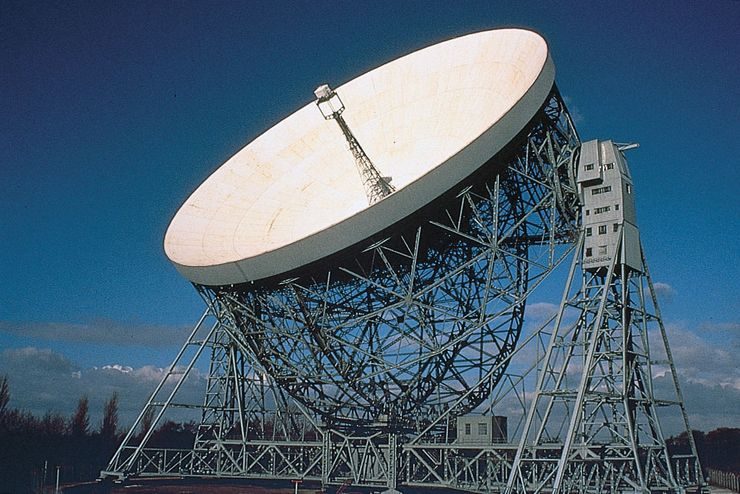
Radio waves cannot be seen with the naked eye. You can’t even feel them. But they are everywhere carrying whispers from the ends of the universe. To catch them, you’ll need ears much bigger than ours.
This is where the radio telescope comes in. This is not a telescope in the traditional sense. There are no glass lenses. There are no mirrors that reflect and focus the light of stars. Instead, it is a giant invisible funnel. The combination of a large antenna and a highly sensitive receiver is designed to pick up signals that most devices miss entirely.
The basic anatomy is simple. You need a dish. Or a series of dishes. You’ll also need a radiometer. This is a fancy word for a receiver that can convert weak electromagnetic noise into data that scientists can actually read. That’s it. Two components. But getting them to work together on the scale required for astronomy is an engineer’s nightmare.
Why is it so big? Because the universe is loud with silence. The radio sources we study were very weak. They traveled light years, losing energy along the way. You need a megaphone to hear the screams from across the continent. So these antennas are huge. The receiver must be sensitive enough to detect the thermal jitter of the atoms without getting lost in the noise.
History clearly demonstrates this process. The first large, fully steerable radio telescope was built in 1957 at Jodrell Bank in England. It changed everything. Suddenly, we’re no longer just pointing at one spot. You can track moving objects. You can scan the sky.
This technology is still evolving.
Currently, the title of the largest fully steerable antenna belongs to the National Radio Astronomy Observatory in Green Bank, West Virginia. This is an off-axis antenna measuring 360 by 330 feet. It is 110 by 100 meters. This is huge. It moves.
But if you ask me which single dish is the biggest, the answer is fixed. The Arecibo Observatory in Puerto Rico holds the record for the 1,000-foot spherical reflector. It didn’t steer. Located in a natural sinkhole, it captures anything that passes overhead. It was an engineering marvel until it collapsed. However, the data it collected is still important for us to understand our place in the Milky Way.
Next is the question of power. Size isn’t everything. Resolution is the currency of astronomy. Can you tell the difference between two stars that are so close together? Or is it just a fuzzy blob?
For this we need a Very Large Array in New Mexico. It isn’t one dish. It has 27 parabolic antennas. They can be rearranged on rails or dispersed over long distances. Together, they work like a telescope with an Angular Resolution equivalent to a 22 miles wide dish. That’s 35 kilometers of baseline.
This is how we map of the Milky Way. How we find pulsars that ticks in the dark? How do we listen to the afterglow of the Big Bang?
You cannot see the universe with a radio telescope. i heard it. It’s more interesting to listen than to watch.

