


Canasta translates to “basket” in Spanish, and the game itself is a basket woven from influences that started in Uruguay. It spread across Latin America during the 1940s before catching fire in the United States in 1950. The rush never really stopped. It is still a staple in card rooms and living rooms today.
If you want to master this classic, you need to look beyond the basic rules. There are variations like Italian Canasta, Pennies from Heaven, and Samba to explore. But first, you have to understand the standard game. How do you deal? How do you score? What are treys, and why does freezing the pack matter? We will break down every mechanic.
The Basics of Standard Canasta
The standard version requires four players. They sit in partnerships, with pairs facing each other across the table. The goal is straightforward: reach 5,000 points or more. You get there by forming melds and canastas. A meld is a group of at least three cards with the same rank. A canasta is a special meld of seven cards that awards bonus points.
The deck is where things get interesting. You use two standard 52-card decks mixed together. That gives you 104 cards. Add four jokers, and you have a total of 108 cards. Make sure the backs of all cards look identical. Mixing distinct decks by accident ruins the game instantly.
Wild cards change the strategy. Jokers and deuces (2s) act as wild cards. They can substitute for any card. But there is a catch. You cannot meld them with natural cards below a four. Natural cards are the 4s, 5s, 6s, and so on. This rule limits how you can use wilds. A three-card meld can contain only one wild card. You need at least two natural cards to support it.
Dealing the Cards
Who deals first? The player to the right of the person who draws the highest card. That person draws from the deck. If they pull a joker, redraw. If two people draw the exact same card, redraw. It sounds simple, but getting the order right sets the tone for the match.
Each player receives ten cards. The rest of the deck forms the stock pile. One card is turned face up next to it to start the discard pile. The player to the dealer’s left goes first. This is standard Canasta protocol.
Why Strategy Matters More Than Luck
You might think Canasta is just luck. It is not. The rules about wild cards and melding create layers of decision-making. When do you meld? When do you hold back? How do you freeze the discard pile to stop opponents from taking it? These questions define the game.
Mastering these nuances separates casual players from winners. You need to know when to risk a wild card and when to save it. You need to read the discard pile. You need to calculate points carefully. One wrong move can cost you the game.
Variations to Explore
Once you get the hang of standard Canasta, look at other versions. Italian Canasta changes the scoring and melding rules slightly. Pennies from Heaven adds a layer of financial strategy. Samba introduces different meld requirements. Each

Dealing the Deck and Setting the Stage
Suits matter when ranks tie. Spades sit at the top, followed by hearts, diamonds, and clubs at the bottom. The player who pulls the second-highest card takes the seat immediately to the dealer’s right. From there, the deal spins clockwise.
Anyone can shuffle the deck. But the dealer holds the final say on when to shuffle. The player to the dealer’s left gets the option to cut the deck.
The dealer hands out 11 cards to each player. One card at a time. Clockwise. Starting with the player on the dealer’s left. The next card flips face up. It becomes the first card on the discard pile. The rest go face down in the center. This is the stock.
If that first face-up card is a joker, a deuce, or a red three, you don’t start with it. You pull the top card from the stock and place it on top. You keep pulling from the stock until you find a natural card—a four or higher. Only then does play begin.
Taking the Lead and Managing the Discard
Play starts with the player to the dealer’s left. It moves clockwise until the hand ends.
Your turn comes around. You have a choice. Take the top card from the stock. Or take the top card from the discard pile.
There is a catch if you choose the discard pile. You must take all the cards in that pile. You can’t just pick the top one and leave the rest. You use that top discard to form a meld. This is how you start building your hand.
Once you draw and meld, you must discard a card. Unless you are going out. If you go out, the game ends.
The discard pile needs to stay organized. Squared up. Neat. Except when specific rules say otherwise later in the hand.
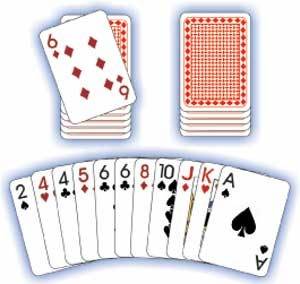


You’re sitting across from your partner. The cards are fresh. The air is thick with the quiet tension of a brand-new game. You hold a 6 in your hand. It looks tempting. It looks like a start.
But here’s the trap most rookies fall into.
You’ve only just met this person. You don’t know their style. Do they hoard? Do they discard early? Do they play aggressively? You have no data. Yet, you’re about to build a set of three 6s on top of whatever else you’ve laid down.
It’s a mistake.
In the opening hand, melding too early, especially with low cards or incomplete sets, can signal your hand’s direction before you’ve even figured out your partner’s. If you drop that 6 to make a triplet, you’re not just playing cards. You’re broadcasting. You’re saying, “I am committed to this suit. I am committed to this number.”
And if your partner has been holding onto those 6s for a different reason? If they’re waiting for a specific discard to complete a larger set? You’ve just blocked their path.
“The first hand isn’t about scoring. It’s about information.”
Think about it. Why rush to declare your strength when the board is still empty?
The Risk of Early Commitment
When you meld a 6 alongside another meld, you’re locking yourself into a specific configuration. If the next card drawn doesn’t fit, you’re stuck. You’ve reduced your flexibility.
Partnerships in card games thrive on adaptability. If you don’t know your partner’s tendencies, you need to keep your options open. Let them lead. Watch their discards. See what they pick up.
- Observe patterns. Do they discard high cards? Low cards?
- Wait for signals. Let them make the first move.
- Stay flexible. Don’t commit to a set until you’re sure it aligns with theirs.
A 6 might seem insignificant. But in the first hand, every card tells a story. And if you start writing yours too early, you might miss the plot twist.
The game is long. The first hand is just the prologue.
Don’t rush the ending.


The Red 3 Rule: Bonus Points or Penalty?
Let’s talk about the treys. Specifically, the red ones. These cards are not played in standard melds. They are bonus cards worth 100 points each, but only if your side has already made an initial meld. If you hold onto a red 3 until the hand ends without melding, it becomes a penalty. Minus 100 points. Ouch.
Handling red 3s is immediate. You must place them faceup on the table the moment you draw or are dealt one.
- From Stock: If you draw a red 3, place it faceup immediately. Draw another card from the stock.
- From Discard: You can take a red 3 from the discard pile, but you must place it faceup and you cannot draw a replacement.
If your team collects all four red 3s by the end of the hand, the bonus doubles to 800 points. That is a massive swing.
Black 3s are different. They stay in play. They cannot be melded with wild cards or used to form standard melds unless you are going out. They also serve as stopper cards for freezing the pack.
How to Take the Pack Without Failing
You can pick up the entire discard pile, known as “taking the pack,” but there are strict rules. You can only do this if you can immediately meld the top card.
The requirements change depending on your team’s progress:
- No Meld Yet: You must use at least two natural cards from your hand to meld with the top discard.
- Meld Already Made: You can use one natural card and one wild card from your hand.
You must also meet the initial meld point requirement using only cards from your hand and the top discard. Any leftover cards from the pile are added to your hand.
Tip: When taking the pack, do not meld everything in it immediately. Keep some cards so you will have natural pairs to take a frozen pack later.
Partners can add cards to each other’s melds. This is how small melds grow into canastas—seven-card melds that define the game.
Canastas: Natural vs. Wild
A canasta must contain at least four natural cards. Wild cards (jokers and 2s) can fill the rest, but they cannot form a meld alone. You also cannot make two melds of the same rank for yourself. If your team has a meld of 6s, you cannot make another. You cannot add to opponents’ melds, however.
Once a canasta is complete, it is squared into a pile. The card on top signals its type:
- Red Card on Top: Natural canasta (no wild cards).
- Black Card on Top: Mixed canasta (contains wild cards).
If you add wild cards to a natural canasta, you must flip the signal card to black. Scoring differs between the two, so accuracy matters.
Freezing the Pack
This is a defensive move that locks the discard pile. The pack is frozen if a black 3 or a wild card is placed on it sideways. No one can take the pack while it is frozen.
To break the freeze, you must show a natural pair from your hand and meld it with the top discard of the same rank.
You can never take the pack if the top card is a wild card or a 3. This rule prevents opponents from easily accessing frozen piles.
Going Out: The Goal
To go out, your team must have at least one canasta. You must have zero cards left in your hand. Discarding is optional at this point. If you don’t go out, you must always hold at least one card. A player with one card cannot take the pack if the discard pile also has only one card.
Before taking from the discard, melding, or adding to a meld, ask your partner: “May I go out?”
- Yes: You must go out.
- No: The game continues.
If the stock runs out, the hand ends. If the last card is a red 3, turn it up and the hand ends immediately with no discarding. If it is not a red 3, play continues as long as the discard pile can be legally taken.
The Concealed Hand Bonus
A concealed hand occurs when you meld your entire hand in one turn and go out. You cannot have made any prior melds or added to your partner’s melds.
This earns a bonus of 200 points, doubling the standard going-out bonus.
If you take from the discard pile, you must meet the initial meld point requirement before accounting for the canasta. If you take from the stock, this requirement is waived.
At any time, you can ask another player to reveal how many cards they hold.
Scoring the Hand
Keep score in columns labeled “We” and “They.”
- Add the value of all melded cards.
- Add bonus points (canastas, red 3s, concealed hand).
- Subtract the value of cards left in each player’s hand.
This includes cards even if they are part of a meld. The final tally determines who wins the round.
The Italian Canasta Variation: Higher Stakes, Faster Play
If standard Canasta felt a bit too measured for your taste, Italian Canasta is the upgrade you’ve been looking for. It takes the core mechanics you already know and cranks up the tension. The goal shifts from steady accumulation to aggressive, high-octane scoring. You aren’t just building melds here; you’re hunting for specific combinations that carry explosive point values.
Why Play Italian Canasta?
The primary draw is the scoring potential. Standard Canasta rewards consistency. Italian Canasta rewards precision and risk. The rules allow for “natural” canastas to be worth significantly more, and the handling of wild cards changes the entire dynamic of your hand. You have to decide when to hold back and when to go all-in. It’s faster. It’s louder. It’s less about patience and more about prediction.
Key Rule Differences
- Natural vs. Mixed Canastas : In this variant, a natural canasta (seven cards of the same rank with no wild cards) is the holy grail. It scores vastly more than a mixed canasta, which includes one or more jokers or deuces. The gap in points creates a tangible hierarchy.
- Wild Card Usage : You can use fewer wild cards in your melds to maximize the value of your natural runs. Every joker you add to a meld lowers the potential score of that specific group.
- Discard Limits : Some versions of Italian Canasta impose stricter limits on discards, forcing players to be more intentional about what leaves their hand.
How to Win at Higher Scores
The strategy pivots around card counting and meld efficiency. You need to track what’s missing from the deck. If you see three 7s have already been played, don’t bother trying to build a 7s canasta. It’s dead in the water. Instead, focus on suits that are still abundant.
“The difference between a good Italian Canasta player and a great one is knowing when a mixed canasta is worth taking versus waiting for a natural one that might never come.”
Scoring Breakdown
| Card Type | Point Value | Notes |
|---|---|---|
| Ace | 20 | High value, but often targeted |
| 2 (Natural) | 20 | Also a wild card in some contexts |
| Joker | 50 | Highest individual card value |
| Natural Canasta | 500+ | The ultimate goal |
| Mixed Canasta | 300+ | Solid, but less rewarding |
Where to Find the Rules
You won’t find this version in every casual game night. It’s popular in specific regions of Europe and among competitive club players. Look for Italian Canasta rule sheets at specialty card shops or online gaming forums dedicated to Rummy-style games. The rules can vary slightly by region, so always agree on the specific scoring table before dealing.
Comparison to Standard Canasta
| Feature | Standard Canasta | Italian Canasta |
|---|---|---|
| Pace | Steady, methodical | Fast, aggressive |
| Scoring Focus | Total melds | High-value natural meld |
The Setup for Italian Canasta
If you think standard Canasta is a breeze, Italian Canasta will humble you pretty quickly. The stakes are higher, the hand sizes are bigger, and the precision required is noticeably sharper. You aren’t just playing for points; you’re hunting for a specific target.
Here is the breakdown of what makes this variation distinct.
The Basics
You need four players for this. Partnerships sit across from each other. The goal isn’t just to win hands, but to accumulate points. Specifically, you need to hit 12,000 points to win the game. That number looms large over every discard and draw.
The Deck
Don’t bother with a single deck. You need three standard 52-card decks mixed together. Throw in six jokers. That gives you a total pool of 162 cards. A crucial detail that trips up beginners: make sure all three decks look identical. If the backs of the cards differ even slightly, the game becomes a nightmare of card-counting rather than strategy.
Melds and Canastas
A meld is any group of three or more cards of the same rank. But the real prize is the canasta. This is a bonus meld consisting of seven cards of the same rank. Forming these is how you chip away at that 12,000-point mountain.
Dealing the Cards
Each player receives 15 cards. To determine who deals first, the players draw cards from the deck. The player who draws the highest card becomes the initial dealer.
There are rules for ties and bad luck here. If two players draw the exact same card, or if someone draws a joker, the draw is void. Redraw. It sounds simple, but in a game with 162 cards, ties happen more often than you’d expect.
“Italian Canasta requires more than luck. It demands a relentless focus on the discard pile and your partner’s signals.”
Why do players stick with this version? The scoring ceiling is higher. The risk is greater. But the payoff, once you finally cross that 12,000-point threshold, is significantly more satisfying than in the simpler variants.

Suits matter when ranks tie. Spades sit at the top. Hearts follow. Diamonds come next. Clubs are the low card. This hierarchy decides who takes the second seat. That person sits to the dealer’s right. The turn rotates clockwise after that.
Anyone can shuffle the deck. But the dealer gets the final say. They can choose to shuffle last. The player on the dealer’s left holds the power to cut. It’s a simple check for fairness before the deal begins.
The Deal and the Frozen Pack
The dealer distributes 15 cards to each player. One by one. Clockwise. Starting with the player to their left. Here is the tricky part. The upcard on the stock pile stays face down. It doesn’t turn over until everyone gets rid of their red threes.
Once that upcard is finally revealed, things get specific. You count the points on that card. Say it’s a 7. You draw seven cards from the stock. Place them face-down under the upcard. This creates the discard pile. Or the pack. Crucially, this pack is frozen. It stays frozen for everyone until someone can play a natural Canasta over it.
Players then take their turn. The dealer’s left goes first. They draw the same number of cards as the upcard’s value. These go into their hand.
Card values shift here. Face cards have specific weights. Jacks are 11. Queens are 12. Kings are 13. Aces, twos, and jokers jump to 20 points each. Everything else? Face value. Simple enough.
Drawing and Discarding
Gameplay is a loop. Draw two cards. Discard one. You keep doing this until someone melds all their cards.
Melds are key. A Canasta is a set of seven cards. All twos form a valid meld on their own. But they can’t join other sets unless you have a deuce Canasta. You need at least two natural twos in that set to break through the restrictions.
“The pack below the upcard is perpetually frozen.”
Why does this matter? Because it controls the flow. If the pack is frozen, you can’t take cards from it unless you can play a natural Canasta. Or unless you have wild cards that match the rank exactly. It adds a layer of strategy. You aren’t just grabbing cards. You’re managing risk.
Red threes change the game too. They are bonus points. But you must discard them early. If you hold onto them, you risk being stuck with low-value cards that don’t help your melds. The rule forces action. It prevents hoarding.
Which cards are you most likely to hold in your hand after the deal? With 15 cards each, the odds of having a complete meld are low. You’re looking for pairs. Triples. Maybe a pair of jokers to use as wild cards. The strategy lies in what you keep. And what you discard.
Dealing 15 cards might seem like a lot. It gives you room to breathe. To sort. To plan. But it also means more cards in the deck. More chances for your opponent to draw what you need. Or for the stock to run out before you’re


The wild card isn’t your golden ticket to freedom in standard Canasta. You can’t just toss it out to clear the deck, and you certainly can’t use it to meet that initial meld requirement. If you’re playing for high stakes, the entry fee changes with the score. When you start a new deal, you’re looking at specific thresholds: hitting the 5,000 to 7,495 range demands a 160-point meld. Push into 7,500 to 9,995, and that jumps to 180 points. Anything over 10,000 requires a stiff 200-point initial meld.
Wild-card bonuses only count if your side actually goes out. Miss that mark, and those jokers are just face value. Opponents scoring with deuce melds? They only get the point value of the cards themselves. The game ends at 12,000.
Pennies From Heaven
Ready to crank the tension up? Pennies from Heaven is the variant for you. It demands 20,000 points to win. That’s a massive grind. It belongs to the Canasta family but gives the 7s a starring role. You need plenty of table space for this one.
You’ll need six players, split into two teams of three. The setup is heavy on cards. Four standard 52-card decks mix with eight jokers. That’s 216 cards total. Make sure the backs are identical. You don’t want to peek at your partner’s hand because of a slight design difference.
Partners sit in an A-B-C-A-B-C pattern. The dealer, determined by the high card draw, deals 13 cards to everyone. Then comes the reserve. Eleven cards go facedown in front of each player. Play starts left of the dealer.
Here’s the twist: you can’t touch those reserve cards until you’ve built your first canasta. Once you do, you can pick them up and add them to your hand. Standard turns apply after that. Draw two. Discard one.
But watch out for the 7s. You cannot discard a 7 unless you or your partner has already created a natural or mixed canasta of 7s. And you absolutely cannot go out with a 7 as your final discard. If a wild card sits on top of the discard pile, the table is frozen. To unfreeze it, you must show a natural pair from your hand and meld it with that top discard.
Melding requirements shift slightly here. If your score starts at 1,500 or more, you need 150 points for the initial meld. For lower scores, stick to the standard table.
A canasta in this game is strictly seven cards. No adding more. You can make wild-card canastas. To go out, though, you need a specific combination of seven-card melds: at least one 7s canasta, one wild canasta, one natural canasta, and one mixed canasta.
The payout is steep. A 7s canasta is worth 1,500 points. A wild-card canasta brings in 1,000. Red 3s are worth 100 each. All 8s? They count for 1,000 points. There’s a penalty, too. If your side fails to make a 7s canasta, any red 3s left in your hand are deducted from your score.
Samba
If 20,000 points feels too steep, Samba offers a lower bar: 10,000 points. It’s a derivative of Canasta that allows sequential suit melds. Each player gets 15 cards. Four players total, in partnerships.
The deck is three standard 52-card decks mixed with six jokers. That’s 162 cards. Again, ensure the backs match.
Melds still require a minimum of three cards of the same rank. But here, you can build sequences. These must be in the same suit and contain at least three cards. No wild cards allowed in these sequences. A seven-card sequential meld is called a Samba. It counts as a Canasta.
The initial meld requirements are lower than Pennies from Heaven but higher than basic Canasta. A score between 3,000 and 6,995 needs a 120-point meld. Hit 7,000 or more, and you need 160.
Consider this tip: the lowest card in a Samba is a 4. Every Samba includes the 8, 9, and 10 of a suit. This makes it incredibly difficult to complete two Sambas in the same suit. You’ll likely need to spread your strategy across suits.
The flow of play mirrors standard Canasta. The player left of the dealer leads. Draw two. Discard one. You cannot meld wild cards without accompanying natural cards. Furthermore, any mixed canasta can hold at most two wild cards.
You can’t pick up the upcard to add to an existing canasta. You can only use cards from your hand. Similarly, you can’t pick up the upcard to start a sequential meld or add it to one using cards from your hand.
To go out and claim the value of your red 3s, you need two canastas, two Sambas, or one of each. It’s a tighter constraint than standard Canasta, forcing you to build specific combinations rather than just clearing your hand.
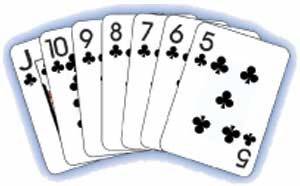

This is a Samba Canasta.
The scoring rules here get a bit spicy. If you go out, you snag a 200-point bonus. But if you actually pull off a Samba, that number jumps to 1,500 points. There’s also a specific condition for the red threes. If your team holds all four of them, you get a 1,000-point bonus. Don’t get cocky though. If you fail to make two canastas by the time play ends, those red threes become a liability. You’ll deduct penalty points equal to the bonus value. And for those hoping to hide their moves? There is no bonus for a concealed hand.
You now have the tools to play standard Canasta and three distinct variations. Your next family game night just got a lot more interesting.
Play Canasta FAQ
Is canasta difficult to learn?
It’s surprisingly simple. You can pick it up quickly whether you’re playing solo or with a full table. The mechanics are straightforward enough that you’ll feel comfortable after just a few hands.
What is a joker in canasta?
Jokers are the big dogs. They are the highest-value cards in the deck, each worth 50 points. Use them wisely. They help you build melds, but they also inflate your score if you’re left holding them when the game ends.
What are melds in canasta?
Melds are the backbone of winning. To win, you need to create as many as possible. A meld is simply three or more cards of the same rank. Suit doesn’t matter. You can mix hearts and spades as long as the numbers match. When a meld grows to seven or more cards, it officially becomes a canasta.
How do you get a canasta?
It’s all about volume. You need a meld consisting of seven or more cards. Once you hit that threshold, you’ve achieved the coveted canasta. This is what separates good players from great ones.
How do you pick up the pile in canasta?
You can’t just grab the discard pile whenever you want. The rules are strict. You can only pick it up if you can immediately use the top card in an existing meld or a new meld with at least two other cards from your hand. This prevents hoarding and keeps the game moving.
Now that you know how to play standard Canasta and three variations of it, you have more options the next time you want to play a card game with family or friends.

