


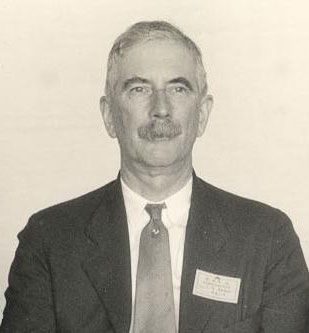
Charles Greeley Abbot was not just a scientist. He was an obsessed one.
From 1872 to 1973, he lived through two world wars. He watched the world change from horse-drawn carriages to jet planes. But he didn’t care about any of that. He cared about one thing: whether the sun gets hotter or colder.
As the director of the Smithsonian Astrophysical Observatory for nearly forty years, Abbot waged a career-long war against the idea that the sun is stable. He wanted proof. He wanted to show that the sun’s energy output varies. And he believed those variations dictate Earth’s weather.
He spent fifty years trying to prove it.
A Farm Boy with a Thermometer
Abbot was born in Wilton, New Hampshire. The youngest of four children in a farming family, he didn’t start out destined for the stars. He started out in the dirt.
But he was smart. In 1895, he earned a Master of Science degree from MIT. Immediately after graduating, he took a job as assistant to Samuel Pierpont Langley. Langley was the first director of the Smithsonian observatory in Washington, D.C.
Their job was simple, in theory. Map the infrared spectrum of the sun. Measure the total solar radiation energy hitting the Earth. They called this value the solar constant.
It sounded steady. Unchanging.
Abbot helped refine the measurement. But he didn’t stop there. He started looking for cracks in the data.
The Great Mistake
Langley died in 1906. Abbot stepped up as acting director. The next year, he was official director.
He didn’t just keep the lab running. He created a new monitoring program. He wanted to find variations in the solar constant. He believed if he could catch the sun changing, he could predict weather patterns.
He found “variations.”
His staff saw them. Abbot saw them. They were real. Or so he thought.
The numbers showed up and down swings of 3 to 5 percent in solar energy reaching Earth. To Abbot, this was the holy grail. A key to weather prediction.
He spent the next half century convincing the world he was right.
He wasn’t.
Why He Was Wrong
The variations Abbot saw were not in the sun. They were in the atmosphere.
His instruments measured radiation after it had passed through clouds, dust, and humidity. When the weather was clear, the sensor read high. When it was cloudy, the sensor read low.
He mistook the weather for the cause of the weather.
Satellite observations later proved it. Once we got sensors above the atmosphere, the solar constant held steady. The 3 to 5 percent swing vanished. It was an artifact of bad data analysis. Abbot had spent decades chasing a ghost he created.
“The cyclic variations that Abbot observed in the solar constant… actually were due to changing weather conditions and incomplete analysis of his data.”
The Legacy of the Error
So was he useless? No.
Abbot established the modern value of the solar constant. Before him, estimates ranged wildly. He pinned it down at 1.93 calories per square centimeter per minute on a theoretical surface outside the atmosphere.
That number matters. It’s the baseline. Without it, we can’t measure climate change accurately. We need to know how much energy enters the system to calculate how much stays.
His emphasis on variation also planted a seed. Modern reanalyses of his data do show minute variations. They are tiny. Much smaller than Abbot claimed. But they exist.
They are caused by sunspots and faculae on the solar surface. Changes in the number and intensity of these features shift the output. Satellites confirmed this decades later.
Abbot was wrong about the magnitude. He was right about the mechanism.
The Demonstration Man
Abbot wasn’t just a theorist. He wanted people to see the power of the sun.
He served as secretary of the Smithsonian Institution from 1928 to 1944. During that time, he designed solar heaters


