


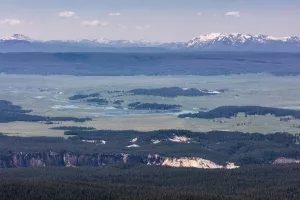
Beneath the geysers and waterfalls of Yellowstone National Park lies a sleeping giant. It is not just a volcano. It is a supervolcano. These things usually hide underground, waiting. When they wake up, the power is unimaginable. A single eruption could rewrite the map of the United States. It could change global weather patterns for years. The thought alone sends a chill down the spine of scientists and tourists alike.
But what actually happens when a supervolcano erupts? And more importantly, should we be packing our bags right now?
The Scale of Destruction
To understand the threat, you have to look at the mechanics. A normal volcano releases lava. It melts rock. It builds new land. A supervolcano works differently. It does not just spew lava. It explodes with such force that it empties its magma chamber entirely.
The result is a massive collapse. The ground above sinks. This creates a caldera. Yellowstone’s caldera is already there. It spans roughly 34 miles by 45 miles. That is huge. But the explosion that formed it was even bigger.
If that same event were to happen today, the immediate effects would be catastrophic. The blast zone would cover much of the American West. States like Wyoming, Montana, Idaho, and parts of Utah would be buried under feet of volcanic ash. This is not just a little dust. This is heavy, concrete-like material. It crushes roofs. It stops engines. It suffocates livestock.
“The immediate blast zone would cover much of the American West. States like Wyoming, Montana, Idaho, and parts of Utah would be buried under feet of volcanic ash.”
Global Climate Shutdown
The danger does not stop at the border. This is where the “apocalyptic” label comes from. The explosion throws billions of tons of sulfur dioxide and ash into the stratosphere. This cloud spreads around the globe. It blocks the sun.
Within weeks, temperatures across the Northern Hemisphere would plummet. Crops would fail. Not just in America. In China. In Europe. In India. The resulting famine could starve hundreds of millions of people. We are talking about a global food crisis. The modern supply chain relies on just-in-time delivery. It is fragile. A shock this large would shatter it.
The ash would also contaminate water supplies. Electrical grids would fail due to the abrasive dust. Air travel would halt worldwide for months. Planes cannot fly through ash clouds. The engines seize up.
Why It Matters Today
You might wonder why we care so much about a volcano in Wyoming. It matters because we are dependent on stability. Our food systems are global. Our energy grids are interconnected. A disruption in one place ripples everywhere.
The Yellowstone supervolcano is a reminder of Earth’s raw power. We think we control nature. We build cities on fault lines. We drill for oil in sensitive areas. We assume the ground beneath us is solid. It is not. It is dynamic. It moves.
The last super-eruption at Yellowstone was about 640,000 years ago. Before that, 1.3 million years ago. And before that, 2.1 million years ago. The intervals are irregular. They are not
How Supervolcanoes Actually Work
You picture a volcano as a cone. A mountain. Classic. Supervolcanoes are different. They are flat. Invisible from the surface.
But underneath? Huge.
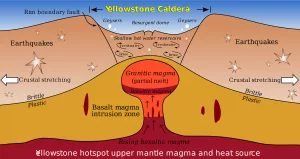
Think of a pressure cooker with the earth’s crust as the lid. The magma chamber is the pot. It expands. It contracts. The ground rises and falls over long periods. It breathes.
Eventually, the lid cracks.
The magma pushes up. The crust can’t hold. It breaks. The magma chamber empties. The ground collapses.
This creates a caldera. A giant hole. Up to one hundred kilometers wide.
Size doesn’t define a supervolcano. Explosiveness does. The amount of material ejected matters. Not the height.

The Caldera Beneath Your Feet
You are walking on a sleeping giant. In the heart of Yellowstone National Park, tourists take photos of geysers and bison, completely unaware of the geological time bomb beneath their boots. This isn’t a metaphor. It is the Yellowstone supervolcano, one of Earth’s most potent geological features, hiding in plain sight.
The scale is almost incomprehensible. Beneath the park lies a complex system of two magma chambers. Together, they hold over 56,000 cubic kilometers of molten rock. To put that volume into perspective, that amount of magma could fill the Grand Canyon more than eleven times. If that entire reservoir erupted, it wouldn’t just be a local disaster. It would be a global event.
A History of Catastrophe
This isn’t a dormant relic. It is an active system with a violent track record. The Yellowstone supervolcano has erupted at least 140 times throughout its existence. More recently, it has blown its top at least three times in the last 2.1 million years.
The last time it went full scale was roughly 630,000 years ago. The eruption was so massive it collapsed the land above, leaving behind a scar that spans 75 kilometers long and 37 kilometers wide. That is a caldera of terrifying proportions.
Why This Matters Now
Scientists monitor these chambers closely because the question isn’t if it will erupt again. It is when. The risk isn’t just about lava flows. It is about ash. An eruption of this magnitude would blast millions of tons of ash into the atmosphere, blocking sunlight and disrupting agriculture across continents.
The ground itself is restless. The caldera rises and falls by centimeters every year. It breathes. It pulses. We have built roads, hotels, and towns on top of a system that has already proven it can reshape the planet. The data is clear. The magma is still there. And the clock is ticking.
What happens when the pressure finally becomes too great? We don’t have to guess. We just have to look at the scars left behind.

The Real Cost of a Yellowstone Super-Eruption
Imagine the ground giving way. Not with a rumble, but with a force comparable to a massive asteroid strike. If the Yellowstone superv volcano eruption happened today, the immediate death toll would be staggering. Within minutes, tens of thousands could perish under a deluge of lava, rock, and ash. The heat alone would be enough; we are talking about material at 800 degrees Celsius spreading across a vast area. Everything in the radius of destruction would simply vanish. Life would be erased.
But the blast zone is only the beginning. The real horror lies in what happens next. Even if you are 3,000 kilometers away in New York City, you aren’t safe. A thin layer of ash—just a few millimeters thick—would coat the streets. It sounds minor until you realize traffic stops. Communication networks fail. The city grinds to a halt under a gray blanket.
“The volcanic winter following past eruptions lasted at least 80 years.”
This isn’t just local damage. It’s a global shutdown. The gases and ash hurled into the stratosphere would spread worldwide, blocking sunlight. Less sun means a volcanic winter. We have a historical precedent for this. When the Toba supervolcano in Sumatra erupted 74,000 years ago, global temperatures dropped by roughly five degrees Celsius. In Western Europe, conditions would have mirrored Siberia.
The last time Yellowstone erupted, studies suggest the cooling effect persisted for at least eight decades. That isn’t a season. That is a generation lost.
If it happens again, the climate zones shift violently. Agriculture collapses. Crops fail across the globe. The result isn’t just discomfort; it is mass starvation. Millions, perhaps billions, could die from the fallout. We wouldn’t just be going back in time. We would be thrown backward as a civilization.
The timeline for Yellowstone’s next catastrophic event has shifted dramatically.
For years, the prevailing theory was straightforward. The supervolcano erupted roughly every 600,000 years. The last big blow happened 630,000 years ago. That math suggested we were overdue. Imminent doom felt like a statistical certainty.
Science disagrees now.
New data indicates the interval between eruptions has stretched over millions of years. The gap is widening. It is now sitting around 1.5 million years. We have about 900,000 years left on the clock. That’s comfortingly long. Or terrifyingly short.
Predicting exactly when remains nearly impossible. The risk is low, but non-zero.
The US Geological Survey puts the annual odds at 1 in 730,000. That is the same likelihood as a catastrophic asteroid strike. We monitor the ground relentlessly. Sensors track tremors. They measure the magma chamber’s rise and fall. But nature does not follow a spreadsheet.
Can Humans Stop a Supervolcano Eruption?
We cannot stop it. Not yet.
The consequences would be global. Humanity would be largely powerless. The sheer scale of a supervolcanic event dwarfs our current engineering capabilities.
NASA scientists once considered intervention. The idea was simple in theory: cool the volcano down. Pump mountain water into the magma chamber. Keep the heat in check.
It is risky. It is impractical. It is science fiction right now.
Another proposal involved tapping the supervolcano as a geothermal power plant. Harvest energy. Cool the system simultaneously. But these concepts remain far from reality. We lack the infrastructure. We lack the understanding.
Volcanic eruptions remain uncontrollable natural disasters.
What we can do is prepare. Early detection is our only defense. We look for the warning signs.
- Frequent earthquakes.
- Gas emissions.
- Ground uplift.
Spotting these signals buys time. It allows for evacuation. It saves lives when the ground finally moves.
The goal isn’t to stop the mountain. It’s to get out of the way before it stands up.
We watch. We measure. We hope the next 900,000 years are quiet.

