For decades, neuroscientists have viewed adolescence through the lens of subtraction. The prevailing theory suggested that the teenage years are defined by “synaptic pruning”—a biological process where the brain trims away excess neural connections to refine its circuits and improve efficiency.
However, groundbreaking research from Kyushu University is challenging this narrative. A new study published in Science Advances suggests that adolescence is not just a period of refinement through loss, but also a critical window of targeted construction.
The Traditional View: The Brain as a Sculptor
To understand why this discovery matters, one must understand the “pruning” model. In this view, the brain builds a massive number of connections during childhood, then spends adolescence “pruning” the weak or unused ones. This is akin to a sculptor removing excess marble to reveal a finished statue.
This process is vital for developing the “control center” functions of the brain—such as impulse control, long-term planning, and complex problem-solving. For years, scientists believed that if this pruning went too far, it could lead to neuropsychiatric disorders like schizophrenia.
A New Discovery: The Emergence of “Synaptic Hotspots”
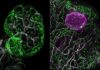
Using advanced super-resolution microscopy and a specialized tissue-clearing agent called SeeDB2, Professor Takeshi Imai and his team observed something unexpected. Instead of seeing a universal decline in connections, they discovered that the brain actively builds dense, highly concentrated clusters of synapses during adolescence.
Key findings from the study include:
- Targeted Growth: Rather than a uniform thinning of connections, specific sections of neurons (specifically in Layer 5 of the cerebral cortex ) experience a sharp increase in “dendritic spines”—the tiny protrusions where neurons communicate.
- Adolescent Timing: These high-density “hotspots” do not exist in early childhood; they emerge specifically during the adolescent developmental window.
- Structural Complexity: This suggests that the adolescent brain is not just getting “leaner,” but is actually building specialized, high-traffic neural hubs to manage complex information.
Rethinking Schizophrenia
This shift in understanding has profound implications for how we view mental health. Traditionally, schizophrenia has been linked to excessive pruning —the idea that the brain loses too many connections.
The Kyushu University team’s research offers a different possibility: impaired formation. By studying mice with genetic mutations linked to schizophrenia (Setd1a, Hivep2, and Grin1 ), researchers found that while early development appeared normal, these mice failed to form the necessary adolescent synaptic hotspots.
“While synaptic pruning occurs broadly… synapse formation also takes place in specific dendritic compartments during adolescent cortical development,” notes Ryo Egashira, the study’s lead author. “Disruption of this process may be the key factor in at least some types of schizophrenia.”
The Path Forward
While these results are transformative, researchers urge caution. The study was conducted on mice, and it remains to be seen if these exact “hotspot” mechanisms function identically in primates and humans.
The next step for the team is to identify exactly which brain regions are creating these new connections. Mapping these specific circuits could provide a roadmap for understanding how the adolescent brain matures and, more importantly, how to intervene when that development goes off track.
Conclusion: This research shifts the scientific paradigm from viewing adolescence as a period of neural loss to recognizing it as a period of strategic, high-density growth. This discovery provides a new potential framework for understanding the biological origins of neuropsychiatric disorders.