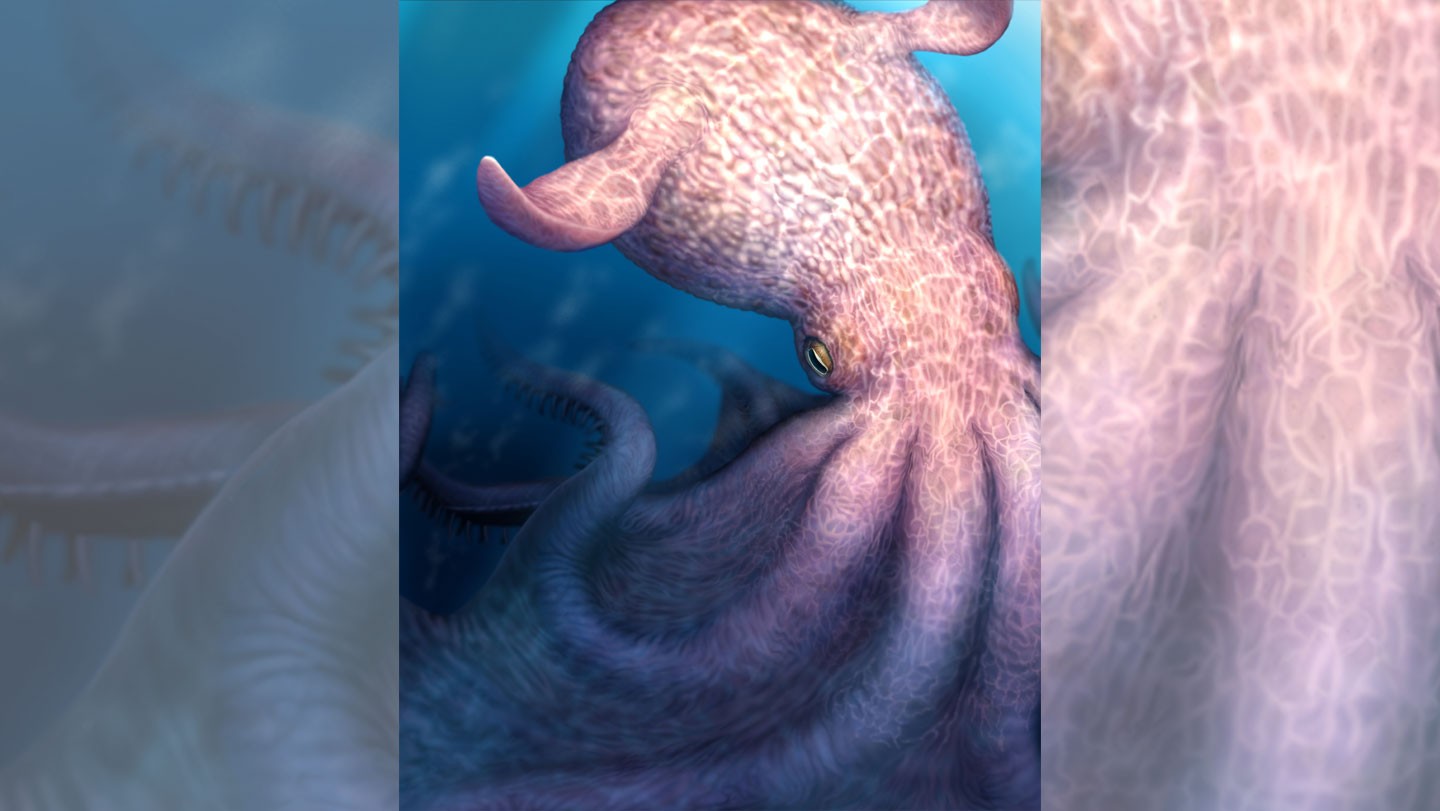
While the legendary “Kraken” belongs to Norse mythology, recent paleontological findings suggest that a real-life version of this sea monster once dominated the prehistoric oceans. New research published in Science reveals that during the Late Cretaceous period—the era of the dinosaurs—enormous, octopus-like creatures may have been among the largest invertebrates to ever exist.
Unlocking the Secrets of Soft-Bodied Giants
Studying ancient cephalopods is a notorious challenge for paleontologists. Unlike dinosaurs, which leave behind massive bones, octopuses are composed mostly of soft tissue that decomposes long before it can fossilize. This leaves researchers with very little to work with: typically, only the hard, beak-like jaws survive the passage of millions of years.
To overcome this, a team led by Yasuhiro Iba of Hokkaido University utilized cutting-edge technology to analyze fossilized jaws found in Japan and on Canada’s Vancouver Island. The team employed a sophisticated process:
– Layer-by-layer rock grinding: Fossils embedded in stone were meticulously removed through micro-abrasion.
– AI-assisted modeling: Because many fossils were too fragile for traditional excavation, artificial intelligence was used to create high-resolution digital models.
– Comparative analysis: By measuring 27 jaw fossils and comparing them to living and extinct species, the team was able to reclassify the specimens.
A New Scale of Predator
The study identified two primary species, most notably Nanaimoteuthis haggarti . This creature was a massive relative of modern “finned octopuses”—deep-sea animals like the Dumbo octopus that possess webbing and fins. However, the scale of N. haggarti was vastly different from its modern counterparts.
The sheer size of these animals is staggering:
– Jaw Size: A single lower jaw from N. haggarti was large enough to cradle a grapefruit.
– Comparison to Giants: The jaw was roughly 50% larger than that of a modern giant squid, one of the ocean’s current largest inhabitants.
– Estimated Length: Researchers estimate that including its full array of arms, N. haggarti could have reached lengths of 7 to 19 meters (approx. 23 to 62 feet).
Redefining the Cretaceous Food Web
This discovery challenges our long-standing understanding of prehistoric marine ecosystems. For decades, scientists believed the “top tier” of the ocean food web was exclusively the domain of large vertebrates, such as mosasaurs and plesiosaurs.
The evidence suggests a much more crowded and competitive hierarchy:
– Apex Competitors: At 19 meters long, these giant invertebrates were large enough to rival or even exceed the size of the era’s most famous marine reptiles.
– Voracious Hunters: Analysis of the fossilized jaws showed consistent wear and damage, indicating these octopuses were powerful predators that routinely bit through hard shells and bones.
– Ecological Complexity: This suggests that the Cretaceous oceans were more complex than previously thought, with giant invertebrates playing a central role as apex predators.
“For a long time, the top of the marine food web has been thought to be dominated by large vertebrates,” says Yasuhiro Iba. “Our study shows that giant invertebrates—octopuses—also occupied that role in the Cretaceous.”
The Unanswered Questions
While the findings are groundbreaking, paleontologists note that much remains unknown. Because the research is based solely on jaw fragments, there is debate regarding the exact size and diet of these creatures. Future discoveries—specifically fossils containing preserved stomach contents—could finally answer whether these “krakens” fed primarily on shelled invertebrates like ammonites or if they actively hunted large vertebrates.
Conclusion
The discovery of Nanaimoteuthis haggarti proves that the Cretaceous oceans were home to massive, predatory invertebrates that rivaled the era’s greatest reptiles. This finding shifts our understanding of prehistoric marine life, revealing a much more diverse and competitive food web than previously imagined.