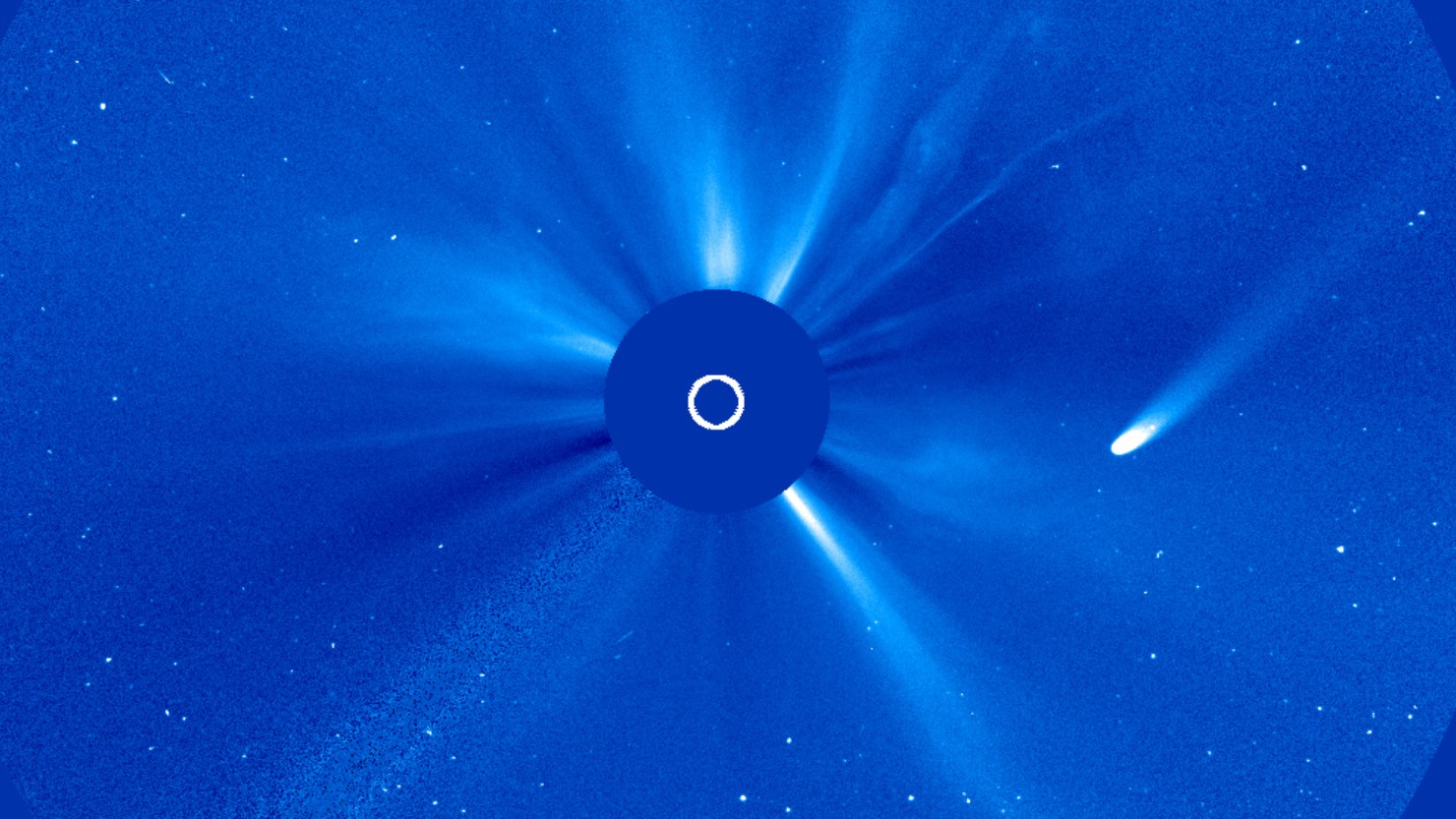
Comet C/2025 R3 (PanSTARRS) is currently making its way toward Earth, offering astronomers and space enthusiasts a unique opportunity to observe its journey from a vantage point far above our atmosphere. Following its recent passage near the Sun, the comet is now heading toward its closest approach to our planet on April 26.
A Cosmic Journey from Sun to Earth
The comet recently completed a major milestone on April 19, reaching perihelion —its closest point to the Sun. Having survived the intense heat of its solar passage, the “icy wanderer” is now transitioning toward Earth. On April 26, it is expected to pass approximately 45 million miles (72 million kilometers) away from us.
Because of its current position, the comet has entered the field of view of specialized satellite instruments, allowing us to track its movement through space in real-time.
How to Watch via Satellite Imagery
While many people look to telescopes on the ground, we can actually watch PanSTARRS through the “eyes” of orbiting spacecraft. This weekend, two primary sources will provide high-altitude views of the comet’s progress:
- SOHO (Solar and Heliospheric Observatory): This joint NASA/ESA mission uses the LASCO instrument to monitor the Sun and its surroundings. Positioned at the L1 Lagrangian Point —a stable gravitational spot 1.5 million kilometers from Earth—SOHO provides an uninterrupted view of the comet as it moves across the solar field.
- NOAA GOES-19 Satellite: The National Oceanic and Atmospheric Administration also provides imagery via its GOES-19 satellite, offering another layer of observation for those following the comet’s trajectory.
In the coming days, observers will see the comet move from the upper right quadrant toward the lower half of the LASCO field of view.
Visibility and Viewing Tips
If you are looking to spot the comet yourself, there are a few technical details to keep in mind:
- Brightness: The comet currently has a magnitude of approximately +4.5. This means it is bright enough to be seen with the naked eye, appearing as a faint, hazy patch of light.
- Equipment: Using binoculars will significantly help in defining the comet’s structure and tail.
- Location: Following its recent perihelion passage, the comet is currently only visible from the Southern Hemisphere.
Note on Solar Activity: The comet’s journey is coinciding with a period of intense solar activity. Recent X-class solar flares and coronal mass ejections have been recorded, reminding us that the space environment around the comet is currently very dynamic and energetic.
Summary
Comet PanSTARRS is currently transitioning from its solar encounter toward its closest approach to Earth on April 26. While it remains a Southern Hemisphere object for terrestrial observers, satellite imagery from SOHO and NOAA provides a rare, unobstructed look at its flight through the solar system.