Eclipses—both solar and lunar—often seem to appear out of nowhere, striking observers with their sudden spectacle. But these events aren’t random; they follow a predictable pattern tied to recurring periods called eclipse seasons. These seasons explain why eclipses almost always occur in pairs, and why they don’t happen every month despite the regular cycle of new and full moons.
The Predictable Rhythm of Eclipses
Every year, there are typically two eclipse seasons, lasting between 31 and 37 days each. These windows occur roughly every 173 days, meaning every eclipse in history has fallen within one of these periods. Outside these windows, the geometry simply doesn’t align for an eclipse to occur.
The key to understanding this is syzygy – the alignment of the Earth, moon, and sun. An eclipse season happens when this alignment occurs close to the plane of Earth’s orbit around the sun, known as the ecliptic. When a new moon falls within an eclipse season, it can cast its shadow on Earth, creating a solar eclipse. A full moon in the same window can pass into Earth’s shadow, resulting in a lunar eclipse.
Why Not Monthly Eclipses? The Moon’s Tilt
Given that we have a new moon every 29.5 days and a full moon two weeks later, why aren’t eclipses monthly occurrences? The answer lies in the moon’s orbital tilt. The moon orbits Earth on a path inclined by about 5 degrees relative to the ecliptic. Most of the time, new moons pass slightly above or below the sun, and full moons pass above or below Earth’s shadow, missing the precise alignment needed for an eclipse.
Lunar Nodes: The Key to Understanding Eclipse Seasons
The phenomenon is governed by two invisible points in space called lunar nodes. These are the points where the moon’s tilted orbit crosses the ecliptic. When the sun moves close to one of these nodes, an eclipse season begins. For about a month, the alignment is right for solar and lunar eclipses to occur. When the sun moves away from the node, the season ends.
These nodes slowly shift over time, causing eclipse seasons to move by about 19 days each year. This means the timing and location of eclipses within seasons are always changing.
The Pairing of Solar and Lunar Eclipses
Once an eclipse season begins, a pair of eclipses almost inevitably follows. If a new moon near a node causes a solar eclipse (when the moon passes between Earth and the sun), roughly two weeks later, a full moon near the opposite node will produce a lunar eclipse (when Earth passes between the sun and the moon).
Occasionally, a third eclipse can occur within the same season, but most seasons deliver just two.
The 2026 Eclipse Seasons
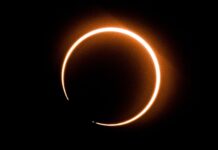
The next eclipse season begins on February 17, 2026, with an annular solar eclipse (where a ring of sunlight remains visible around the moon). Two weeks later, on March 3, 2026, a total lunar eclipse will occur. The second eclipse season of 2026, in August, will include a total solar eclipse on August 12, visible from Greenland, Iceland, and northern Spain.
Understanding eclipse seasons clarifies that these dramatic events are not isolated occurrences, but predictable consequences of celestial mechanics. The pairing of solar and lunar eclipses within these windows is a natural outcome of the Earth, moon, and sun’s relative positions.