You have seen the green boxes. They are everywhere on Twitter, hovering over your feed in that familiar shade of success. Wordle changed everything for daily web games. It took a simple five-letter constraint and turned it into a global obsession. Now, there is a new challenger entering the ring. It keeps the same addictive loop but swaps letters for landscapes.
Enter Worldle.
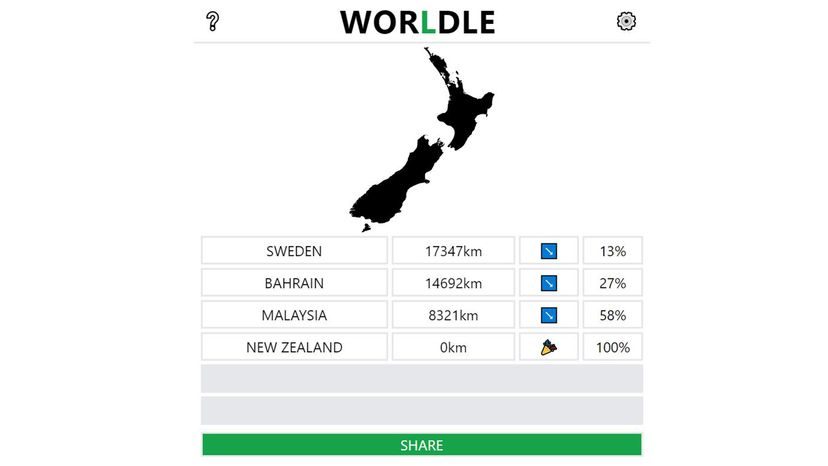
The premise is deceptively simple. You are shown a silhouette of a country. You have six tries to guess which one it is. The interface is clean. A dropdown menu helps you spell correctly, so you do not get penalized for typos. It is a small mercy in a game built on precision.
When you submit a guess, the game does not just tell you if you are wrong. It gives you data. Real data.
You get three specific pieces of feedback. First, the distance to the correct country in kilometers. Second, the direction you need to go. Third, a percentage score indicating proximity. Hit 100 percent. You have won the round.
This leads to a common point of confusion. Where is the center of a country? The game measures distances between geographical centers. Not borders. Not capital cities. The mathematical middle of the landmass.
This distinction matters. Take the United States and Canada. They share a long border. You could walk from one to the other in minutes. But according to Worldle, they are 2,260 kilometers apart. That is 1,404 miles. You have to travel deep into North America to find the center of the US. The game does not care about your passport status. It cares about geometry.
The creator of Worldle goes by @teuteuf on Twitter. They are based in Montpelier, France. The project started as a side hustle. A weekend coding session that turned into a traffic jam. The developer openly admits to taking inspiration from Wordle. In fact, @teuteuf retweets other geography-based spinoffs. It is a generous move in a niche industry.
There is no app store listing. You will not find it on iOS or Android. There are no ads cluttering the screen. It is strictly a web experience. You can bookmark the site or save it to your phone’s home screen. It functions like an app without the overhead.
The launch date was January 24, 2022. The growth was exponential. By February 13, more than half a million players had tried their luck. The server load became so intense that @teuteuf had to switch infrastructure. The transition was smooth. No downtime. No lost progress. Just a seamless shift in the digital backend.
These games are not new. They trace their lineage back to Mastermind. That logic puzzle from the 1970s required deducing a code based on feedback. Worldle adapts that logic to maps.
The trend has branched out in strange directions.
If numbers are your thing, try Nerdle. It applies the same six-guess structure to math equations.
If you grew up in the 90s, Squirdle tests your knowledge of Pokémon. You guess the creature based on a silhouette and distance clues.
Then there is Lewdle. It follows the same format but for adults only. The words are not SFW. It is a different kind of guessing game entirely.
Why does this matter right now? The appeal is the constraint. We love limits. Six guesses. One shape. One answer. It is a puzzle you can solve in two minutes or twenty.
The geography genre is expanding. You can try other variations. The community builds them constantly. New silhouettes appear daily.
What country did you guess wrong today?
The servers are running. The shapes are loading.