Pea crabs are tiny, pinkish-white crustaceans that live inside the soft bodies of clams, oysters, and scallops. They belong to the genus Pinnotheres and practice commensalism, meaning they use other animals for shelter and protection but do not eat the host. These crabs are part of the order Decapoda, which includes most familiar crabs, lobsters, and shrimp.
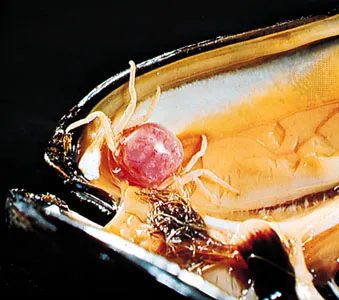
The most common species in North America is Pinnotheres ostreum, often called the oyster crab. You will find them primarily in Atlantic coastal waters, with high concentrations in the Chesapeake Bay. The female oyster crab is easy to spot if you open the right shell. She is up to 2 cm (about 0.75 inches) across, with a body that looks pinkish white. An irregular stripe runs front-to-back across her carapace. Males are much rarer, smaller, dark brown, and typically free-swimming rather than hiding inside hosts.
The female pea crab holds her eggs with her back legs until they hatch.
Once the larvae hatch, they leave the mollusk and swim freely. They eventually settle into the mantle cavity of another bivalve to start their cycle again. The mantle cavity is the space inside the shell where the gills and other soft tissues reside.
Which species live in European waters?
While P. ostreum dominates the North American scene, other species occupy similar ecological niches in Europe. Pinnotheres pisum lives in mussel and cockle shells in European coastal waters. Pinnotheres maculatus has a range similar to P. ostreum but is often found inside scallops, clams, and mussels.
Why do pea crabs hide inside mollusks?
Predators. The inside of a bivalve shell is a safe place. Most fish and larger crabs cannot reach the soft tissue deep within the mantle cavity. By living inside, the pea crab avoids being eaten. This relationship benefits the crab without harming the host, which is why scientists classify it as commensal rather than parasitic.
The crab does not derive nourishment from the mollusk. It eats its own food, usually small particles or plankton, while staying tucked away. This makes them fascinating examples of how marine life adapts to coexist in tight spaces.
Next time you open an oyster and spot a small pink crab with a striped back, you are looking at one of the ocean’s best-kept secrets. It’s not a mistake. It’s a survival strategy.