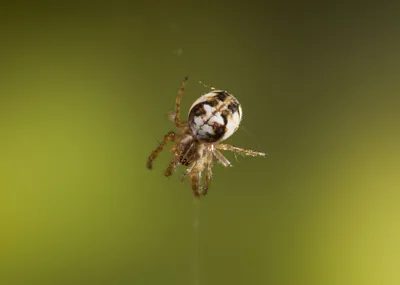
Most spiders spend their lives carefully weaving intricate geometries. The ray spider, a member of the Theridiosomatidae family, does something different. It builds a trap that functions more like a loaded spring than a sticky net. With around 175 identified species, these tiny arachnids rely on mechanical violence rather than adhesion to secure their meals.
They are small creatures. Most ray spiders measure less than 3 mm in body length. You will usually find them near streams or in other damp, humid environments where their specific hunting strategy works best.
The mechanics of a snap-trap
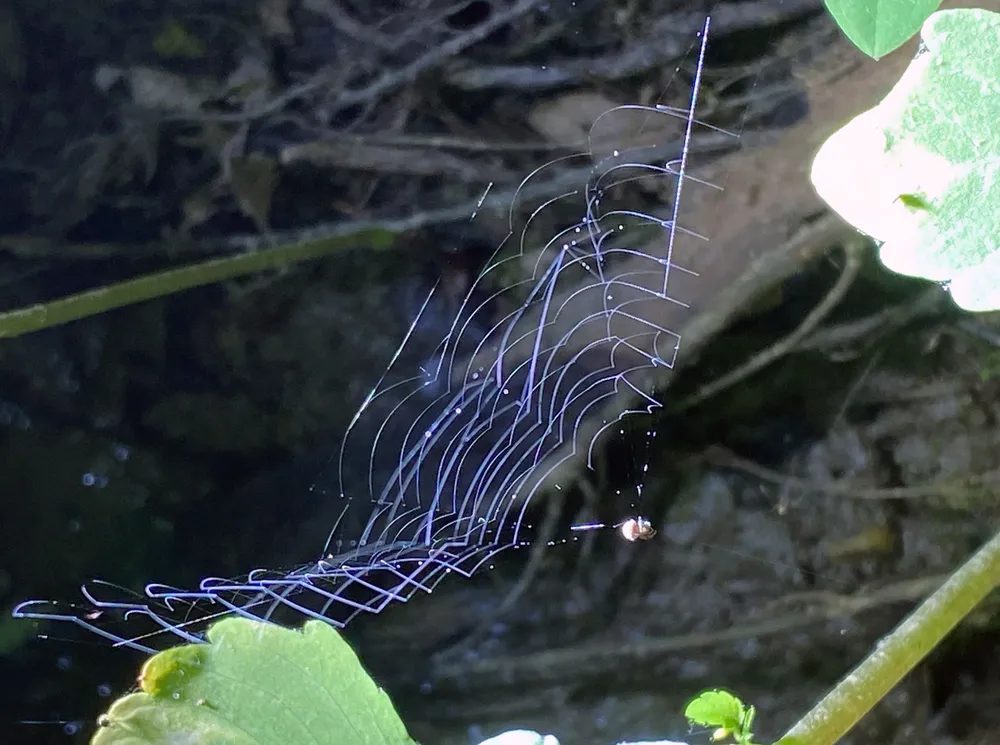
The web itself looks deceptively simple. Strands extend outward in raylike groups of three or four. From the center of this radial pattern, a single strand connects to a nearby twig or leaf. The spider holds this strand taut. It acts as the trigger mechanism.
When an insect becomes caught in the web, the tension is broken. The spider releases its hold. The web snaps back into a cone shape. This sudden movement ensnares the prey further, trapping it against the center before it can escape.
The web snaps back, further ensnaring the insect.
This method is efficient for such small hunters. It conserves energy compared to chasing fast-moving prey. It also reduces the risk of damage to the delicate web structure. The ray spider remains hidden, waiting for the right moment to pull the trigger.