Erwin Schrödinger didn’t ask permission to cross boundaries.
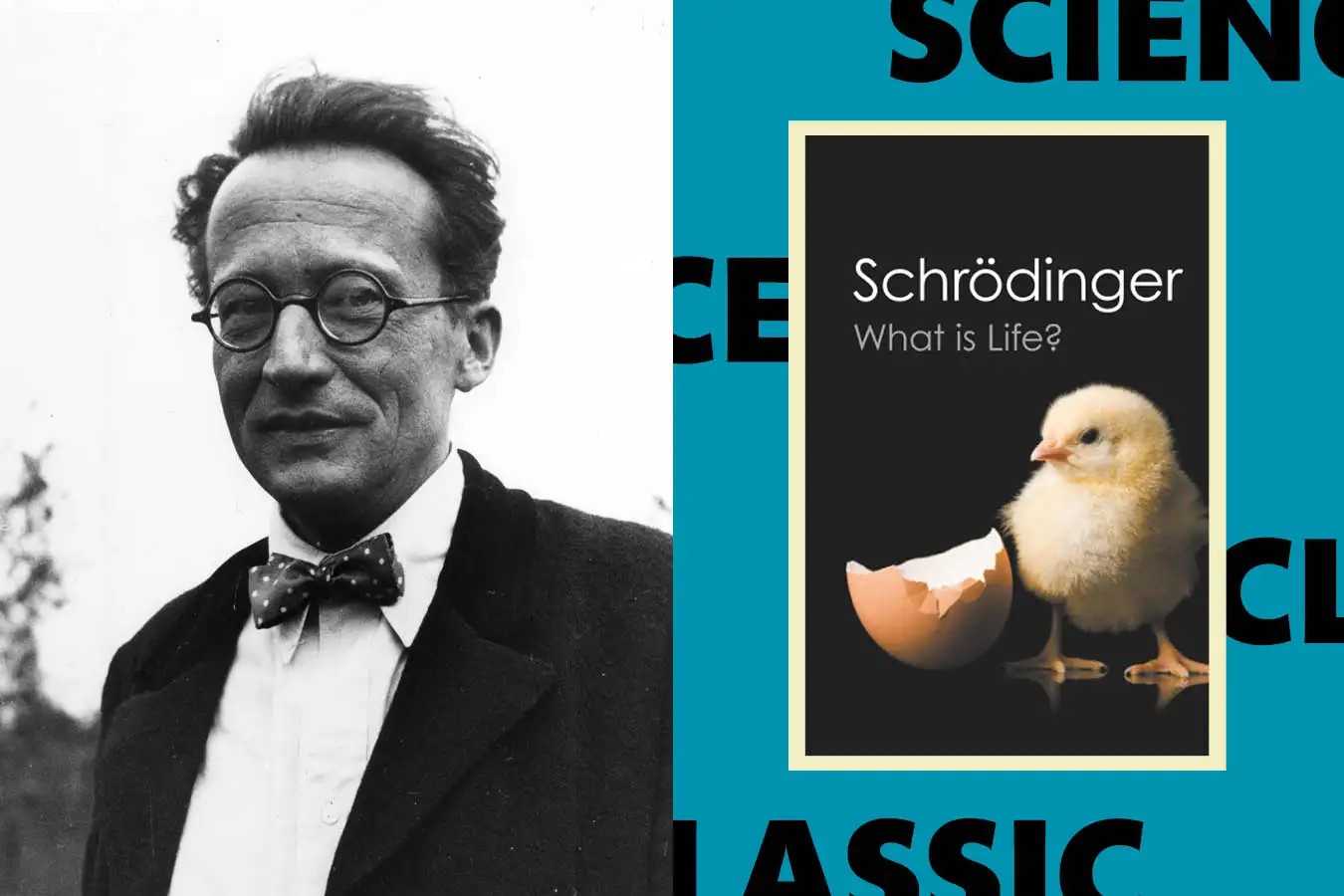
In 1944, he wrote What Is Life?, a small book with outsized consequences. He started by telling readers he was stepping out of his lane. Usually, a scientist stays within their expertise, a matter of professional etiquette, what he called “noblesse oblige.” Schrödinger renounced that noblesse.
He walked away from the atoms that made him famous.
He walked toward the messy, wet world of living organisms.
For roughly 90 pages, he left his status as a titan of physics on the shelf. He joined us, the strivers, the dabblers, in trying to understand something completely different. The result wasn’t a dry textbook. It became one of the most influential science books of the twentieth century.
The Physics of Being Alive
The book came from lectures in Dublin, 1943. It feels conversational. Self-deprecating, even. Poetic at times.
But the core question was hard-nosed. Written in the stark language of physics:
“How can the events in space and take place which take place within the spatial boundary a living organism be accounted by physics chemistry?”
Schrödinger thought like a physicist when looking for an answer. The physical aspect the living cell, as the subtitle claimed, starts with size. The building blocks of life are tiny. Atoms. They are also numerous. So they obey statistical physics.
Schrödinger had this right.
When you look at billions of tiny things, you can talk about averages. You cannot predict any single one exactly.
Physics demands disorder. Entropy always rises. Fluctuations shake everything apart.
But living things are orderly.
Neat. Precise.
Schrödinger compared cells to intricate clocks.
They reproduce.
They pass traits down.
And they do this with very little “hereditary substance.” That part confused him.
Before the Double Helix
This was before anyone knew the shape of DNA. Schrödinger didn’t know what this substance was.
He looked at radiation mutations.
He linked them to “quantum jumps.”
He wondered what kind of solid could hold this information so stably.
Then he made his big leap.
He argued living organisms need negative entropy.
To avoid turning into disorder, a creature must “continuously suck orderliness from its environment.”
How?
He suggested we might need entirely new laws of physics to explain it.
The Backlash
When the book came out, it hit hard.
Physicists loved it. Several switched to biology.
Pop readers kept buying it. It sits on “best of” lists to this day.
Chemists and biologists were not impressed.
Nobel laureate Max Perutz wasn’t kind. He said Schrödinger ignored plenty of existing research. Take cell division. Schrödinger marveled that genetic material could be copied without falling apart from thermal fluctuations. Perutz said enzymes handled this. It was known.
Perutz also mocked the idea of negative entropy.
Later, writer Philip Ball pointed out that Schrödinger missed connections between entropy and information. Specifically, Leo Szilard’s work on Maxwell’s demon in 1929. That work explained how information relates to disorder. Schrödinger just didn’t look there.
Valid criticisms.
All of it.
Why We Still Care
But in 2026, the book feels prophetic again.
I’m a former physicist, so I lean sympathetic. Biologists might roll their eyes at me.
Yet I keep hearing Schrödinger in the words of modern researchers.
Last year, someone talked to me about drafting a new physical law for living matter.
Another researcher quoted Philip Pincus, a physicist at UCSB: “If you’re in equilibrium, you’re dead.”
Schrödinger was thinking that in the 1940os.
He was right to be frustrated. Right to be curious.
In 2021 biophysicist Rob Phillips of Caltech said the book should be read as a manifesto. About frontiers. About how physics always needs new concepts when it meets new phenomena. Which leads to new laws.
I tend to agree.
Schrödinger knew little biology.
His chemistry was shaky.
But his physicist intuition survived.
Will physicists ever explain the mechanism of life?
Or is that job for philosophers?
We might find out in the coming decades.
It’s infuriating.
It’s exciting.
Schrödinger captured that feeling more than eighty years ago. He didn’t solve the puzzle. He just set up the table.
We’re still looking at it.