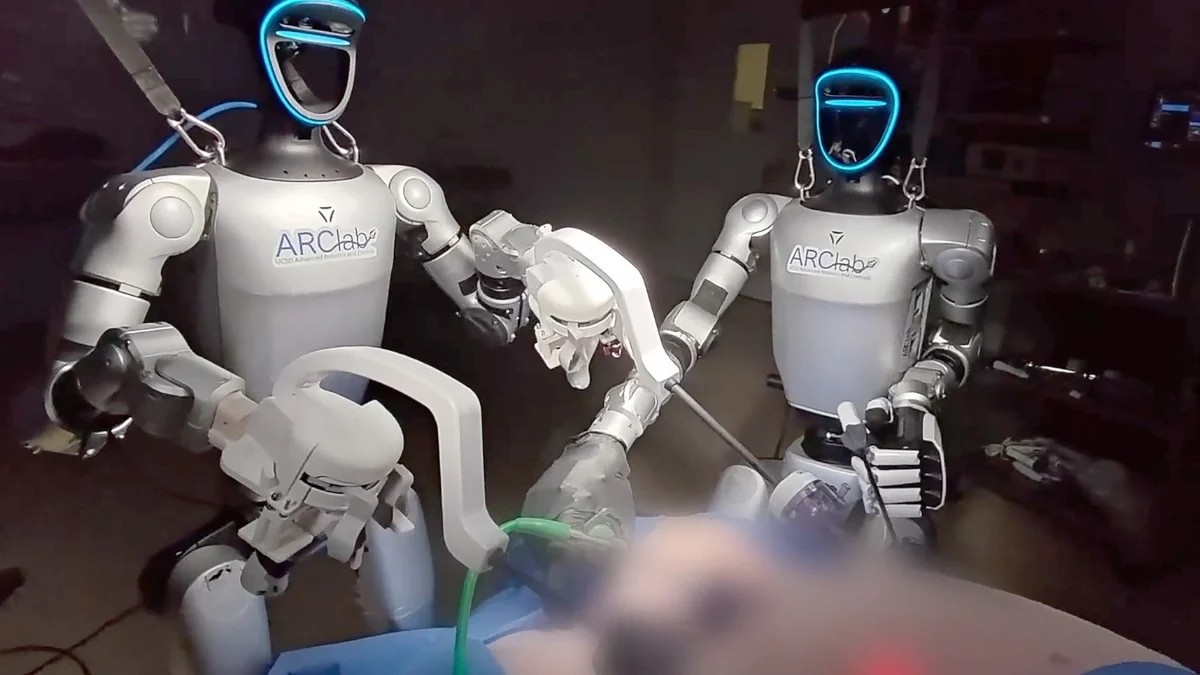
Humanoid robots have officially entered the operating room.
Not just in labs. Not just in theory. In live pig surgery.
A new study in Nature confirms what many of us suspected: two-legged machines can handle laparoscopic procedures with surgical precision.
The team from the University of California, San Diego didn’t just want to prove the bots could move. They wanted to see if they could remove gallbladders without killing the patient.
Spoiler alert: it worked.
From Console to Clinic: How It Works
Robotic surgery isn’t new. The da Vinci System has been the gold standard for years. Surgeons sit at a console, manipulating arms with three or four instruments and a 3D camera.
It’s precise. It’s expensive. It takes up half the OR.
The UCSD team swapped the bulky industrial arms for bipedal humanoids.
They started simple. Benchtop tasks. Moving tools. Handling instruments. Guided by real surgeons, obviously.
Then came the leap. Anesthetized pigs.
A human surgeon at a console controlled the robot. Another doctor stood by the bedside.
One case even involved a second robot pitching in for assistance.
The result?
Minor bleeding occurred in one instance. It was stopped quickly.
The gallbladders were removed.
The animals recovered.
“The experience of performing surgery using the humanoid robot felt similar to the early days of modern robotic surgery—limited by instrument collision and signal delay.” — Shanglei Liu, UCSD Surgeon
Speed of Innovation
Here is the kicker.
Traditional robotic surgical platforms took decades to reach this milestone in live animal models.
This team went from concept to live surgery in nine months.
That isn’t just progress. That’s exponential velocity.
Ryan Broderick, the lead surgeon, admitted there was “nervous anticipation.” But he noted the tech was developed thoroughly.
“The humanoid robot felt very similar to commercially available robotics,” Broderick said. “Some latency and recalibrating were required. But this is expected from a proof of concept.”
And that speed matters.
If the path to perfection follows this trajectory, humanoid robots could become mainstream faster than we think.
Why Size Matters (And Where They Could Operate)
Standard robotic arms are big. They’re stationary. They require specific setups.
Humanoids?
They’re compact.
They’re transportable.
Liu pointed out that their small footprint opens up possibilities that bulkier systems simply can’t touch.
Think underserved communities.
Dangerous zones.
Places that are hard to reach.
But there’s a more extreme application.
Space.
“These two-legged robots take up much less space and are easier to transport,” Liu noted. “I expect the trajectory to perfect this technique will be faster.”
Telesurgery isn’t just about remote control. It’s about accessibility.
If a human can pilot a robot from thousands of miles away, local resource shortages become less critical.
One surgeon can cover more ground. Literally.
The Future of Solo Surgery
The benefits mirror existing robotic systems.
Precision increases.
Surgeon fatigue decreases.
But humanoids offer an added layer: autonomy in staffing.
“We can perform telesurgery… expanding my reach beyond the walls of UCSD,” Broderick said.
Imagine a rural clinic with one surgeon and no team.
Currently, that’s a bottleneck.
With a humanoid robot, that solo practitioner might have a reliable “assist.”
No need for a full operating team on site.
Just one expert. One robot. One patient.
It’s not science fiction anymore.
It’s a feasibility study.
But the implications are huge.
For remote areas.
For disaster zones.
For the future of medicine where distance is no longer a barrier.
The robots are walking into the OR.
They’re handling the tools.
And soon, they might be saving lives in places we can’t easily get to ourselves.