Four years in. The James Webb Space Telescope hasn’t just taken photos. It’s been reading tea leaves. Or rather, peering through the cosmic dust of Centaurus A to find a story hidden in plain sight for over two centuries.
This thing is a giant. Located in the southern sky’s constellation of the same name, Centaurus A (also called NGC 5128 or LEDA 46953 depending on who you ask) is one of the brightest smudges visible to the naked eye. James Dunlop found it way back on April 29th, 1826. Scottish astronomers have long loved their obscure stars, apparently.
But here’s the catch: it’s the closest active galactic nucleus we’ve got, sitting roughly 13 million light-years away. That makes it close. Like, neighbors-close, in cosmic terms. And what do we see when we look closer?
Messy.
Astronomers have suspected for a while that this galaxy started as an elliptical. Smooth. Boring. Then a smaller spiral galaxy crashed into it. A galactic fender bender two billion years ago. The result? A weird, twisted shape.
At the heart sits a supermassive black hole, feasting.
It’s not polite about it, either. As the black hole consumes surrounding material, it spits out powerful jets. Lots of energy. It reshapes everything around it, forcing matter to move. Centaurus A wears its scars like jewelry.
We’ve tried looking before. The Hubble Space Telescope? Good at visible light. Not great at seeing through thick dust. Hubble saw the dust and gave up on the center. Then Spitzer came along, using infrared. It saw large-scale structures but couldn’t resolve individual stars. Just blobs. Beautiful, mysterious blobs, but blobs nonetheless.
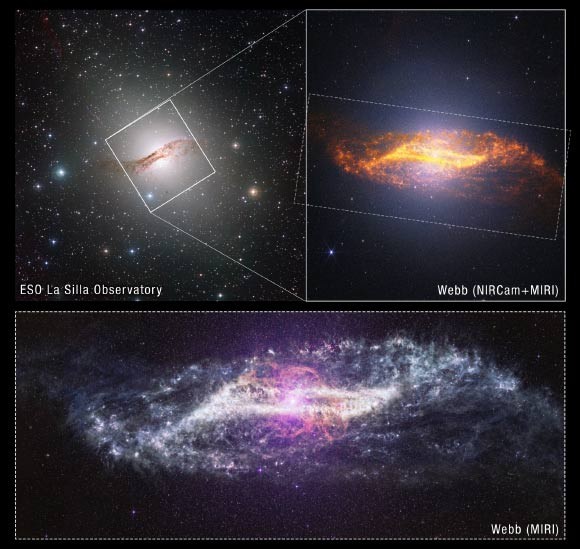
Now Webb has arrived. It brings clarity. It brings depth. It strips away the dust to expose the machinery.
Mid-infrared vision highlights rich dust structures glowing in intricate, perplexing shapes.
There’s a warped band cutting across the center, almost like a parallelogram. Wisps of material stretch outward, looking less like scientific data and more like abstract art. And then there’s the “S” shape. Visible mostly in images from the MIRI instrument. Weird, right? It invites questions. What made it? How much did the black hole shove it into place? Or is this the result of merger-induced star formation? We don’t know yet. We’ll keep staring at it until we figure it out.
Those red glowing points in the images? Stars. Old ones shedding skin, young ones forming from scratch. Dust-rich stellar nurseries.
Dust isn’t dirt in space. It’s the raw ingredient for planets. For life. For the next generation of galaxies.
But here’s where Webb really shines: resolution. The stuff that looked “grainy” to other telescopes is actually dense fields of individual stars. Every single speck holds history.
Think of it as galactic archaeology. Each revealed star tells you when something happened. Did the older stars form early? When did things quiet down? There was a burst during the collision, obviously. But look deeper. Look at the stars born from gas stirred up after the impact.
Put it all together and you get a timeline. A history written in light, finally readable after 200 years of static.
What’s next for this bruised galaxy? Nobody really knows. The dust settles, the stars burn. Webb watches. We watch. It’s quiet enough to hear the history echoing.