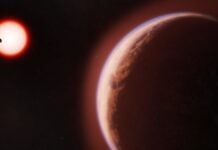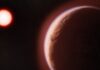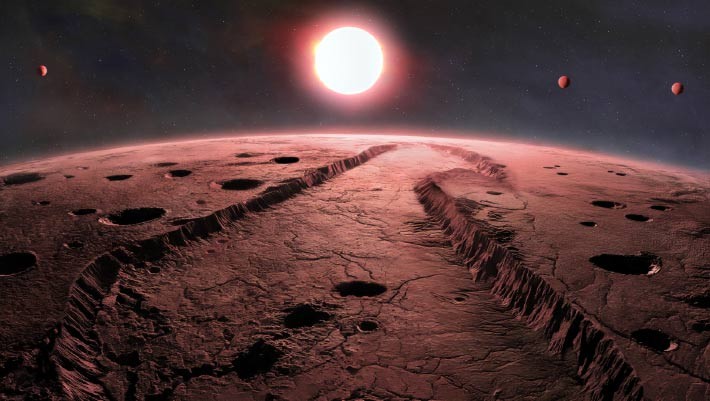
Forget the lush garden worlds we dream about. Barnard’s star—our closest single-star neighbor—is hosting four planets that sound like bad news. A new analysis says they are water-starved, atmospheric-less, and likely filled with deep-Earth minerals that hate moisture.
It is a 10-billion-old red dwarf sitting in Ophiuchus. Six light-years away. Just past Alpha Centauri. Discovered in 2025 these four sub-Earths are bigger than Mars but smaller than Venus. Not big. Not small. Just wrong for us.
The Magnesium Trap
Xander Byrne from Cambridge looked at the star’s chemistry. Found something odd. Too much magnesium.
“Barnard’s star has an enormeous amount of magnesium,” Byrne said.
On Earth that magnesium goes into olivines. Olivines love water. They store it. They hide it in the crust. But here the ratio is skewed. The abundance of magnesium forces the chemistry toward periclase. A rare mineral on our planet. You have to drill hundreds of kilometers down to find it.
Periclase doesn’t hold water. It lets it slide off. The planets are built for drought.
And the weather isn’t helping. These rocks are screaming hot. The outermost planet sits ten times closer to its star than Mercury does to the Sun. Close. Too close. Gravity is too weak to hold onto an atmosphere against the stellar wind. The air just blew away. Maybe it hung on for two billion years. Two billion years in a system that has existed for ten billion.
That’s not stability. That’s erosion.
Locked in Time
Proximity creates another problem. Tidal locking.
Like our Moon shows only one face to Earth these planets are frozen in a permanent glare. One side bakes in eternal day. The other rots in eternal night. No day cycle. No relief.
Usually systems this compact collapse. Gravity plays tug-of-war and someone loses. They collide or get flung out. But Barnard’s star has a trick up its sleeve. Orbital resonance.
The inner three planets orbit in a 9:12:16 ratio. If you’re musically inclined that’s two perfect fourths. It’s harmony in gravity. It stabilizes the chaos. Keeps the planets from eating each other. A fragile peace maintained by mathematical rhythm.
Looking Backward
We haven’t seen much of this because big planets are loud. They are easy to detect. Small rocky worlds are quiet. They hide in the noise.
“We know about very few sub-Earth planetS,” Byrne noted.
ESA’s Plato mission is coming. It might fix the bias. We might start seeing more of these barren rocks. More periclase worlds. More atmospheric ghosts.
The paper came out in June. MNRAS. June 24. The data is out.
It changes what we think is common. It changes what we hope for.
So if we are looking for a home among the stars we should probably skip this corner of Ophiuchus. Or maybe we should wonder. What else is out there that is just as empty