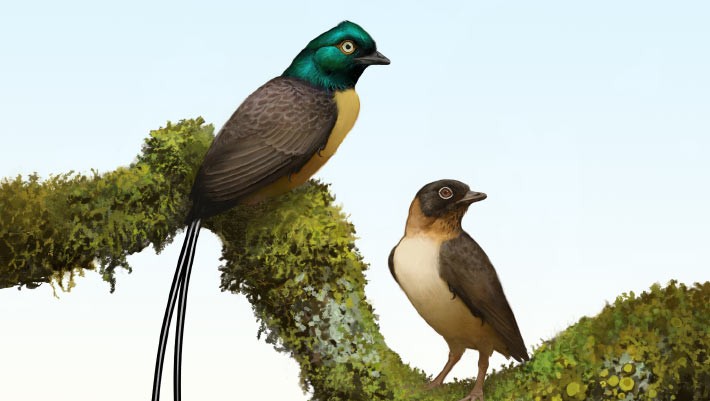
Imagine a bird no bigger than your thumb. Roughly six inches. American robin territory. But attached to that tiny frame are two tail feathers dragging at a foot behind it.
Plumadraco bankoorum is a mess of contradictions, mostly because it defies what we expect from prehistoric birds. This new species of enantiornithin lived about 121 million years ago in northeastern China. Back then, the Jehol Biota was pumping out incredible fossil preservation. We’re talking soft tissues, feathers, the works.
Enantiornithines were the champions of their day. The most diverse bird clade in the Mesozoic, over 100 genera strong, found everywhere but Antarctica. They vanished when the meteor hit, taking their reign with them.
Here’s the kicker though. Most of these guys? No tail feathers at all. Just boring body contour plumage covering the tail area. If you looked at an average enantiornithin, its tail looked plain. Modern birds don’t do that. We always have rectrices, real tail feathers. Not these guys. Until Plumadraco.
Its tail feathers were twenty-nine centimeters long. The body? fourteen centimeters. It was literally twice as long as it was big. The runner-up in the long-tail competition was Junornis. Its feathers stretched only one-and-a-half times its body length. Plumadraco made Junornis look modest.
So why? Why waste that much keratin on drag-inducing sticks of death?
Lead researcher Alex Clark thinks we’re looking at a male. Almost certainly. The theory tracks perfectly with sexual selection dynamics we see today. Ground-nesting birds need mothers to be stealthy. Cryptic coloring hides them from predators while they sit on eggs. The dads? They don’t need camouflage. They need attention.
It creates an evolutionary free pass for the guys. Let the feathers grow. Make them flashy. Signal fitness. Clark points out a physiological constraint too. Fossils from similar birds show specific muscle structures around the tail base.
Those muscles restricted movement. These birds couldn’t swish their tails around wildly. They could only pump them up and down. Sound familiar? That’s the exact motion male birds use during courtship displays today. Females don’t pump; males pump. The muscle biology tells a story that matches the feather physics.
Did they have color? The chemical analysis suggests a dark palette. Likely dark brown or black on the shafts. Researchers used a mass spectrometer that looked suspiciously like a toy ray gun to break down the chemical makeup of the specimen. But chemistry doesn’t catch everything. Structural colors like blue or iridescent shimmer come from how cells are stacked, not from pigment concentrations. The tips might have been blazing with structural hues we’ll never see in the lab data.
Does any of this matter beyond cool trivia? Sure.
This fossil proves birds have been spending resources on costly, elongate ornamentation to woo mates for over 120 million years.
Female choice wasn’t some new trick evolved recently. It’s an ancient driver. Females picking ornamented males shaped how these creatures looked and behaved long before us. It suggests a continuity in bird psychology and aesthetics that stretches back into deep time.
The paper came out in PLoS ONE. Hyperelongate ornamental tail feathers, the researchers call them. Dry terminology for what was probably a ridiculous spectacle.
We assume extinction ends stories. But looking at Plumadraco, it feels like they were mid-performance. Showing off. Getting ready for something we missed. Or maybe just dancing alone in the Jurassic sunlight until the sky went black.