Astronomers think they miscalculated everything.
The Milky Way isn’t what we thought it was. It’s bigger. Heavier. And distinctly lopsided. Scientists finally stopped guessing based on rotation rates and started listening to echoes. Specifically, the afterglow of distant cosmic explosions.
We used to estimate our home’s dimensions by how fast it spins.
“We usually model the Milky Way’s outer arms indirectly based on what we knows of how our galaxy rotates,” says Beatrice Vaia. “But doing it this way leaves room for big error.”
Especially when you’re stuck inside the house trying to measure the yard. For 175 years.
Here’s the setup: The Milky Way is a barred spiral. It’s got a supermassive black hole named Sagittarius A* at the center. Four main arms spiral out—Sagittarius, Scutum-Centaurus, Perseus, and Outer. We’ve estimated the total size at 100,00 light-years and the mass at 1.5 trillion times the Sun. Rough numbers. NASA called them facts. They weren’t quite.
The X-ray trick
Gamma-ray bursts are loud. Brighter and more powerful than anything else in the sky.
When their X-ray light hits dense gas clouds, it bounces. Creates luminous rings. Echoes.
If you measure the ring. You know the distance.
No need to guess how fast things spin.
Researchers published their method on June 19 in Astronomy and Astrophysics. They looked at data from Chandra and XMM-Newton. Two telescopes orbiting Earth. They tracked echoes from three specific gamma-ray bursts passing through the Perseus. The Outer arm. The Scutum-Centaurus arm.
The results were unsettling.
The Outer arm is farther away than we thought. The Scutum-Centaurus is too. Both are roughly 10% more distant.
Does ten percent matter?
Yes. Because in cosmic terms, that’s thousands of light-years.
A lopsided mess
If the arms are longer. The galaxy is wider.
“Any revision of these distances is fundamental for understanding our galaxy,” says co-author Ilaria Fornasieri.
It changes the math. It changes the mass estimate. A wider galaxy probably holds more matter. This messes with everything we think we know about our cosmic neighborhood.
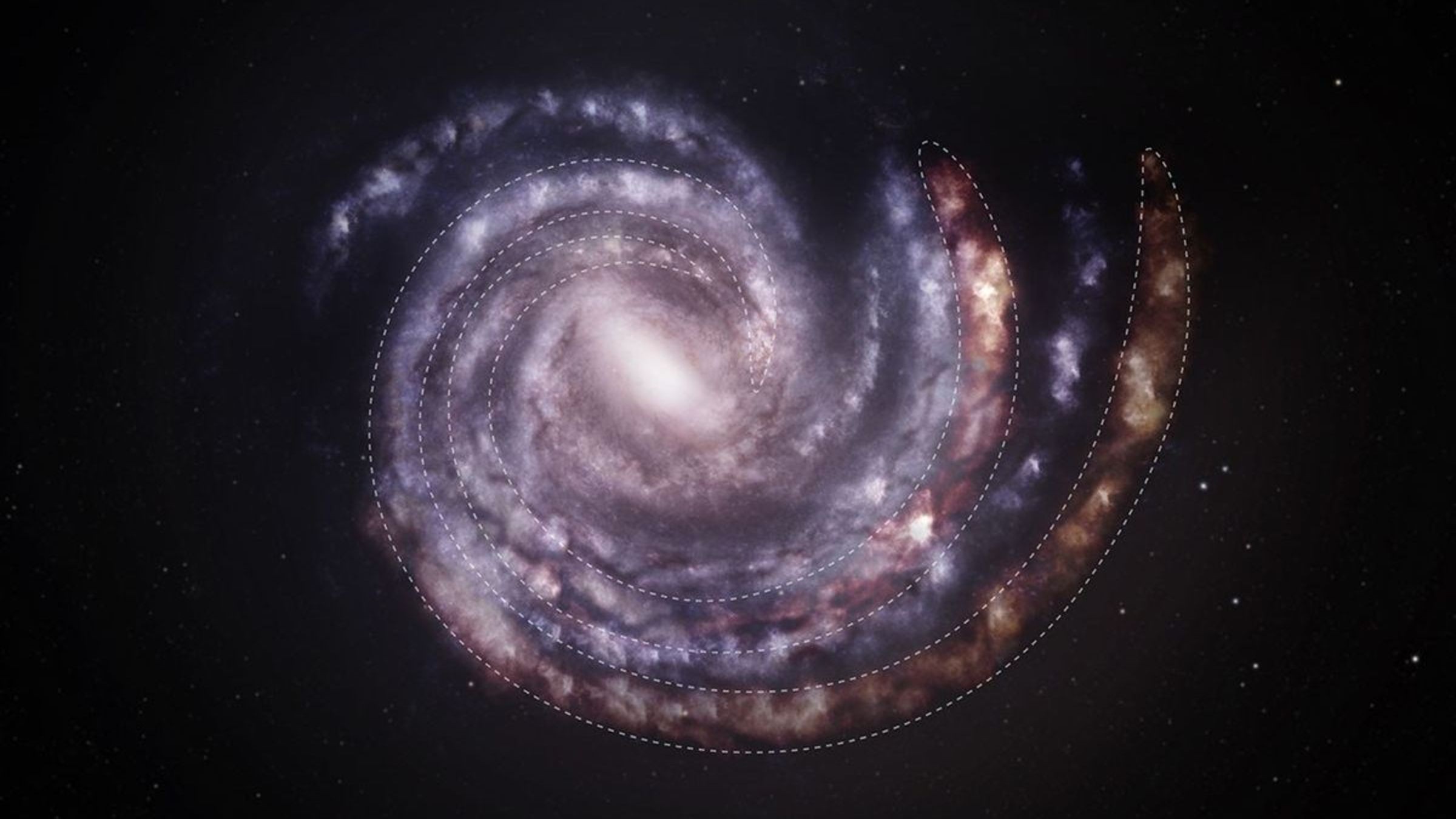
Animations accompanying the study show a weird shape. The Outer and Scutum-Cent arms stretch way out. Into intergalactic darkness.
It doesn’t look like a pinwheel. It looks like a snail shell. Lopsided. Asymmetric.
Why?
We don’t know yet.
The Perseus arm stayed put. The others shifted. This suggests a structural asymmetry we couldn’t explain before. Maybe the galaxy is just irregular. Maybe gravity pulls differently on different limbs. We only mapped two arms fully so far. Sagittarius? Still guessing.
Waiting for fireworks
Now we wait.
“We’re relying on the universe to give us these events,” says co-author Andrea Tiengo. “In 25 years. We found a handful.”
It’s hard. These explosions are rare. We need more to map the rest of the structure. To see if the weirdness continues or stops at two arms.
The search continues. The universe remains silent mostly. When it speaks, though? We finally heard it correctly.