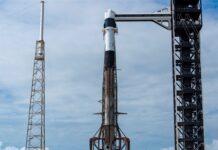
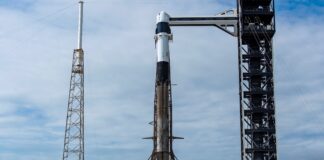
SpaceX has achieved a critical milestone in its quest to build a fully reusable space transportation system: the company has successfully fueled its new Starship Version 3 (V3) megarocket for the first time. This “launch rehearsal,” completed on May 11, involved loading over 5,000 metric tonnes of liquid oxygen and liquid methane propellant onto the stacked vehicle.
The successful test clears a major technical hurdle ahead of Flight 12, which is expected to launch as early as next week. This mission marks the debut of the V3 variant, a significant upgrade from previous models that represents SpaceX’s first rocket capable of deep-space exploration.
A New Record for Rocket Height
The preparation for Flight 12 began over the weekend at SpaceX’s Starbase facility in South Texas, where engineers assembled the V3 vehicle for the first time. By stacking the upper stage (Ship) atop the Super Heavy first-stage booster, SpaceX set a new record for the world’s tallest rocket.
- Total Height: Approximately 408 feet (124.4 meters).
- Comparison: This is 4 feet (1.2 meters) taller than the previous Starship V2 variant.
The sheer scale of the vehicle underscores the engineering complexity involved in managing such massive structures. The successful loading of propellant during a flight-like countdown demonstrates that the fuel systems, valves, and structural integrity of the V3 can handle the immense pressures required for launch.
Why Flight 12 Matters: From Test Flights to Deep Space
Starship’s journey has been rapid and iterative. Since its debut in April 2023—a flight that ended in a dramatic explosion just minutes after liftoff—SpaceX has conducted ten additional suborbital test missions. The most recent flight, in October 2025, was part of a streak of two completely successful missions.
However, all previous flights utilized the V1 or V2 variants. Flight 12 is distinct because it introduces V3, the first version of Starship designed with deep-space capabilities. This shift is not merely incremental; it is foundational to SpaceX’s long-term goals:
- Mars and Moon Settlement: Starship is intended to be the primary vehicle for transporting humans to the Moon and Mars.
- Starlink Deployment: The rocket will continue to play a crucial role in deploying SpaceX’s broadband satellite constellation.
- Commercial Versatility: Beyond NASA contracts, Starship aims to handle a wide variety of heavy-lift spaceflight tasks.
Implications for NASA’s Artemis Program
The success of Starship V3 has direct implications for NASA’s Artemis program, which aims to return humans to the lunar surface. NASA has selected Starship as one of two crewed landers for Artemis missions, alongside Blue Origin’s Blue Moon.
- Artemis 3: Planned for launch as early as next year, this mission will test rendezvous and docking operations in low Earth orbit using the Orion capsule and either Starship or Blue Moon.
- Artemis 4: Targeted for late 2028, this mission intends to land astronauts near the lunar south pole. The choice of lander for Artemis 4 will depend on which private vehicle is ready first.
With Flight 12, SpaceX is proving that its hardware can support these ambitious timelines. A successful V3 test flight would provide NASA with greater confidence in the vehicle’s reliability for crewed missions.
What Comes Next?
While the fueling rehearsal was a success, Starship still has significant technical challenges to overcome before it is ready for crewed deep-space missions. Key milestones remaining include:
- Orbital Flight: The vehicle has yet to reach orbit and return safely.
- Propellant Transfer: Demonstrating the ability to refuel in space is essential for Mars missions.
- Life Support: Current test vehicles lack life-support systems, which will be critical for human passengers.
SpaceX has not announced an official date for Flight 12, but industry observers suggest a launch could occur as soon as Monday, May 19. The company has already completed static fire tests for both the Ship and Super Heavy stages, indicating that the engines are ready for ignition.
Conclusion: The successful fueling of Starship V3 marks a pivotal transition from iterative testing to operational readiness. As SpaceX prepares for Flight 12, the world watches closely, knowing that this mission could unlock the next era of lunar exploration and interplanetary travel.