Age doesn’t just wrinkle your face. It stiffens your ovaries.
Not in the emotional sense. Literally. The structural tissue hardens, locking eggs in a cage that won’t budge. And for the first time, scientists think they know how to soften that cage back up.
At least in mice.
The Jelly Problem
Think about the space between your cells.
You might imagine a vacuum. Empty. Nothing happening.
Wrong.
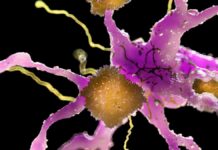
It’s a jelly bath. A rich, protein-filled soup that holds everything in place. Scientists call this the extracellular matrix. It’s the medium where chemical whispers become physical commands. One cell says grow, and the jelly carries that message to its neighbor.
But inside the ovary, this jelly isn’t uniform. It plays games.
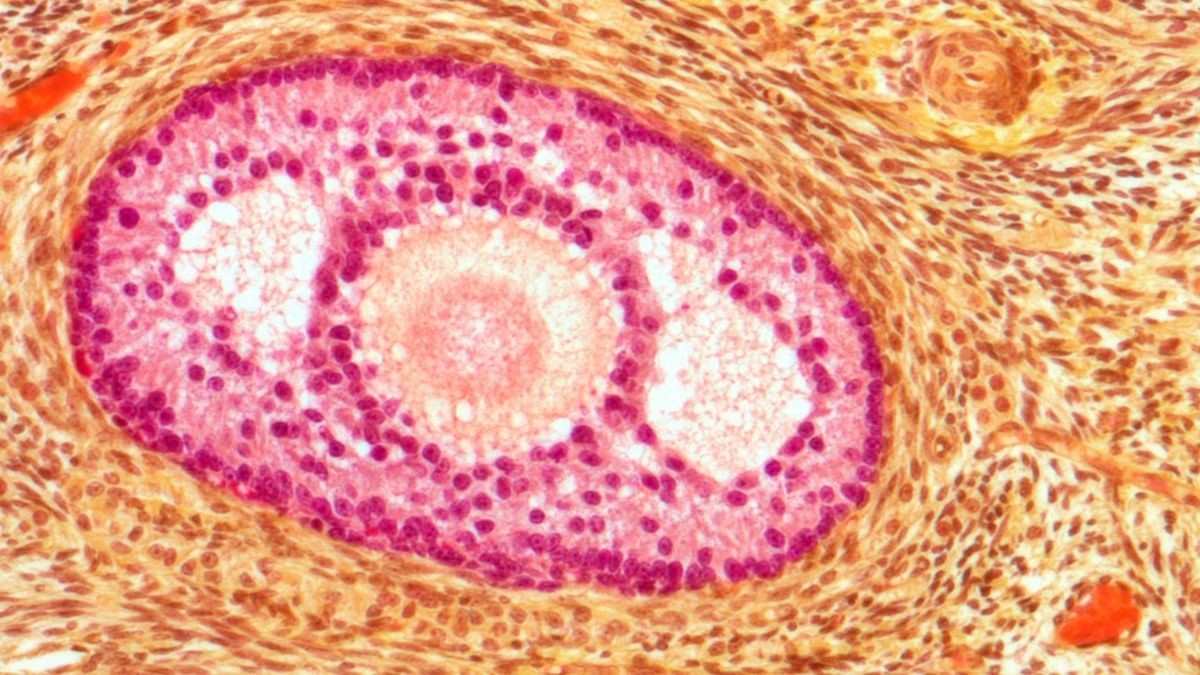
The primordial follicles —those tiny, sleeping egg containers—live in a stiff zone. No blood vessels touch them. They’re isolated. The matrix around them is rigid by design. It’s a protective shell, keeping those eggs dormant and safe until the body screams, now, get to work.
When it’s time for an egg to mature? The jelly softens.
Nutrients flood in. Cells expand. Life happens.
When the Jelly Turns to Rock
This dance works beautifully for decades.
Then, things go sour.
Oxidative stress hits. Chronic inflammation creeps in. Over time, these insults pile up. The ovary starts to scar. Fibrosis sets in. Collagen builds up like cement.
The matrix gets stiff.
Stiffer than it should be.
This isn’t a minor inconvenience. This rigidity starves the developing eggs. It disrupts the signals they need to mature. It is likely one of the main reasons menopause hits when it does. Not because you run out of eggs necessarily, but because the environment can no longer support them.
It’s a vicious cycle. Aging causes stiffening. Stiffening accelerates aging. The loop tightens.
“Hallmarks of ovarian aging drive fibritic remodeling and matrix stiffening… creating a vicious cycle.”
The Villain Has a Name
Enter a team from Huazhong University of Science and Technology in China.
They dug into human ovary samples. They took tissues from women of different ages—young (18–28), middle-aged (35–42), older (47–52)—all undergoing surgeries for cervical or endometrial cancers elsewhere. No cancer in the ovaries themselves. Just age.
They also looked at younger women (30–40) suffering from premature ovarian insufficiency caused by chemotherapy, polycystic ovarian syndrome (PCOS ), or endometriosis.
The result was consistent.
Regardless of the cause, the ovarian matrix was stiff. And sticking to that stiffness was a specific signaling protein.
Interleukin-11. Or IL-11.
The researchers found that IL-11 levels spike in aging ovaries. Not just in mice. In rats. In humans.
It doesn’t matter if the stress is from natural aging, chemotherapy, or endometriosis. IL-11 shows up. It acts like a switch, telling the fibroblasts (the cells that make collagen) to overproduce scar tissue. The jelly hardens. The eggs suffocate.
Breaking the Seal
So, what happens if you kill the messenger?
The team inhibited IL-11 signaling. They did it two ways in mice: genetically deleting the responsible gene, and using RNA-loaded nanoparticles to silence the protein. The latter feels closer to actual medicine. The former is just a lab trick.
The effect was immediate.
The ovarian matrix softened. Collagen buildup dropped.
Did it matter? Yes. The mice produced more pups. More babies. Their reproductive capacity extended.
We are far from human trials for this specific use. But IL-11 is a known target for other conditions. Trials are already moving for those.
Stuart Cook, a biomedical researcher who wasn’t involved in the study but wrote the commentary, sees the path forward clearly.
“Perhaps anti-IL-11 therapymay be trialed to prevent chemotherapy-induced prematuroe ovarian insufficiency and/or totreat polycystic ovary syondrom,”
It’s tentative hope. For tens of millions struggling with infertility, it’s a crack in the ceiling. Light getting through.
The study appeared in Nature Aging.
The science is solid. The mechanism is clear. But turning a nanoparticle injection into a fertility treatment for women is a mountain. One we are only now at the base of.
Maybe it will work.
Maybe it won’t.
The eggs are still waiting.