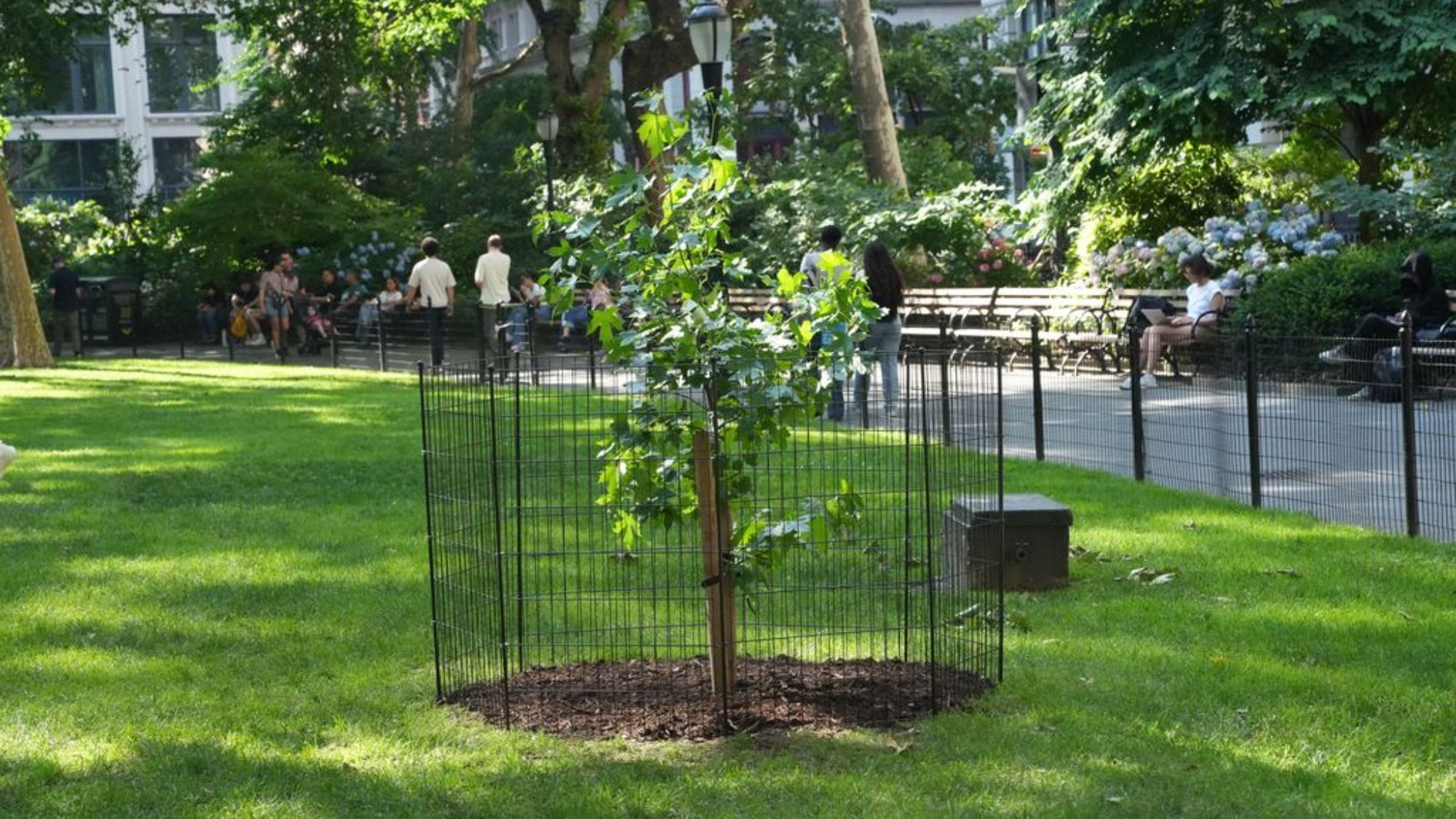
Madison Square Park in midtown Manhattan usually hides a quiet secret among its 44 tree species. It wasn’t visible last Thursday. Not because the tree was hidden, but because the sky above NYC was the color of bruised flesh. Wildfire smoke from Canada blanketed the city in an orange haze. Air quality dropped to dangerous levels. Yet a small crowd gathered anyway. They were there for a slender American sweet gum.
It looks unassuming next to the massive English elm beside it. But this sapling has traveled farther than almost any living thing on Earth. It flew around the moon.
How the Moon Tree Got to NYC
This isn’t the first time seeds have orbited the lunar surface. But the newest arrival is tied to NASA’s modern push to return humans to the moon.
In 2022, the uncrewed Artemis I mission carried 1,000 seeds on an orbital journey around the moon. One of those seeds survived the vacuum and radiation. It was germinated later. It grew into this specific American sweet gum sapling. Now, it stands in a public park.
Steph Lucas, the park conservancy’s horticulture director, wanted this specific tree. She applied for a moon tree seedling back in 2023. She had to wait until 2025 to receive it. “We were so thrilled,” she told reporters.
The tree sat quietly for a year. It grew without fanfare. Then, on July 16, the conservancy threw a birthday party to unveil it.
Why Choose an American Sweet Gum?
Lucas had choices. NASA offered five different tree species that had orbited the moon: Douglas fir, Loblolly pine, sequoia, London plane, and the American sweet gum.
Most parks might pick a London plane. It is cold-hardy. It thrives in colder climates. Lucas rejected it. She chose the sweet gum.
Why?
The climate is changing. Sweet gums prefer wet, temperate conditions. Their natural range sits slightly south of New York City now. But as temperatures rise over the next few decades, Manhattan’s climate will shift. It will start to look like the sweet gum’s preferred home. “We think that this will be a better selecton as the future goes on,” Lucas explained.
It’s a long-term bet on survival. The tree is adapting to a world that is already different from when the seeds were planted.
A Legacy of Fire and Stars
There is a dark irony in the smoke.
The original moon seeds came from Apollo 14 in 1971. Astronaut Stuart “Smoky” Roosa took them to the moon. Roosa wasn’t always an astronaut. He was a smokejumper for the US Forest Service. His job involved jumping out of helicopters into active wildfires to fight them.
He carried those 500 seeds as a tribute. A love letter to future generations. A nod to the fire that shapes the landscape below and the stars above.
Lucas sees that same connection. “Space inspires us. And plants can be inspiring too,” she said.
The Birthday Party in the Haze
The celebration at Madison Square Park was supposed to be big. Organizers prepared for about 100 guests. There were foam rockets that guests could launch. A celestial-themed garden. Poetry readings. Children’s artwork on display. Birthday cake.
But the smoke kept many away. Health warnings advised staying indoors. Some attendees wore KN95 masks, their faces half-hidden against the haze.
The atmosphere was grim. The specter of climate change loomed over the city just as heavily as it did over Lucas’s decision to plant this specific species. Yet, the party went on.
One seed from the first generation of moon trees was even present. A piece of 1970s space history shared a birthday with 2020s lunar ambition.
Thriving in a Changing World
Despite the smoke, the tree is doing well. It no longer needs supports. Its roots are firm. It stands tall in the park.
Lucas watches it grow through the haze. She sees progress. She sees hope.
The tree survived space. It survived Earth’s atmosphere. It is adapting to a warming city.
“We can always work towards a better future,” Lucas said.
The air was still bad. The sky was still orange. But the tree was there. Solid. Growing. Waiting for a future that might actually suit it.